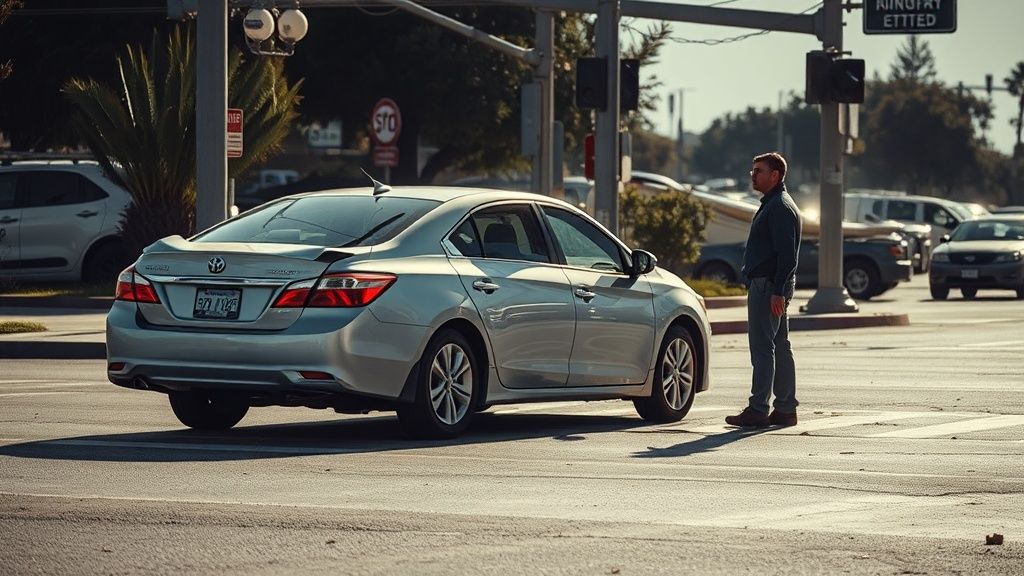
If you've been in a car accident in California, the first question most people ask is not about lawyers. It's about the pain, the damage, and the stack of paperwork that starts arriving within days. The question of whether to hire an attorney comes later, often after an insurer has already made a move you weren't ready for.
Here are nine concrete signs that your situation calls for legal representation. Each one has real legal weight behind it.
Quick summary:
- Serious, lasting, or permanent injuries are involved
- Fault is disputed or being assigned to you
- More than one driver or party was responsible
- The insurer denied your claim or is stalling
- You received a fast settlement offer before your treatment ended
- The other driver had no insurance or not enough of it
- Medical bills and lost income are growing
- An adjuster is pushing you to sign or record a statement
- You feel outmatched and unsure what you are entitled to
1. You Suffered Serious, Lasting, or Permanent Injuries
If you suffered serious injuries in a California car accident, the value of your claim almost certainly exceeds what a basic insurance negotiation can recover on its own.
Broken bones, traumatic brain injuries, spinal cord damage, internal injuries, and burns are not cases for a quick insurance settlement. Neither are soft-tissue injuries like whiplash that linger past the initial treatment phase. The more serious and lasting your injury, the larger the gap between what an insurer first offers and what your actual lifetime medical and economic losses amount to.
California tort law allows you to recover both special damages (medical bills, lost wages, future care costs) and general damages (pain and suffering, loss of enjoyment of life). Accurately valuing either category, especially for long-term or permanent harm, requires documented evidence, often including medical expert testimony. That is not something an unrepresented claimant can build effectively against a carrier with a professional claims team on the other side.
Takeaway: If your injuries required hospitalization, surgery, or ongoing treatment, or if they have affected your ability to work, talk to an attorney before you talk further with any insurance adjuster.
2. Fault Is Disputed or Being Blamed on You
Under California's pure comparative fault rule (Li v. Yellow Cab Co.), insurers can reduce your payout by whatever percentage of fault they assign to you, which is why disputed liability cases almost always need an attorney.
California follows a pure comparative fault system. Under this rule, your recovery is reduced by your share of fault for the accident. If an insurer decides you were 30% at fault, they pay 30% less. Adjusters know this and routinely inflate the claimant's percentage of fault as a cost-reduction strategy.
Disputing a fault assignment requires evidence: the police report, witness statements, traffic camera footage, accident reconstruction analysis, and sometimes data from the vehicles themselves. Gathering, preserving, and presenting that evidence is the work of a trained personal injury attorney. Without legal representation, you are negotiating against a professional whose job is to keep your share of fault as high as possible.
Takeaway: Any time an insurer even hints that you were partly responsible for the crash, get an attorney before responding further.
3. More Than One Driver or Party Was Involved
Multi-vehicle crashes, chain-reaction pile-ups, rideshare accidents, and collisions involving commercial vehicles or government entities all create layered liability. More parties mean more insurers, more competing claims, and more opportunities for each carrier to point responsibility at someone else.
In some cases, liability extends beyond the drivers. A crash caused by a defective tire, a poorly designed intersection, or a negligent property owner may involve product liability or premises liability claims alongside the standard auto negligence claim. Identifying every liable party and preserving the right to pursue each one requires legal analysis that goes beyond what a standard insurance claim process handles.
California's two-year statute of limitations for personal injury claims runs from the date of the crash under Cal. Code Civ. Proc. §335.1. Claims against government entities have a much shorter window: a government tort claim under Cal. Gov. Code §911.2 must be filed within six months of the incident. Missing that window eliminates the claim entirely.
Takeaway: If anyone other than two private drivers in personal vehicles was involved, consult an attorney immediately to preserve every avenue of recovery.
4. The Insurer Denied Your Claim or Delayed It
California insurers are bound by the Fair Claims Settlement Practices Regulations. Under Cal. Ins. Code §790.03, an insurer commits an unfair claims practice when it denies a claim without a reasonable basis, misrepresents coverage, or delays acknowledgment, investigation, or payment without proper justification. Under California regulations, an insurer must acknowledge a claim within 15 days and accept or deny it within 40 days of receiving proof of claim.
A denial letter is not the end of the road. It is frequently a negotiating tactic. Denials can be challenged and often reversed when an attorney formally disputes them and presents evidence the carrier did not consider or chose to ignore. If the denial is in bad faith, California law allows you to pursue a bad faith claim against the insurer on top of your underlying personal injury recovery.
Takeaway: If your claim was denied or has sat unanswered for weeks, an attorney can compel a response and challenge an improper denial.
5. You Received a Fast, Lowball Offer
A signed settlement release permanently closes all future claims from the crash, even if your injuries turn out to be more serious than they first appeared.
A fast settlement offer shortly after the accident is not generosity. It is a business decision. Insurers close claims quickly because early offers are almost always lower than the full value of the case, and many injured people accept them before the extent of their injuries is clear.
Once you sign a release, you are done. There is no reopening the claim if your back condition worsens, if surgery becomes necessary six months later, or if a diagnosis you did not yet have changes the picture entirely. California courts enforce these releases strictly. The only protection is to not sign anything until you have reached maximum medical improvement, or at minimum, until an attorney has reviewed the offer against your documented damages.
We have represented clients in California personal injury cases who were offered a fraction of what their cases were worth in the first weeks after the crash. The difference between that first offer and the final recovery is often substantial.
Takeaway: Do not accept any settlement offer, no matter how reasonable it sounds, until an attorney has reviewed your complete medical picture.
6. The Other Driver Is Uninsured or Underinsured
California requires uninsured motorist coverage under Insurance Code §11580.2, but collecting that coverage often requires negotiation or formal arbitration.
California law requires insurers to offer uninsured motorist (UM) and underinsured motorist (UIM) coverage under Cal. Ins. Code §11580.2. If you were injured by a driver who had no insurance, or whose policy limits are too low to cover your damages, your own UM/UIM coverage is supposed to step in.
In practice, UM/UIM claims are among the most contested claims in California. Your own insurer, despite being your carrier, has a direct financial interest in minimizing what it pays you. These claims frequently require formal arbitration under the terms of your policy rather than a simple negotiation, and the rules of that arbitration affect your outcome significantly.
An attorney who regularly handles UM/UIM claims knows how to properly document damages, how to demand arbitration when negotiation stalls, and how to identify whether other responsible parties, such as a negligent employer if the at-fault driver was working at the time, may provide additional recovery.
Takeaway: If the other driver had no insurance or too little of it, an attorney is often the difference between recovering your full UM/UIM benefit and accepting whatever your insurer first offers.
7. Your Medical Bills and Lost Wages Are Piling Up
When financial losses grow large, the legal stakes grow proportionally. California tort law allows recovery of all reasonably necessary medical expenses, past and future, as well as lost earnings and reduced future earning capacity. If your crash has kept you out of work for weeks or months, or if you face ongoing treatment costs, the math on your claim is no longer simple.
Documenting future medical needs requires expert medical opinion. Calculating lost earning capacity, especially for workers in skilled trades, construction, transportation, or any field where physical capacity determines income, requires economic analysis that connects your injury to your specific work situation. These elements must be built into the claim proactively, not added as an afterthought during negotiation.
Insurance adjusters are trained to minimize future damages by casting doubt on whether future treatment is necessary or causally connected to the crash. An attorney builds the evidentiary record that makes it harder for the carrier to dismiss those losses.
If your injury also arose in the context of your employment, there may be both a personal injury claim and a workers' compensation claim in play simultaneously. Coordinating those properly protects the full value of both. You can learn more about how those claims interact on our workers' compensation practice area page.
Takeaway: The larger your economic losses, the more important it is to have an attorney who can document every compensable damage category before you negotiate.
8. The Adjuster Is Pressuring You to Sign or Record a Statement
You have no legal obligation to give a recorded statement to the other driver's insurance company, and doing so without an attorney can seriously reduce the value of your claim.
You are not legally required to give a recorded statement to the at-fault driver's insurer. Adjusters ask for them routinely because they are useful tools for locking in facts that can later be used to reduce or deny claims. A recorded statement taken days after the crash, before the full extent of your injuries is known, before you have reviewed the police report, and before you have had time to consult anyone, is almost never in your interest.
Pressure to sign a medical authorization is equally concerning. A broad medical release allows the insurer to access your entire medical history, not just the records relevant to this crash, giving them ammunition to attribute your injuries to preexisting conditions rather than the accident.
If you are being pushed to act quickly, sign something, or give a statement before you have spoken to an attorney, that pressure itself is a sign that an attorney needs to be involved. Once an attorney represents you, all adjuster contact routes through the attorney, and that pressure stops.
Takeaway: Tell the adjuster you are consulting an attorney and stop the conversation there. You lose nothing by waiting; you may lose a great deal by not waiting.
9. You Simply Feel Outmatched and Unsure of Your Rights
Car accident attorneys in California work on contingency, meaning you pay nothing upfront and nothing at all unless your case results in a recovery.
The insurance claims process is designed by and for insurance companies. Adjusters handle dozens of claims every week. They know the process, the arguments, the negotiating strategies, and the thresholds at which carriers settle. The average injured person, dealing with pain, medical appointments, missed work, and a disrupted life, does not have the same information, the same experience, or the same leverage.
That asymmetry is not incidental. It is structural, and it is reflected in outcomes. Represented claimants, as a consistent pattern across the personal injury system, recover more than unrepresented claimants in comparable cases. The contingency fee structure exists precisely to close that gap: you pay nothing upfront, and the attorney's fee comes only from a recovery, so there is no financial barrier to getting professional representation.
Feeling outmatched is not a sign of weakness. It is an accurate read of the situation. Every injured worker and car accident victim deserves the same quality of legal representation as any corporation or insurance carrier. That is the principle this firm was built on.
Takeaway: If something feels wrong about how your claim is being handled, call an attorney. The consultation is free, and you owe nothing unless we recover for you.
What to Do Next
If any of the nine signs above describe your situation, the most important move you can make today is to talk to a California car accident attorney before taking another step with the insurance company.
At Nordanyan Law, we've recovered over $150,000,000 for injured people across Southern California. We take personal injury cases on contingency, meaning $0 upfront and no fee unless we win. We come to you if you cannot travel.
Schedule a free case review or call (818) 794-9947 now. Available in English and Spanish.
Frequently Asked Questions
When should I hire a car accident lawyer?
Hire an attorney as soon as possible after the crash, before giving any recorded statements, before signing any releases, and before the other driver's insurer makes you a formal offer. The earlier an attorney gets involved, the more evidence can be preserved and the more options you retain. Many attorneys, including Nordanyan Law, offer free consultations so there is no cost to calling early.
Do I need a lawyer for a minor car accident?
Not always. If you were not injured, your property damage was minor, and the at-fault driver's insurer accepted liability without dispute, you may be able to handle the property claim yourself. But if you had any injury symptoms, even ones that seemed minor at first, an attorney should evaluate your case. Symptoms like neck stiffness, headaches, or back pain can indicate injuries that worsen over days or weeks, and a signed release you obtained before that happened eliminates your ability to recover later.
How do I know if my case needs an attorney?
The nine signs in this article are reliable indicators. The clearest signals are: serious or lingering injuries, any dispute over fault, a denial or delay from the insurer, pressure to sign or record a statement, or damages large enough that a lowball offer leaves major losses uncovered. When in doubt, call an attorney for a free case evaluation. The evaluation costs nothing and leaves you better informed either way.
Is it worth getting a lawyer for a car accident?
For any claim involving injury, fault disputes, insurance complications, or damages beyond minor property damage, yes. Attorneys who handle car accident cases work on contingency, so the financial barrier to representation is removed. The practical question is not whether you can afford a lawyer. It is whether you can afford the difference between an unsupervised settlement and a fully recovered claim. That difference, in cases involving real injuries and real financial losses, is regularly substantial.
What if the other driver was uninsured?
Your own auto insurance policy is required under Cal. Ins. Code §11580.2 to include uninsured motorist coverage unless you waived it in writing. An attorney can help you make a UM claim against your own carrier and, where applicable, identify other potentially liable parties such as a negligent employer if the at-fault driver was on the job.
How long do I have to file a car accident lawsuit in California?
The standard statute of limitations for a personal injury lawsuit in California is two years from the date of the crash under Cal. Code Civ. Proc. §335.1. Claims against a government entity have a much shorter deadline: a government tort claim must be filed within six months of the incident under Cal. Gov. Code §911.2. Missing either deadline can permanently bar your claim, which is why waiting to consult an attorney is one of the most common and costly mistakes injured people make.