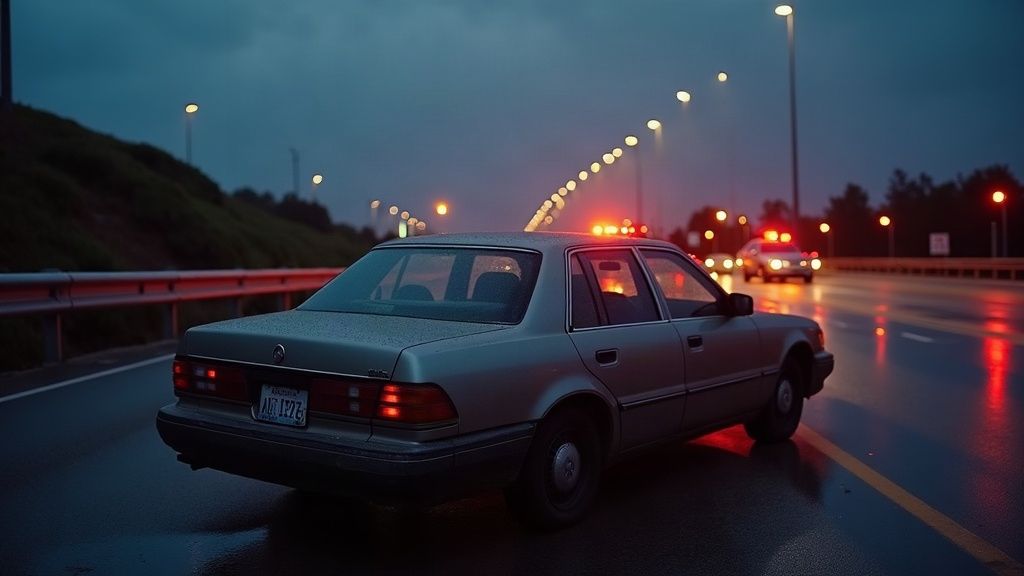
If you were the only car involved in your accident, you may have already been told there is nothing to pursue legally. That assumption is wrong more often than most people expect. In California, a single-vehicle crash can involve defective parts, a dangerous road, a negligent mechanic, or a driver who cut you off and disappeared. Any one of those can give you a valid legal claim.
This article explains who can be held liable, which California laws apply, and what evidence you need to build a case. No invented settlement figures, no guaranteed outcomes. Straight answers, statute citations included.
If you were hurt in a single-vehicle accident and want to know whether you have a claim, call (818) 794-9947 for a free consultation. No fee unless we win.
TL;DR: Key Points for Skimmers
- "Single-vehicle" does not mean "no one else is responsible."
- Liable parties can include vehicle manufacturers, parts suppliers, mechanics, road-maintenance agencies, and other drivers who caused you to swerve.
- California's pure comparative fault rule means you can recover even if you shared some fault.
- A government tort claim under Cal. Gov. Code §911.2 must be filed within six months when a public agency is responsible for a road defect.
- The general personal injury statute of limitations is two years under Cal. Code Civ. Proc. §335.1.
- Your own collision, MedPay, and uninsured motorist coverage may also respond to a solo crash.
- Evidence matters enormously: physical damage patterns, vehicle data, road maintenance records, and witness statements all build or break the case.
Why "Single-Vehicle" Doesn't Always Mean "No One Else Is Responsible"
A single-vehicle accident in California does not automatically mean the driver is the only one at fault, manufacturers, road-maintenance agencies, mechanics, and other drivers can all bear legal responsibility.
California law measures fault based on the cause of the crash, not the number of cars involved. Under Cal. Civ. Code §1714, everyone has a duty to exercise ordinary care to avoid harming others. That duty applies to:
- A tire manufacturer that sold a defective product.
- A city public works department that left a pothole unrepaired for months.
- A shop that incorrectly installed your brake pads.
- A driver who swerved into your lane, forcing you off the road, and kept going.
When any of those parties breached their duty of care and that breach caused your crash, they can be held legally responsible. The fact that you were the only vehicle at the scene when first responders arrived does not erase their role in causing the accident.
Possible At-Fault Parties: Manufacturers, Mechanics, Road Crews, and Other Drivers
Vehicle Manufacturers and Parts Suppliers
If a defective tire, brake failure, or steering component caused your single-vehicle crash, the manufacturer or distributor may be liable under California product liability law.
California recognizes strict liability for defective products. You do not have to prove the manufacturer was careless. You must show:
- The product had a defect (manufacturing flaw, design flaw, or failure to warn).
- The defect existed when the product left the manufacturer's control.
- The defect caused your crash and injuries.
Common vehicle-defect claims in single-car accidents include:
- Tire blowouts caused by tread separation or sidewall defects.
- Brake failure from defective master cylinders, calipers, or brake lines.
- Steering loss from defective power-steering components or tie-rod failures.
- Sudden unintended acceleration from electronic throttle control malfunctions.
- Roof crush and rollover defects that worsen injuries in a crash that might have been minor.
If a federal recall covered your vehicle or part, that record is powerful evidence. The National Highway Traffic Safety Administration (NHTSA) maintains a searchable recall database, and a recall notice for the exact defect that caused your crash can anchor a products liability case.
Negligent Mechanics and Repair Shops
A mechanic or shop that performed faulty work on your vehicle can be liable for the resulting crash. Common scenarios include incorrect brake service, improperly torqued lug nuts that cause a wheel to come off at speed, and steering or suspension repairs done incorrectly. A claim against a repair shop typically sounds in both negligence (they failed to meet the standard of care) and breach of contract (they agreed to fix the car properly and did not).
Retain every repair invoice, inspection record, and written estimate. If the shop's negligent work caused your crash, those records establish the critical link.
Government Agencies and Road-Maintenance Entities
California roads are maintained by a mix of the California Department of Transportation (Caltrans), county public works departments, and city agencies. When a road defect causes a crash, the agency responsible for that road segment may be liable.
Common road-defect claims include:
- Unmarked or unrepaired potholes.
- Missing or defective guardrails.
- Inadequate signage at curves or steep grades.
- Pooling water from poor drainage design.
- Debris left on the roadway by a government contractor.
Critical procedural requirement: Before you can file a lawsuit against a California government entity, you must present a written government tort claim. [SPEAKABLE] Government agencies in California can be sued for dangerous road conditions, but you must present a government tort claim within six months of the accident date under Cal. Gov. Code §911.2 before filing a lawsuit.
The six-month clock under Cal. Gov. Code §911.2 typically runs from the date of the accident. Missing that deadline generally bars the lawsuit entirely. Once the agency mails you a written rejection, you then have six months to file suit in court. If the agency never mails a written rejection, you instead have two years from when your claim arose to sue (Cal. Gov. Code §945.6).
This timeline is far shorter than the two-year personal injury statute of limitations that applies to private defendants. If a road defect contributed to your crash, call an attorney immediately.
When a Swerve to Avoid Another Car Still Counts as Their Fault
When a driver swerves to avoid a vehicle that cut them off and crashes, the other driver can still be held liable for negligence under California Civil Code §1714 even if there was no physical contact.
This is called a no-contact accident. The other driver's negligent maneuver (cutting lanes without signaling, running a red light, making an illegal left turn) caused you to take evasive action. Your evasive action resulted in the crash. The causal chain still connects their negligence to your injuries.
The challenge is proof. Because the other driver did not stop, you need independent evidence to identify them. Useful sources include:
- Traffic camera footage from nearby intersections.
- Dashcam video from your own vehicle or a bystander's.
- Witnesses who saw the other vehicle and can describe it or provide a partial plate.
- Gas station, business, or parking structure cameras along the route.
If the other driver cannot be identified at all, your own uninsured motorist (UM) coverage may still compensate you for a no-contact accident, though California UM claims for no-contact accidents typically require independent witness corroboration that the other vehicle actually existed. Review your policy language carefully, and talk to an attorney before giving a recorded statement to your own insurer.
Weather, Road Debris, and Poor Roadway Design as Contributing Causes
Not every single-vehicle accident involves a human actor whose negligence can be traced directly. Some crashes happen in conditions that the law still allows you to challenge.
Weather and Visibility Conditions
Rain, fog, and ice do not automatically mean the crash was an act of God. If Caltrans or a local agency failed to install adequate drainage, causing a known flooding zone, or if a public entity failed to post advisory speed limit signs on a documented hazardous curve, weather is not the sole cause. The agency's failure to address a known hazard can constitute a dangerous condition of public property under Cal. Gov. Code §830.
Road Debris Left by Third Parties
If a construction contractor, landscaping company, or other private party left debris on the road that caused your crash, that private entity can be liable. If the debris came from a government project, the analysis returns to the government-claim process described above.
Roadway Design Defects
Some roads are dangerous by design, not just by poor maintenance. Inadequate sight lines, shoulders that drop sharply, and poorly banked curves can all cause crashes regardless of driver behavior. These claims typically require expert testimony from a traffic or civil engineer who can explain why the design fell below accepted engineering standards.
How Your Own Insurance Responds to a Solo Crash
Even when no third party is clearly at fault, your own auto insurance policies may pay some or all of your losses.
Collision Coverage
Collision coverage pays to repair or replace your vehicle after a crash, regardless of who caused it. Your insurer will pay the actual cash value of your vehicle (or the repair cost) minus your deductible. This coverage does not pay for medical bills or lost wages.
Medical Payments Coverage (MedPay)
MedPay is an optional first-party coverage that pays medical expenses for you and your passengers after an accident, regardless of fault. It is not required in California, but many policies include it. MedPay typically covers emergency room bills, surgeries, and follow-up care up to the policy limit.
Uninsured Motorist Coverage (UM/UIM)
Under Cal. Ins. Code §11580.2, California insurers must offer uninsured motorist coverage. If a phantom driver caused your single-vehicle crash, UM coverage can step in for your bodily injury losses. As noted above, no-contact UM claims in California generally require independent corroboration that another vehicle was actually involved.
A Word of Caution on Recorded Statements
Your insurer will likely call quickly after the accident and ask for a recorded statement. You are not required to give one immediately. The questions asked and your answers can affect coverage determinations. Consulting an attorney before that call is free with us, and it can prevent a misstep that limits your own coverage.
Evidence That Turns a "No One's Fault" Crash Into a Valid Claim
The difference between a dismissed case and a recoverable claim often comes down to evidence collected in the first days after a crash. Here is what matters most.
Vehicle inspection: Do not repair your vehicle until an attorney and, if appropriate, an expert can inspect it. Physical damage patterns and mechanical condition are primary evidence in both product liability and negligent-repair cases.
Event data recorder (EDR) download: Most vehicles manufactured after 2014 contain an event data recorder (sometimes called a "black box") that logs speed, throttle position, brake application, and steering inputs in the seconds before impact. This data can confirm a sudden mechanical failure or dispute a narrative that you were speeding. EDR data can be overwritten, so preservation must happen quickly.
Roadway photographs and measurements: Document the road surface, debris, skid marks, and guardrail condition immediately after the accident. If a pothole or road defect was involved, photograph it before it is repaired. Maintenance request logs from the responsible agency may show the defect was reported and ignored.
Maintenance and repair records: Every service record for your vehicle is relevant to a mechanical-defect or negligent-repair theory. Gather them from dealerships, shops, and any DIY logs you kept.
Witness statements: Names and contact information from every bystander, especially those who saw a second vehicle or unusual road conditions. Witnesses disappear; get their information at the scene.
Medical records: Immediate medical evaluation creates an evidentiary record linking the crash to your injuries. A gap between the accident and the first doctor visit gives insurers an opening to argue your injuries had another cause.
California's Comparative Fault Rule and What It Means for You
California's comparative fault rule, means you can still recover compensation even if you were partly at fault for a single-vehicle accident, though your award is reduced by your percentage of fault.
California follows a pure comparative fault system. If a jury finds you were 30 percent at fault and a tire manufacturer was 70 percent at fault, you recover 70 percent of your total damages. You are not barred from recovering at all.
This is important because insurance adjusters often use a claimant's partial fault as a reason to deny the entire claim rather than reduce it. That is not how California law works. An attorney familiar with comparative fault litigation can push back on that framing and work to correctly allocate fault among all contributing parties.
FAQ
Can you get compensation from a single car accident?
Yes. Compensation is available if another party's negligence or a product defect contributed to the crash. Possible sources include a third-party liability claim against a manufacturer, road-maintenance agency, mechanic, or other driver, as well as your own collision, MedPay, and uninsured motorist coverage.
Who is liable if you crash alone in California?
Liability depends on the cause. A vehicle manufacturer can be liable for a defective part. A government agency can be liable for a dangerous road condition. A mechanic can be liable for faulty repairs. Another driver can be liable if their negligent maneuver caused you to swerve and crash, even without physical contact.
Can a mechanical defect cause a single-vehicle accident lawsuit?
Yes. Under California's strict product liability doctrine, you can sue a manufacturer or parts supplier without proving they were negligent. You need to show the product had a defect, it existed when the product left the manufacturer's control, and it caused your crash. Vehicle black box data, expert inspection, and recall records are key evidence in these cases.
Does insurance cover single-vehicle accidents in California?
Your collision coverage pays for vehicle damage regardless of fault. MedPay covers medical bills regardless of fault. Uninsured motorist coverage can pay for bodily injuries if a phantom or unidentified driver caused the crash. The specific coverage available depends on your policy terms and deductibles.
What is the deadline to file a claim after a single-vehicle accident in California?
For a claim against a private party, the statute of limitations is generally two years from the date of injury under Cal. Code Civ. Proc. §335.1. For a claim against a government entity (such as a city or county whose road maintenance caused the crash), you must present a written tort claim within six months of the accident under Cal. Gov. Code §911.2 before you can file a court lawsuit.
What if the other driver who caused me to swerve drove away?
A hit-and-run or phantom driver can still be the basis for an uninsured motorist claim under Cal. Ins. Code §11580.2. California UM claims for no-contact accidents typically require independent witness corroboration that another vehicle was involved. If the other driver can be identified through camera footage or witnesses, a direct negligence claim is possible as well.
Does California's comparative fault rule help me if I was partly at fault?
Yes. California follows a pure comparative fault system under Cal. Civ. Code §1431.2. Even if you were partly responsible for the crash, you can still recover damages. Your award is reduced by your percentage of fault, but you are not barred from recovery. An attorney can help ensure your fault percentage is not overstated by an insurer or opposing party.
Do I need an attorney for a single-vehicle accident claim?
An attorney is not legally required, but single-vehicle cases are often more complex than they first appear. Product liability claims require expert inspections and fast evidence preservation. Government claims require the six-month filing window under Cal. Gov. Code §911.2. Comparative fault negotiations require knowledge of how California allocates liability among multiple parties. The consultation is free, and there is no fee unless we win.
What to Do Today
If you were hurt in a single-vehicle accident in California, the path forward depends on how quickly evidence is preserved and deadlines are tracked. The six-month government-claim window under Cal. Gov. Code §911.2 is particularly unforgiving.
We have recovered over $150,000,000 for injured clients across Southern California. Our attorneys evaluate single-vehicle crashes for product defects, road hazards, and third-party liability every day. We come to you if you cannot travel.
Call (818) 794-9947 for a free consultation. No fee unless we win. Available in English and Spanish.
Reviewed by Minas Nordanyan, CA Bar #296806. Last updated August 2026. This article is for general informational purposes and does not constitute legal advice. Your rights depend on the specific facts of your case.