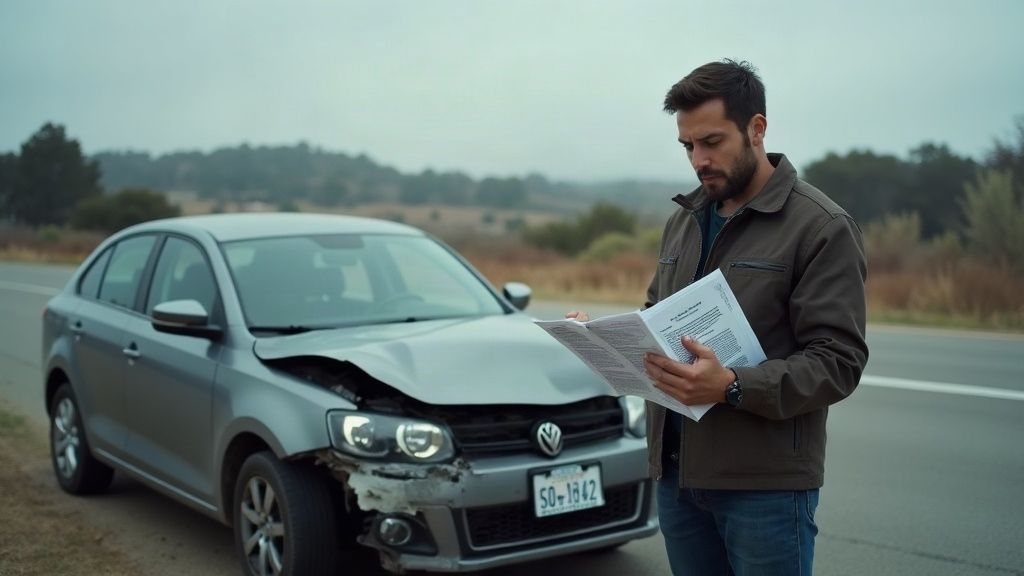
If you were hit by an uninsured or underinsured driver in California, you may have more than one insurance policy available to you. The question is whether California law allows you to combine, or "stack," the coverage limits from those policies to increase your total recovery. The short answer: sometimes yes, sometimes no, and the difference almost always comes down to specific policy language and a statute that insurers rely on heavily. This article explains exactly how stacking works under California law, when it helps injured drivers, and what to watch for when insurers push back.
If you've been seriously hurt and need to identify every dollar of coverage available, call (818) 794-9947 for a free case review. No fee unless we win.
Quick Answers (TL;DR)
- Stacking means combining UM or UIM limits from more than one vehicle or policy to increase the total amount available after a crash.
- California does not automatically allow stacking. Your policy language controls, and California Insurance Code §11580.2 lets insurers include anti-stacking clauses.
- Intra-policy stacking (vehicles on the same policy) may be allowed if your policy does not contain an explicit anti-stacking clause.
- Inter-policy stacking (two separate policies) may be allowed when neither policy bars it, such as layering your own UM coverage with a household relative's UM coverage.
- Insurers routinely challenge stacking claims. Knowing the right policy language and case law matters.
- A personal injury attorney can identify all available policies and negotiate with each carrier on your behalf.
What "Stacking" Uninsured Motorist Coverage Actually Means
When someone drives without insurance and hits you, your own uninsured motorist (UM) coverage steps in to pay what the at-fault driver cannot. If a driver carries insurance but not enough to cover your injuries, your underinsured motorist (UIM) coverage fills part of that gap.
Stacking is the strategy of adding together the coverage limits from more than one source to create a larger pool of money for your claim.
There are two types of stacking that matter in California:
Intra-policy stacking. This means combining the UM limits for multiple vehicles listed on the same insurance policy. If you have three cars on one policy and each carries $30,000 in UM coverage, intra-policy stacking would argue that $90,000 is available for a single claim, not $30,000.
Inter-policy stacking. This means layering the UM coverage from two entirely separate policies. The most common example is when you are injured in a crash and you want to collect from your own UM policy and also from a household family member's UM policy.
Intra-policy stacking means combining the UM limits from multiple vehicles listed on the same policy, while inter-policy stacking means layering UM coverage from two entirely separate insurance policies.
Both types of stacking are legally contested in California. Whether either works for you depends almost entirely on your policy language.
California's Rules on Stacking Across Multiple Vehicles or Policies
California Insurance Code §11580.2 is the governing statute for UM and UIM coverage in California. It sets the minimum required UM limits at $15,000 per person and $30,000 per occurrence. Critically, it also allows insurers to include provisions that limit or eliminate stacking.
California Insurance Code §11580.2 sets the minimum required UM coverage at $15,000 per person and $30,000 per occurrence, but those minimums often fall far short of what serious injuries actually cost.
California does not have a statute that either broadly permits or broadly bans stacking. Instead, the legislature has left the question to policy language, and California courts have spent decades interpreting those clauses case by case.
What that means practically:
- If your policy has a clear, conspicuous anti-stacking clause, a California court will likely enforce it.
- If your policy is silent on stacking or the anti-stacking language is ambiguous, courts tend to construe the ambiguity against the insurer, which can open the door to stacking.
- If you have policies with two different insurers, the analysis must be done separately for each policy.
California does not automatically allow stacking of uninsured motorist coverage, whether you can stack depends on your specific policy language, because California Insurance Code §11580.2 permits insurers to include anti-stacking provisions.
The Division of Workers' Compensation handles work-injury claims separately, but if you were injured in a work-related vehicle crash, you may have both a workers' comp claim and a UM claim running simultaneously. The interaction between those two claims is an important part of any recovery analysis.
When Stacking Is and Isn't Allowed Under Your Policy Language
When Stacking Is Typically Allowed
Your policy almost certainly does not contain an anti-stacking clause if:
- It is an older policy issued before anti-stacking language became standard in California.
- You purchased non-owner coverage and also have a UM policy on a vehicle.
- The anti-stacking language exists but refers only to liability coverage, not UM or UIM coverage specifically.
- The clause is buried in a way that a court finds insufficiently conspicuous to be enforceable.
When a policy is silent or ambiguous, California courts apply the general rule that ambiguities in insurance contracts are resolved against the insurer and in favor of coverage. This principle has supported stacking arguments in several California cases.
When Stacking Is Typically Not Allowed
California courts have generally enforced anti-stacking clauses when:
- The clause is written clearly, placed prominently, and applies specifically to UM or UIM coverage.
- The clause uses language like "the most we will pay is the highest limit applicable to any one vehicle" or "coverage limits may not be combined across vehicles or policies."
- Each vehicle's premium was clearly calculated as a separate, independent UM coverage unit.
If your policy contains an explicit anti-stacking clause that is clear and conspicuous, California courts have generally upheld those provisions as enforceable.
The strongest anti-stacking clauses in use today leave little room for argument. The weaker ones often contain ambiguities that an experienced attorney can challenge. Reading your policy language carefully, or having an attorney read it, is the only way to know where you stand.
Household Member and Resident Relative Coverage Questions
One of the most commonly misunderstood areas of UM coverage in California is the resident-relative doctrine. Many UM policies extend coverage not just to the named insured, but also to household members or "resident relatives." This matters because it creates a potential second layer of coverage when a family member's policy also covers you.
Here is how this plays out in a real scenario: You are riding as a passenger in a friend's car, the car is hit by an uninsured driver, you are seriously hurt, and the friend's UM coverage is only $15,000. You live with a family member who has their own auto policy with $100,000 in UM coverage. If that policy covers resident relatives who are injured in any car, not just the insured vehicle, you may be able to make a UM claim under your relative's policy as well.
A household resident relative's UM policy may extend coverage to an injured family member in California, but insurers frequently challenge these claims, and the outcome depends on the exact policy wording.
What insurers argue against resident-relative claims:
- That you were not a "resident" of the household at the time of the crash.
- That the resident-relative provision does not extend to vehicles owned by third parties.
- That an anti-stacking clause in the resident-relative policy bars the second claim.
- That you are an "owned vehicle" exclusion applies because a vehicle you own separately was available to you.
Each of these defenses can be challenged depending on the specific facts and policy language. Residency, in particular, is a fact-specific determination. Courts have found that a college student still living at home for part of the year qualifies as a resident relative. They have also found that an adult child who moved out years ago does not.
Real-World Scenarios Where Stacking Increases Your Recovery
The following are illustrative scenarios that show when stacking arguments have potential. They are examples, not guarantees of outcome, because every case turns on its specific policy language and facts.
Scenario 1: Two-vehicle household, older policy. You own two cars, both on the same policy, each with $30,000 in UM coverage. An older policy issued before the insurer standardized anti-stacking language covers both. An uninsured driver causes serious injuries. The policy is silent on whether limits stack. A stacking argument could push the available limit toward $60,000.
Scenario 2: Resident relative with separate policy, no anti-stacking clause. You are seriously injured as a pedestrian by an uninsured driver. You live with a spouse who has an auto policy with $100,000 in UM coverage. Your own policy has $50,000 in UM coverage. Neither policy has an anti-stacking clause. A stacking argument could potentially bring total available coverage to $150,000.
Scenario 3: Work-related crash with both UM and workers' comp claims. You are injured in a crash while driving for work. The at-fault driver has no insurance. You have UM coverage on your personal vehicle. Your employer's commercial auto policy may also have UM coverage. Workers' comp also applies. Identifying and coordinating all three sources of recovery requires careful legal strategy. Explore your workers' compensation options alongside your UM claim if the crash happened on the job.
Scenario 4: Severely underinsured at-fault driver. The at-fault driver has only the California minimum of $15,000 in liability coverage, but your injuries require $200,000 in medical care. Your UIM coverage is $100,000. A stacking argument based on a household relative's UIM policy could potentially bring total available coverage significantly higher. Your results will depend on the specific policies at issue.
How to Identify All Available Policies After a Serious Crash
Insurance coverage analysis after a serious crash is a multi-step process. Most injured people stop at their own policy. That is almost always a mistake.
Here are the coverage sources you should identify and evaluate:
1. Your own auto policy. Pull the declarations page. Look at the UM and UIM limits. Read the exclusions section for anti-stacking language specifically.
2. Every other vehicle on your household's policies. If you or a household member has additional vehicles on the same policy, check whether the policy allows intra-policy stacking.
3. Household resident relatives' separate policies. Every adult in your household who drives may have their own policy. Each one is a potential source of inter-policy stacking if you qualify as a resident relative under that policy's definition.
4. Non-owner or umbrella policies. Some people carry non-owner auto policies or personal umbrella policies that include UM or UIM coverage. An umbrella policy that explicitly includes UM coverage can be a significant additional layer.
5. Employer commercial auto policies. If the crash occurred during the course of employment, your employer's commercial auto policy may carry UM coverage that applies to employees driving on company business.
6. The at-fault driver's liability policy. This is not a UM stacking question, but you should know exactly how much liability coverage the at-fault driver carried. That number determines how deep the underinsured gap is and how much pressure falls on your UIM coverage.
After a serious crash with an uninsured or underinsured driver, you should identify every policy that might apply, your own, every household relative's, and any non-owner policy, before accepting a single-policy settlement offer.
Gathering all of this information takes time, and insurers do not make it easy. They have no obligation to volunteer information about other policies that might provide you coverage. That is your job, or your attorney's.
Common Insurance Company Pushback and How to Respond
When you raise a stacking argument, expect resistance. These are the most common defenses insurers use and what a strong response looks like.
"Our policy clearly prohibits stacking." Ask for the exact clause language in writing. Look at where it appears in the policy and whether it is specific to UM and UIM coverage. If the language is ambiguous or poorly placed, that is a challenge point.
"You don't qualify as a resident relative." This is a factual dispute. Gather evidence of your living arrangements, mail, lease agreements, utility records, driver's license address. Courts look at the totality of the circumstances, not just the address on a license.
"The owned vehicle exclusion applies." Many policies exclude UM coverage when the insured is injured in a vehicle they own that is not covered under that policy. If you own a separate vehicle that is insured elsewhere, an insurer may argue the exclusion applies. Whether it does depends on the exact wording and California case law interpreting similar clauses.
"You can only recover once for the same loss." This is true in the sense that your total recovery across all sources cannot exceed your actual damages. You cannot collect more than what your injuries actually cost. But you can draw from multiple policies up to your actual damages, which is exactly what stacking is designed to do when one policy alone falls short.
"We'll accept the claim but only pay one policy limit." This is where having legal representation matters most. An insurer agreeing to pay one limit while arguing against stacking needs to be told clearly that you are preserving all rights to proceed against all applicable policies.
If you are facing these arguments from an insurer, the best move is to get a free case review before signing anything. Call (818) 794-9947. No fee unless we win.
Frequently Asked Questions
Can you stack uninsured motorist coverage in California?
Sometimes. California Insurance Code §11580.2 permits insurers to include anti-stacking provisions in their policies. If your policy contains a clear anti-stacking clause, stacking is generally not allowed. If your policy is silent or the anti-stacking language is ambiguous, California courts tend to construe that ambiguity in favor of coverage, which can support a stacking argument.
What does stacking insurance coverage mean?
Stacking means combining the UM or UIM coverage limits from more than one vehicle or policy to create a larger total coverage amount available for your claim. Intra-policy stacking combines vehicles on the same policy. Inter-policy stacking combines two separate policies, such as yours and a household family member's.
Can I use my own UM policy and a family member's after a crash?
Potentially, yes. If you qualify as a resident relative under your family member's policy definition, and if neither policy contains an enforceable anti-stacking clause, you may be able to make UM claims under both policies. Insurers frequently challenge resident-relative claims on grounds of residency or policy exclusions, so this analysis requires careful review of both policies.
How many vehicles can I stack coverage from in California?
There is no California statute that sets a numeric limit. The limit is practical: you can only stack coverage from policies and vehicles that (a) cover you, (b) contain no enforceable anti-stacking clause, and (c) together do not produce a recovery that exceeds your actual damages. In practice, most stacking arguments involve two or three sources of coverage.
What is the minimum UM coverage required in California?
California Insurance Code §11580.2 requires UM coverage of at least $15,000 per person and $30,000 per occurrence. These minimums are far below what serious injuries cost. If the uninsured driver who hit you had been carrying the California minimum in liability coverage, $15,000 would be their policy limit, and your UM coverage would need to fill the gap.
Do I have to accept an anti-stacking provision in my policy?
When you purchase a California auto policy, the insurer may include anti-stacking language as a standard term. You generally do not get to negotiate individual provisions. However, you have the right to purchase higher UM limits, and you have the right to challenge an insurer's interpretation of their own anti-stacking clause if that language is ambiguous or was not conspicuously disclosed.
What if the at-fault driver had no insurance at all?
If the at-fault driver carries zero insurance, your UM coverage is your primary source of recovery from insurance. The at-fault driver remains personally liable for your damages, but collecting on a personal judgment against an uninsured driver is often difficult. A strong UM claim, plus stacking where it is available, is usually the realistic path to meaningful compensation.
Should I talk to an attorney before contacting my own UM insurer?
Yes. Your own UM insurer, while nominally on your side, has a financial interest in paying as little as possible. Anything you say during a recorded statement can be used to limit your claim. An attorney can manage communications with all carriers, preserve your rights under all potentially available policies, and advise you before you make any statements or sign any documents.
What is the difference between UM and UIM coverage in California?
Uninsured motorist (UM) coverage applies when the at-fault driver has no insurance at all. Underinsured motorist (UIM) coverage applies when the at-fault driver has insurance, but not enough to cover your full damages. Stacking analysis applies to both types of coverage, and both are governed by California Insurance Code §11580.2.
How do I know if I have an anti-stacking clause in my policy?
Look at your policy's UM or UIM coverage section, then read the exclusions and conditions sections. Search for language like "limits shall not be stacked," "the most we will pay is the highest single-vehicle limit," or "coverage under this policy may not be combined with coverage under any other policy." If you cannot locate clear language one way or the other, that ambiguity may itself be valuable. An attorney can review your full policy and tell you where you stand.
The Bottom Line
Stacking uninsured motorist coverage in California is not automatic, but it is not impossible either. The outcome depends on your specific policy language, how many policies apply to you, and whether any of those policies contain enforceable anti-stacking provisions. Serious crashes involving uninsured or underinsured drivers often produce losses that a single policy limit cannot cover. Identifying every available source of coverage before you settle is one of the most important steps you can take to protect your full recovery.
We've recovered over $150,000,000 for injured workers and accident victims in Southern California. We take every case personally, and we never settle for less than you deserve.
If you were hit by an uninsured or underinsured driver and want to know how many policies may apply to your claim, call (818) 794-9947 for a free case review. No fee unless we win.
Reviewed by Minas Nordanyan, CA Bar No. 296806. Last reviewed for legal accuracy prior to publication. This article is for general informational purposes and does not constitute legal advice. Every case depends on its specific facts and policy language. Contact a licensed California attorney to evaluate your individual situation.