If you were hit broadside at an intersection, or if you were turning left when another car plowed into you, the first question out of everyone's mouth is the same: who had the right of way?
The answer matters enormously. California's fault rules determine whose insurance pays, how much compensation you can recover, and whether your own payout gets reduced for any part you played.
This article walks through California's right-of-way statutes, how fault is assigned in T-bone and left-turn crashes, and what evidence actually proves who ran the light.
If you've been hurt in an intersection crash in California, call (818) 794-9947 for a free case review. No fee unless we win.
TL;DR: Quick Answers for Skimmers
- California law requires left-turning drivers to yield to oncoming traffic (Cal. Veh. Code §21801). That makes the left-turner presumptively at fault in most collisions.
- A driver who runs a red light or stop sign can be held fully at fault, overriding that presumption (Cal. Veh. Code §21453).
- California uses a pure comparative fault system. Your compensation is reduced by your own percentage of fault, but you can still recover something even if you were partly responsible.
- Evidence that resolves "both drivers say the light was green" disputes: traffic cameras, event data recorders (EDRs), skid marks, and eyewitness accounts.
- Intersection crashes involving T-bone impacts are among the deadliest crash types because the door panel provides little structural protection.
Why Side-Impact and Left-Turn Crashes Cause Severe Injuries
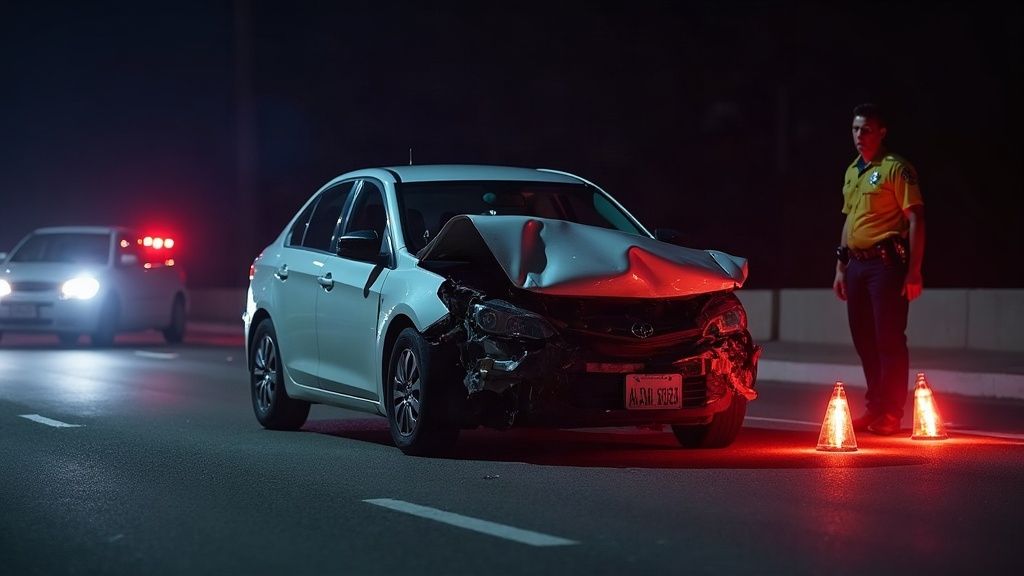
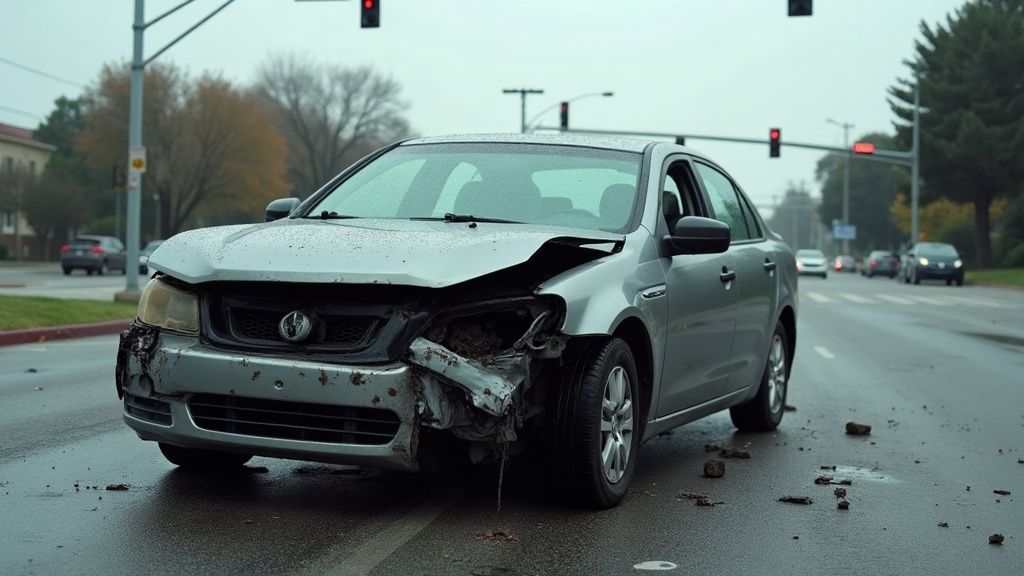
T-bone collisions happen when the front of one vehicle strikes the side of another, usually at or near a right angle. Left-turn crashes follow a similar geometry: one car is crossing or turning through the path of oncoming traffic.
What makes these crashes so dangerous is a matter of physics and car design. The front and rear of a modern vehicle have substantial crumple zones built to absorb impact energy. The side of a car has only the door panel, a few inches of metal and glass, between the occupant and the striking vehicle.
The result is that side-impact crashes often produce:
- Traumatic brain injuries from lateral head movement or contact with the window.
- Rib fractures and internal organ damage, including liver and spleen lacerations, from door intrusion.
- Spinal injuries, particularly to the thoracic and lumbar spine.
- Pelvic and hip fractures when the door is pushed inward against the occupant's lower body.
- Shoulder and arm injuries from the direct point of impact.
Speed multiplies all of these risks. A T-bone impact at highway speeds on a surface street can be catastrophic even for a vehicle that otherwise passes all safety ratings.
California Right-of-Way Rules at Intersections and Turns
California's right-of-way rules at intersections come from the California Vehicle Code, and a few sections govern the vast majority of T-bone and left-turn crash disputes.
Controlled intersections with traffic signals
Under Cal. Veh. Code §21453, a driver facing a red signal must stop before entering the intersection and may not proceed until a green signal is given, unless making a lawful right turn on red. A driver who enters on a red light has committed a traffic violation and, if a collision results, carries substantial fault.
Under Cal. Veh. Code §21461, failing to obey a traffic control device is itself an infraction. More importantly for civil liability, that violation is evidence of negligence.
Left-turn yield requirement
Cal. Veh. Code §21801 is the central statute in left-turn crash cases. It reads, in substance: a driver intending to turn left shall yield the right of way to all vehicles approaching from the opposite direction that are close enough to constitute a hazard, and shall continue to yield until the turn can be made safely.
The practical consequence is a strong presumption that the left-turning driver is at fault in any collision that occurs during the turn, because the statute placed the duty to yield on that driver. Defeating that presumption requires evidence that the oncoming driver did something that made the turn unsafe through no fault of the turning driver, such as running a red light or driving at an excessive speed.
Uncontrolled intersections and stop signs
At an intersection with stop signs, Cal. Veh. Code §21800 governs. The driver who reaches the intersection first has the right of way. If two drivers arrive at the same time, the driver on the left must yield to the driver on the right. At an all-way stop, the same first-to-arrive rule applies, with the same tie-breaker.
A driver who fails to stop at a stop sign and T-bones another vehicle has almost certainly committed the primary fault-causing act.
Turning left at a green light (not a green arrow)
A driver turning left on a green circle (not a protected green arrow) has the right to turn but must still yield to oncoming traffic under §21801. A green light does not eliminate the yield obligation. This is a point many drivers misunderstand. The oncoming driver going straight through a green light has the right of way over the left-turning driver at the same signal.
A protected green arrow, by contrast, holds oncoming traffic at a red and gives the turning driver a lawful gap. In that situation, a car that enters the intersection against the red and gets hit by the turning driver is the at-fault party.
The General Rule: Left-Turning Drivers Are Usually at Fault (And the Exceptions)
In California, a driver making a left turn must yield to all oncoming vehicles that are close enough to be a hazard, under Cal. Veh. Code §21801.
Because §21801 places the duty of care squarely on the left-turning driver, California courts and insurers treat the left-turner as presumptively at fault when a collision occurs mid-turn. If you turned left and got hit, expect the other driver's insurer to point directly to that statute.
The presumption, however, is rebuttable. You can shift fault back to the oncoming driver by showing:
1. The oncoming driver ran a red light.
If you had a green light and began your turn legally, and the other driver entered on a red, their violation of §21453 defeats the presumption. The question then becomes one of evidence: can you prove they ran the light?
2. The oncoming driver was speeding.
A driver who enters an intersection on a red light and causes a T-bone crash can be held entirely at fault under Cal. Veh. Code §21453, even if the other car was turning left.
Even where the signal is not in dispute, an oncoming driver traveling far above the speed limit may have made it impossible for the turning driver to reasonably judge the gap. Speed in excess of the limit is itself negligence under Cal. Veh. Code §22350 (the basic speed law). If the excess speed was a substantial factor in causing the collision, fault can be apportioned to the speeding driver.
3. The oncoming driver was distracted or impaired.
Driving under the influence (Cal. Veh. Code §23152) or operating a phone without a hands-free device (Cal. Veh. Code §23123.5) are independent violations that can bear on fault. An impaired driver who failed to slow or react normally may share or bear primary fault.
4. A sudden emergency made the turn necessary.
California's sudden emergency doctrine provides a partial defense when a driver was confronted with an unexpected hazard that required an immediate response. It rarely eliminates fault entirely but can reduce the turning driver's share of it.
Proving Who Ran the Light: Cameras, Witnesses, and Reconstruction
"Both drivers say the light was green" is one of the most common disputed facts in T-bone cases. Here is how that dispute actually gets resolved.
Traffic signal cameras and intersection cameras
Many California intersections, particularly in Los Angeles County, have red-light enforcement cameras or general monitoring cameras operated by the city or California Department of Transportation (Caltrans). Footage from these cameras can show directly which signal phase was active when each car entered the intersection.
After a crash, this footage is time-sensitive. Cities often overwrite intersection camera data within 24 to 72 hours if no preservation request is made. Your attorney should send a litigation hold letter to the relevant city traffic engineering department immediately.
Event data recorders (EDR) / black boxes
Most vehicles manufactured after 2012 contain an event data recorder, colloquially called a black box. An EDR captures vehicle speed, brake application, throttle position, and other parameters in the seconds before impact. This data can confirm whether a driver braked before entering the intersection (consistent with stopping at a red) or continued at speed without braking (consistent with running a light).
EDR data requires a specialist to download and interpret, and the vehicle itself must be preserved before repair or total-loss disposal.
Skid marks and vehicle rest positions
Traffic cameras, event data recorders, skid marks, and independent eyewitnesses are the four most reliable sources of evidence in a disputed right-of-way case.
An accident reconstructionist can use the length and location of skid marks to calculate pre-impact speed and reconstruct where each vehicle was in the intersection at the moment of contact. The final rest positions of the vehicles, combined with the crush patterns on each car, establish the angle and direction of the collision with mathematical precision.
Eyewitnesses
Independent witnesses who had no relationship to either driver carry significant weight with insurers, juries, and the Workers' Compensation Appeals Board. Witness accounts gathered at the scene, before drivers have had time to coordinate their stories, are especially valuable.
Cell phone records and distraction evidence
If one driver was on a handheld phone at the time of the crash, subpoenaed carrier records can confirm whether a call or data session was active at the moment of impact, corroborating a distracted-driving theory.
When Fault Is Shared: California's Comparative Negligence System
California is a pure comparative fault state. Under Cal. Civ. Code §1431.2, each defendant is liable only for their proportionate share of non-economic damages, and pure comparative negligence applies so that a plaintiff's recovery is reduced by their own percentage of fault regardless of how large that percentage is.
California uses a pure comparative fault system, so each driver's damages are reduced by their own percentage of responsibility, you can still recover compensation even if you were partly at fault.
A practical example (hypothetical):
You are turning left on a green light. You misjudge the gap and the oncoming driver is also going 15 mph over the speed limit. A jury finds you 40% at fault for the inadequate gap assessment and the other driver 60% at fault for the speed. If your total damages are $100,000, you recover $60,000. The other driver, if injured, would recover 40% of their damages from you.
This is meaningfully different from the contributory negligence rules in some other states, where any fault at all bars recovery. In California, partial fault does not end your case. It adjusts your recovery.
Insurance adjusters are trained to inflate your comparative fault percentage because every percentage point of fault they assign to you reduces what they owe. This is one of the primary reasons having legal representation matters in disputed intersection cases.
What to Do at the Scene of an Intersection Crash
The actions you take in the first minutes after a T-bone or left-turn crash directly affect the evidence available later. Here is the short list:
- Call 911. A police report creates an official record, including the officer's observations about the signal phase, road conditions, and any admissions made by either driver. California law requires you to report an accident that causes injury or death (Cal. Veh. Code §20008).
- Do not move the vehicles if it is safe to stay. The final rest positions of the vehicles are evidence. Move only if staying creates an immediate safety hazard.
- Photograph everything. Take wide shots of the full intersection, showing signal positions and lane markings. Take close-up shots of the damage on both vehicles. Photograph skid marks, debris fields, and any traffic cameras you can see at the intersection.
- Collect witness information. Names and phone numbers of any independent witnesses. Bystanders scatter quickly.
- Ask whether there are cameras. Look for red-light cameras, ATM cameras on nearby businesses, and dashcam footage from other vehicles that may have been at the light.
- Seek medical attention the same day. Many serious internal injuries, including organ lacerations and spinal damage, do not produce obvious pain immediately after a crash. A same-day examination creates a medical record that ties your injuries to the collision.
- Do not give a recorded statement to the other driver's insurer without speaking to an attorney. Adjusters are trained to ask questions in ways that elicit admissions of fault. You are not required to give a recorded statement to an adverse insurer.
If you were hit in a T-bone or left-turn crash in California, photograph the intersection, collect witness contact information, and seek medical attention the same day, delays in all three weaken your case.
When a T-Bone Crash Involves a Work Vehicle
If you were driving a company vehicle, making a delivery, or performing any work-related task at the time of the crash, you may have two separate legal claims running at the same time: a workers' compensation claim against your employer's carrier, and a personal injury claim against the at-fault driver.
These claims work differently and can compound your recovery. The workers' comp claim covers your medical bills and a portion of lost wages regardless of fault. The personal injury claim against the third-party driver can recover pain and suffering, full lost earnings, and other damages that workers' comp does not cover.
Coordinating these two claims requires careful handling to protect both. Visit our workers' compensation practice area for more on how the two claims interact.
FAQ: T-Bone and Left-Turn Accidents in California
Who is at fault in a left-turn accident in California?
Under Cal. Veh. Code §21801, the driver making the left turn must yield to oncoming traffic. That makes the left-turning driver presumptively at fault in most collisions. The presumption can be rebutted if the oncoming driver ran a red light, was speeding, or was otherwise driving negligently in a way that caused the crash.
Who is at fault in a T-bone accident?
Fault in a T-bone crash depends on who had the right of way at that intersection. At a signalized intersection, the driver who entered on a red light is typically at fault under Cal. Veh. Code §21453. At an uncontrolled intersection, fault turns on who arrived first or, if simultaneous, who was on the right.
How is right of way decided at a California intersection?
At a traffic signal, the green light holder has the right of way, subject to specific yield rules for left turns. At a stop sign, the first-to-arrive driver has the right of way; ties go to the driver on the right under Cal. Veh. Code §21800. At an uncontrolled intersection, the same first-to-arrive and yield-to-the-right rules apply.
What if both drivers say the light was green?
If both drivers claim the light was green, an accident reconstruction expert can analyze physical evidence like vehicle crush patterns and final rest positions to determine the actual sequence of events.
In addition to reconstruction, traffic camera footage, EDR data, and eyewitness accounts can resolve the dispute. Preserving this evidence quickly after the crash is critical, because camera footage is often overwritten within 24 to 72 hours.
Can I recover compensation if I was partly at fault for the T-bone crash?
Yes. California's pure comparative fault system, established under Cal. Civ. Code §1431.2, allows you to recover damages reduced by your own percentage of fault. If you are found 30% at fault, you recover 70% of your total damages. There is no fault threshold that bars recovery entirely.
Does a police report determine who was at fault?
A police report is evidence of the responding officer's observations, including any citations issued. It is not a binding legal determination of fault. Insurers, attorneys, and ultimately juries can reach different conclusions than the officer who wrote the report.
How long do I have to file a personal injury lawsuit after a T-bone crash in California?
Under Cal. Civ. Proc. Code §335.1, the statute of limitations for personal injury claims in California is two years from the date of the injury. Certain exceptions apply, including claims against government entities, which carry a six-month claim presentation deadline under Cal. Gov. Code §911.2. Missing these deadlines generally bars your claim entirely.
What damages can I recover in a T-bone accident case?
Recoverable damages in a California personal injury case include past and future medical expenses, past and future lost earnings, loss of earning capacity, pain and suffering, emotional distress, and, where applicable, loss of consortium. Punitive damages are available in rare cases involving malice or oppression, such as a confirmed DUI.
Should I accept the insurance company's first offer?
In most cases, no. An initial settlement offer is typically made before the full extent of your injuries is known. Once you sign a release, you cannot reopen the claim for future medical expenses or complications. Speaking with an attorney before accepting any offer is strongly recommended.
What if the at-fault driver had no insurance?
California requires drivers to carry minimum liability insurance under Cal. Veh. Code §16020, but not all drivers comply. If the at-fault driver is uninsured, your own uninsured motorist (UM) coverage may be your primary source of recovery. If you were injured while driving a work vehicle, workers' comp coverage may also apply.
Talk to a California Intersection Accident Attorney
Right-of-way disputes at intersections are fact-intensive and fought hard by insurance adjusters who know exactly how to minimize your recovery. The outcome often turns on evidence collected in the first 48 to 72 hours after the crash.
We've recovered over $150,000,000 for injured Californians since 2014. We handle every case as if it were going to trial, because that is exactly what moves insurers to pay what a case is actually worth.
If you or someone you know was hurt in a T-bone or left-turn crash in California, call (818) 794-9947 for a free case review. No fee unless we win. Available in English and Spanish.
Reviewed by Minas Nordanyan, CA Bar #296806. Last updated 2026.