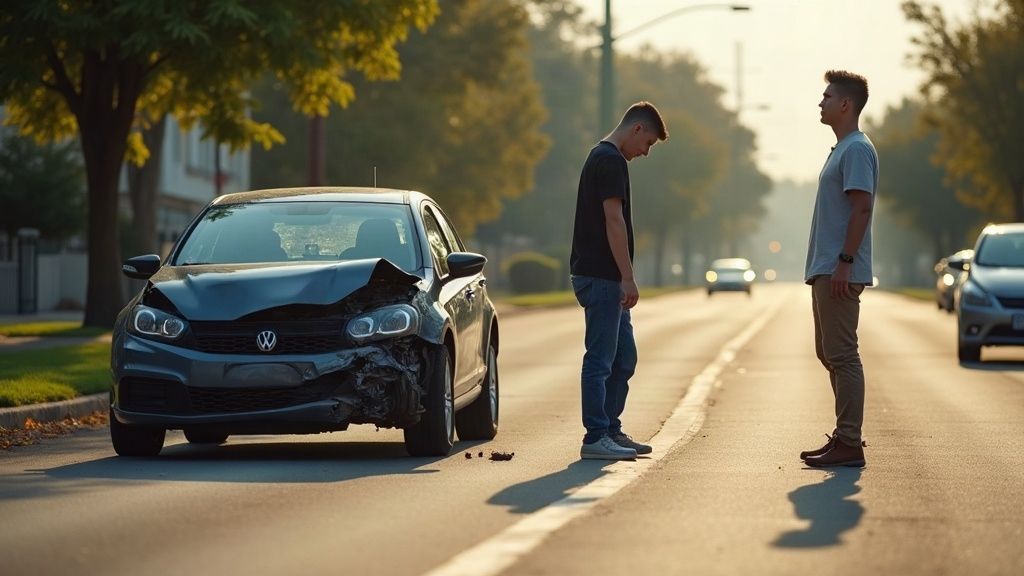
If you were hit by a teenage driver in California, you are probably asking two questions: who is legally responsible, and how do you actually collect? The answers depend on a handful of California statutes that most people have never read, and getting them wrong can cost you the recovery you deserve.
This article walks through how California law assigns liability when a minor causes a crash, what insurance coverage is in play, and what steps protect your claim from day one.
If you need to talk through your specific situation, call (818) 794-9947 for a free case review. No fee unless we win.
Quick-Answer Summary
- A parent or guardian who signed the minor's license application is jointly liable for any damages the teen causes while driving (Cal. Veh. Code §17707).
- The family car's owner can also be liable when a teen drives with permission, under Cal. Veh. Code §17150.
- As of January 1, 2025, California's minimum auto liability limits are $30,000 per person, $60,000 per accident, and $15,000 in property damage under Cal. Veh. Code §16056 as amended by SB 1107.
- The family auto insurance policy typically covers a teen listed as a household driver, but coverage disputes are common.
- You have two years to file a personal injury lawsuit under Cal. Code Civ. Proc. §335.1.
- If the teen is uninsured or underinsured, your own UM/UIM coverage may be your best practical option.
Why Crashes Involving Young Drivers Raise Unique Issues
A car accident is always stressful. When the at-fault driver is a minor, the situation has several layers that a standard adult-driver crash does not.
First, a minor generally cannot be sued and forced to pay a judgment the same way an adult can. Even if a court awards you damages, the teen has no wages to garnish and no assets to reach. The practical recovery almost always runs through the parents or the insurance company.
Second, California has two separate statutes that can make a parent or vehicle owner financially responsible for what a teen did behind the wheel. Understanding which statute applies, and whether both apply, shapes the entire claim strategy.
Third, insurance coverage in households with teen drivers is sometimes incomplete or disputed. The family may have minimum limits that fall short of serious injuries, or the teen may have been driving a vehicle not covered by the household policy.
None of this means you cannot recover. It means you need to identify the right targets and the right legal theories from the start.
How California Can Hold Parents Responsible for a Minor's Driving
The Liability-by-Signature Rule: Vehicle Code §17707
Under California Vehicle Code §17707, a parent or guardian who signs a minor's driver's license application is jointly and severally liable for any injuries or property damage the minor causes while driving.
This is not a theory you have to argue, it is a statute. The moment a parent signs that DMV application, they accept co-responsibility for every accident the minor causes until the minor turns 18, surrenders the license, or the parent files a formal release with the DMV (Cal. Veh. Code §17708).
"Jointly and severally liable" means you can pursue the parent for the full amount of your damages without first exhausting what you can get from the teen. The parent cannot argue "go after the kid first."
Practical implication: The parent's personal assets and the family auto insurance policy are both on the table.
Negligent Entrustment (Common Law)
Even apart from §17707, California common law recognizes negligent entrustment. If a parent knowingly gives car keys to a teen who is inexperienced, impaired, or has a history of reckless driving, the parent can be held directly liable for negligently handing over control of a dangerous instrument.
This theory matters in cases where the teen was driving a vehicle that a parent did not sign the license for, for example, a divorced parent who was not the cosigner but regularly let the minor drive their car.
Owner Liability When the Teen Drives the Family Vehicle
The Permission Rule: Vehicle Code §17150
California Vehicle Code §17150 makes a vehicle owner liable when someone drives the car with the owner's express or implied permission, that includes a teenager borrowing the family vehicle.
This is separate from the §17707 parent-signature rule. §17150 runs with the car, not with the license application. If Dad owns the car and Mom cosigned the license, both statutes can apply simultaneously, with both parents potentially on the hook.
"Implied permission" is important here. A teen who regularly uses the family minivan for school and errands typically has implied permission even on a day when no one explicitly said "yes, take the car." Courts look at the pattern of use, not just the specific conversation before the crash.
When Permission Was Not Given
If the teen took the car without permission, a so-called "joy ride" scenario, the owner's §17150 liability may not apply. However, courts scrutinize "no permission" defenses carefully, especially when the teen lives in the household and has regular access to the keys.
Even if §17150 does not apply, §17707 liability (tied to the license signature) may still hold.
Insurance Coverage Questions with a Household Driver
Who Is Covered Under the Family Policy?
Most standard auto policies cover family members living in the household when they drive a covered vehicle. A teen who is listed on the policy, or who lives with the named insured, is typically covered, subject to the policy's terms.
As of January 1, 2025, California's minimum auto liability limits are $30,000 per person, $60,000 per accident, and $15,000 in property damage under Vehicle Code §16056 as amended by SB 1107.
For a serious injury, minimum-limits policies may not be enough. A broken arm, a soft-tissue injury that requires surgery, or any head trauma can easily exceed $30,000 in medical bills alone. This is why understanding what coverage exists, and knowing your own policy's uninsured/underinsured motorist (UM/UIM) limits, matters so much.
What If the Teen Was Excluded from the Policy?
Some insurers offer lower premiums if the parents sign a named-driver exclusion, removing the teen from coverage entirely. If that exclusion is in place and the teen is involved in a crash, the family policy will not pay your claim.
In that situation, your own UM/UIM coverage becomes critical.
Uninsured and Underinsured Motorist Coverage
If the teen driver is uninsured or underinsured, your own uninsured/underinsured motorist coverage, required to be offered under California Insurance Code §11580.2, may be your most reliable path to recovery.
California law requires insurers to offer UM/UIM coverage when they sell an auto policy. If you accepted that coverage (or if the insurer failed to get a proper written waiver from you), you may be able to make a claim on your own policy even though the other driver caused the crash.
This matters most when:
- The teen's family has minimum-limits coverage and your damages exceed those limits.
- The teen was driving an uninsured vehicle.
- The teen was excluded from the household policy by name.
Recovering Fairly When the At-Fault Driver Is Young
What Damages Can You Claim?
In a California personal injury case, you can seek compensation for:
- Medical expenses, past bills already incurred and future costs for ongoing treatment, physical therapy, or surgery.
- Lost wages, income you missed while recovering, and reduced earning capacity if the injury affects your ability to work long-term.
- Pain and suffering, physical pain, emotional distress, and loss of enjoyment of life.
- Property damage, repair or replacement of your vehicle.
California does not cap these damages in standard car accident cases (note: medical malpractice has a separate cap structure that does not apply here).
Comparative Fault
California follows a pure comparative fault rule under Cal. Civ. Code §1714. If the other driver's insurer or a defense attorney argues that you were also partially at fault, for example, you were speeding, your damages are reduced by your percentage of fault, but you are not barred from recovery entirely.
Do not let an insurer use a minor comparative fault argument to dismiss your claim. That is a negotiating tactic, not a legal bar.
The Challenge of Collecting from a Minor Directly
A minor in California can be held personally liable for a car accident, but collecting from the minor is rarely practical, the parent's liability and the family auto insurance policy are the realistic recovery sources.
A judgment against a 17-year-old has limited immediate value. The realistic recovery paths are:
- The family auto insurance policy (primary target in most cases).
- The parents under §17707 (jointly liable by statute).
- The vehicle owner under §17150 (if different from the parents).
- Your own UM/UIM coverage (when the above sources fall short).
An attorney's job in a teen-driver case is to identify every available source of recovery and pursue them strategically.
Steps to Take After a Crash with a Teen Driver
Acting quickly after a crash protects your legal rights and preserves the evidence you will need.
1. Call 911 and get a police report. A California Traffic Collision Report documents the parties, the scene, and any citations issued. The responding officer will note the at-fault driver's age and whether a citation was issued, both matter for your claim.
2. Get the teen's information and the parents' information. Ask for the driver's license, the vehicle registration, and the insurance card. Note the name of the registered owner. If the registered owner is a parent and the teen is listed as a driver, that combination is important for liability analysis.
3. Document the scene. Photograph the vehicles, the road, any skid marks, traffic signals, and your own injuries. Video is even better. Do this before vehicles are moved if it is safe to do so.
4. Seek medical care immediately. Even if you feel "okay," adrenaline masks pain. Delayed symptom onset is common with whiplash, soft-tissue injuries, and concussions. A gap in medical treatment is the first thing an insurance adjuster will use to minimize your claim.
5. Report the crash to your own insurer. Even if the teen was clearly at fault, notify your own insurance company. If UM/UIM coverage becomes relevant, your insurer needs timely notice.
6. Preserve everything. Save all medical bills, pharmacy receipts, mileage logs for medical appointments, and any correspondence from the teen's insurer. If you miss work, document it.
7. Talk to an attorney before giving a recorded statement. The teen's family insurer may call quickly and ask for a recorded statement. You are not required to give one. Anything you say can be used to minimize your claim. Call (818) 794-9947 first.
You have two years from the date of a California car accident to file a personal injury lawsuit under Code of Civil Procedure §335.1.
That two-year window sounds long, but evidence disappears, witnesses move, and insurance policies lapse. The earlier you start, the stronger your position.
FAQ
Are parents liable for a teen driver's accident in California?
Yes, under two separate theories. First, Cal. Veh. Code §17707 makes a parent or guardian who cosigned the teen's license application jointly and severally liable for any damages the minor causes while driving. Second, Cal. Veh. Code §17150 makes a vehicle owner liable when any driver, including a teen, operates the car with express or implied permission. Both can apply at the same time.
What happens if a minor causes a car accident in California?
The minor can be held personally liable, but practical recovery usually runs through the parents and the family's auto insurance policy. The parent who cosigned the license is jointly liable under §17707. If the teen was driving the family vehicle with permission, the owner is also liable under §17150. The family's auto insurance policy is typically the first source of payment.
Who pays when a teenager crashes the family car?
The family's auto insurance policy pays first, up to the policy limits. If the teen is listed on the policy or has implied permission to drive, the policy covers the accident. After policy limits are exhausted, the parents may be personally liable under §17707. If limits fall short of your damages, your own UM/UIM coverage can fill part of the gap.
Can I recover damages from a teen driver in California?
Yes, but you will almost certainly recover from the parents and the insurance company rather than from the teen directly. A minor can be held liable for negligence, but they rarely have assets to satisfy a judgment. The §17707 statutory liability for the cosigning parent is the cleaner recovery path.
What if the teen was not on the insurance policy?
It depends on whether the teen was expressly excluded from coverage by name. If the teen was simply unlisted but lived in the household and regularly drove the vehicle, most policies still cover the accident. If there is a formal named-driver exclusion, the family policy will not pay your claim, and your own UM/UIM coverage becomes the primary option.
What if the teen was driving someone else's car?
The owner of that vehicle can be liable under Cal. Veh. Code §17150 if the teen had permission to drive. The owner's insurance policy would also be implicated. The teen's parents may still be liable under §17707 for the cosigned license, regardless of whose car was involved.
Does California's comparative fault rule affect my recovery against a teen driver?
California's pure comparative fault rule under Cal. Civ. Code §1714 reduces your damages by your own percentage of fault, but it does not bar recovery entirely even if you were partially at fault. If the teen was primarily at fault, you can still recover a proportionate share of your damages.
How long do I have to file a lawsuit after a crash with a teen driver?
Two years from the date of the accident under Cal. Code Civ. Proc. §335.1. If the at-fault teen was driving for a government entity or if a government agency is involved, the timeline is shorter and requires a government tort claim first. Talk to an attorney as soon as possible to protect your deadline.
What are the current minimum auto insurance limits in California?
As of January 1, 2025, California's minimum auto liability limits are $30,000 per person, $60,000 per accident, and $15,000 in property damage under Cal. Veh. Code §16056 as amended by SB 1107. Many serious injury cases exceed these minimums.
Should I talk to an attorney if I was hit by a teen driver?
Yes. Teen-driver cases involve multiple potential defendants, statutory liability theories most people have not heard of, and insurance coverage disputes that are easy to mishandle without legal guidance. A free case review with a California personal injury attorney costs nothing and can identify recovery sources you would otherwise miss.
Talk to a California Personal Injury Attorney Today
A crash with a teen driver is not a simple fender-bender claim. It involves multiple parties, overlapping statutes, and insurance coverage questions that can make or break your recovery.
We've recovered over $150,000,000 for injured people across Southern California. We handle personal injury cases from the first call to the final check. No fee unless we win.
Call (818) 794-9947 for a free case review. We're available in English and Spanish.
Reviewed by Minas Nordanyan, CA Bar #296806. Last reviewed 2026-07-13. This article is for general informational purposes and does not constitute legal advice. Your case depends on facts specific to you. Contact our office to discuss your situation.