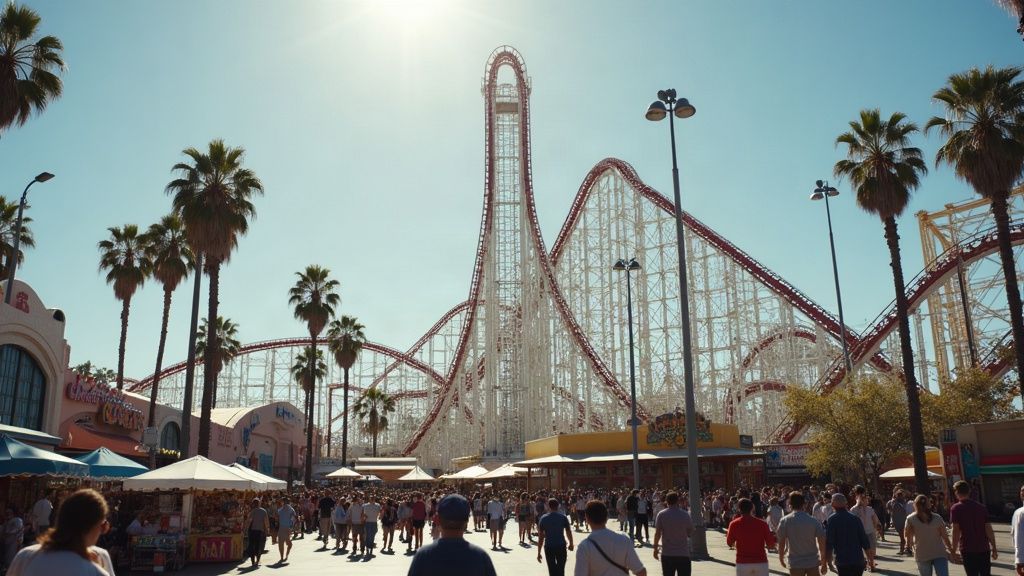
California amusement parks draw tens of millions of visitors every year. Most trips end with nothing worse than sore feet. But when a ride malfunctions, an operator makes a mistake, or a hidden hazard sends someone to the emergency room, the legal questions become complicated fast.
If you've been injured at a theme park in California, here are eight things you need to know before you talk to the park's insurance adjuster or sign anything they hand you.
Quick summary:
- California law requires annual Cal/OSHA inspections of fixed amusement rides under Cal. Lab. Code §7920.
- Signed waivers cannot excuse gross negligence or willful misconduct under California law.
- Ride mechanical failures, operator error, and premises hazards each point to a different liability theory.
- These claims often involve multiple defendants at once: the park, the manufacturer, and third-party operators.
- Maintenance and inspection records are subpoenable and often reveal prior known defects.
- Surveillance footage and incident reports can be overwritten quickly, time matters.
- California imposes no cap on pain and suffering damages in personal injury cases.
- Report the accident immediately, get same-day medical care, and retain an attorney before signing any release.
1. How California Regulates Amusement Ride Safety and Inspections
California imposes some of the strictest amusement ride safety rules in the country. Under Cal. Lab. Code §7920 through §7928, every fixed amusement ride must be inspected and permitted annually by Cal/OSHA, the Division of Occupational Safety and Health within the California Department of Industrial Relations (DIR). A park cannot lawfully operate a fixed ride without a current permit.
Cal/OSHA conducts both scheduled and surprise inspections. Inspectors check mechanical components, restraint systems, operator training documentation, and maintenance logs. When an inspector finds a violation, the citation becomes part of the public record and part of the evidence in any injury lawsuit that follows.
Mobile rides at fairs and carnivals fall under a parallel framework administered by the Division of Occupational Safety and Health's Amusements Rides Unit. The inspection obligation is the same; what changes is the permit category.
California requires fixed amusement rides to be inspected and permitted every year by Cal/OSHA under California Labor Code Section 7920.
Takeaway: A park's permit history and Cal/OSHA citation record are public documents. Your attorney can obtain them at the start of a case, often before discovery even begins.
2. Why Signed Waivers Don't Always Block a Claim
Most California theme parks ask guests to acknowledge risk warnings on tickets, at ride entrances, or on separate paper forms. Many people assume that signing means they gave up all their rights. That is not how California law works.
Under California Civil Code §1668, any contract that purports to exempt a party from responsibility for fraud or willful injury to another person is void as against public policy. California courts have extended that principle to gross negligence, meaning conduct that shows a reckless disregard for the safety of others.
In the amusement park context, if a ride operator ignored a known mechanical defect, bypassed a safety check, or allowed an improperly restrained rider to board, a court may refuse to enforce the waiver entirely. The waiver might shield the park from claims based on ordinary negligence, such as an unexpected jolt that is an inherent part of the ride experience, but it offers far less protection when the park itself created or knowingly tolerated the danger.
A signed theme park waiver does not automatically block your injury claim in California because waivers cannot excuse gross negligence or willful misconduct under California Civil Code Section 1668.
Takeaway: Do not assume a waiver ends your case. Whether it applies at all depends on exactly what went wrong and whether the park knew about the hazard beforehand.
3. Common Causes of Injury: Mechanical Failure, Operator Error, Premises Hazards
Not all theme park injuries happen on rides. And even among ride injuries, the cause matters because it determines who is legally responsible.
Mechanical failure occurs when a component breaks, wears out, or is assembled incorrectly. Restraint bar malfunctions, wheel failures, track defects, and hydraulic system breakdowns have all been documented at California parks. When mechanical failure is the cause, the claim may lie against the park for inadequate maintenance, the manufacturer for a design or manufacturing defect under California product liability law, or both.
Operator error includes loading riders incorrectly, failing to check that restraints are secured, starting a ride before all riders are seated, or ignoring a rider who appears unwell. Parks are responsible for the conduct of their employees under the doctrine of respondeat superior.
Premises hazards include wet floors near water rides, broken pavement, inadequate lighting in queue areas, and poorly maintained handrails. These injuries arise under standard premises liability principles. California landowners owe a duty of reasonable care to guests under Cal. Civ. Code §1714.
Takeaway: Identifying the right cause is not just an academic exercise. It determines which defendants to name, which experts you need, and how long the case is likely to take.
4. What Makes These Claims Different from Typical Premises Liability
A standard slip-and-fall at a grocery store involves one defendant, one hazard, and one legal theory. A theme park injury claim routinely involves several at once.
Consider a scenario: a rider is injured when a roller coaster car lurches unexpectedly. The car's restraint system was manufactured by a third-party supplier. The ride was operated by a staffing company under contract with the park. The park's own maintenance team had been logging complaints about that car for three weeks without pulling it from service.
Theme park injury claims can name the park owner, the ride manufacturer, and a third-party operator as defendants at the same time.
In that one scenario, you potentially have a product liability claim against the restraint manufacturer, a negligence claim against the staffing company, and a separate negligence or gross negligence claim against the park for ignoring documented complaints. Each defendant has its own insurer and its own legal team. California's comparative fault rules, codified at Cal. Civ. Code §1431.2, allow a jury to apportion responsibility among all of them.
Takeaway: The complexity of these cases is exactly why theme park operators and their insurers move quickly to control the narrative after an accident. You need representation that moves just as fast.
5. How Ride Inspection and Maintenance Records Become Evidence
California law requires operators of fixed amusement rides to maintain maintenance and inspection records. When a case goes into litigation, your attorney can subpoena those records through discovery.
What those records often reveal:
- Prior incidents on the same ride that were not reported to Cal/OSHA as required
- Documented mechanical complaints that maintenance personnel flagged but management did not act on
- Gaps in the required inspection schedule
- Alterations to the ride that were not approved by the original manufacturer
If records show that the park knew about a defect and allowed the ride to continue operating, that evidence supports a gross negligence finding. Gross negligence in California goes beyond ordinary carelessness; it is conduct that rises to a conscious disregard for the safety of others. A gross negligence finding also limits the park's ability to hide behind the waiver, as discussed in item 2 above.
For rides that have had previous Cal/OSHA citations, those records are part of the public file and your attorney can obtain them independently of any discovery the park controls.
Takeaway: Maintenance records are often the most powerful documents in a theme park case. Preserving the right to obtain them is one of the first things a personal injury attorney does when you retain them.
6. Why Witness and Video Evidence Is Critical at Parks
Theme parks operate extensive surveillance camera networks. Cameras cover ride loading areas, queue lines, midways, and parking structures. After an accident, ride operators typically complete an incident report within minutes. These documents capture the scene while memories are fresh.
Here is the problem: digital video footage is typically overwritten on a rolling basis, often within 30 to 90 days. Incident reports may be withheld as internal documents unless litigation is pending. If you wait weeks to contact an attorney, the footage of exactly what happened in the moments before your injury may already be gone.
Surveillance footage at amusement parks can be overwritten quickly; contacting an attorney the same day you are injured helps preserve that evidence before it disappears.
When litigation is reasonably anticipated, California courts impose a duty to preserve relevant evidence. An attorney's demand letter sent promptly after an accident puts the park on written notice that litigation is anticipated and that footage must be preserved. If the park then allows footage to be overwritten, that may constitute spoliation of evidence, which courts can address through jury instructions that allow an adverse inference against the park.
Beyond surveillance cameras, witnesses, including other riders, bystanders, and ride operators who were not directly involved in the accident, can provide testimony about what they observed. Contact information from those witnesses disappears fast. Collecting it at the scene is one of the most valuable things you or a family member can do in the immediate aftermath.
Takeaway: Every hour you wait is potentially another hour of video coverage that no longer exists. The evidence preservation clock starts the moment the accident happens.
7. What Compensation May Be Available Beyond Medical Bills
Many injured visitors underestimate what a successful theme park injury claim can recover. Medical bills are the most visible expense, but California law allows recovery of significantly more.
In a personal injury case arising from a theme park accident, recoverable damages may include:
- Past and future medical expenses, including surgery, rehabilitation, physical therapy, and ongoing specialist care
- Lost wages for time missed from work during recovery
- Loss of earning capacity if the injury affects your ability to work in your current occupation or field going forward
- Pain and suffering, including physical pain, emotional distress, and loss of enjoyment of life
- Loss of consortium for the injured person's spouse, in cases of serious injury
California has no statutory cap on pain and suffering damages in personal injury cases, so your recovery is not limited to a fixed formula.
In cases involving gross negligence or willful misconduct, punitive damages may also be available under Cal. Civ. Code §3294. Punitive damages are designed to punish especially egregious conduct and deter similar behavior. They require clear and convincing evidence that the defendant acted with malice, fraud, or oppression, but documented knowledge of a defect combined with a decision to keep operating can support that showing.
California does cap economic damages for medical malpractice claims, but those caps do not apply to premises liability or product liability claims arising from theme park injuries. Your recovery in this category of case is not subject to a fixed ceiling.
Takeaway: Before accepting any settlement from a theme park or its insurer, have an attorney evaluate the full scope of your damages, including those you may not have thought to calculate. You can explore your potential recovery using our settlement calculator.
8. Steps to Take If You're Injured at a Park
The hours and days immediately after a theme park injury are when the most important decisions get made, often before the injured person has had time to think clearly. Here is what to do.
Report the accident to park staff before you leave. Ask for an incident report number and a copy of any written documentation the park creates. Do not leave the park without confirming that the incident is on record.
Get medical care the same day, even if you feel okay. Adrenaline masks pain. Concussions, spinal injuries, and soft tissue damage often do not show their full severity until hours or days later. A same-day medical record establishes the connection between the accident and your injuries, which is a foundation the insurance carrier will try to undermine if you delay.
Photograph everything you can. Your injuries. The ride. The location where the incident occurred. Any visible hazard. Ride signage. Your surroundings. Do this before you leave the park if possible.
Collect contact information from witnesses. Names and phone numbers from anyone who saw what happened. Other riders on the same ride. People standing in the queue. Bystanders nearby.
Do not sign any release the park offers. Parks and their insurers sometimes approach injured guests with quick settlement offers or release forms before the full extent of injuries is known. Signing a release typically extinguishes all future claims, even if your injuries turn out to be far more serious than they appeared on the day of the accident.
Retain a personal injury attorney promptly. The evidence preservation, demand letter, and early investigation work that protects your claim all happen in the days right after the accident. Our firm handles theme park and amusement park injury claims across California on a contingency basis, meaning you pay nothing unless we recover for you.
If you are injured at a California theme park, report the accident to park staff, get medical care the same day, and do not sign any release the park offers before speaking with an attorney.
Takeaway: The steps you take in the first 24 to 48 hours after a theme park injury can determine whether you recover the full value of your claim or settle for far less than you deserve.
Frequently Asked Questions
Can I sue a theme park for an injury in California?
Yes. If your injury was caused by the park's negligence, a defective ride, an employee's error, or a known hazard the park failed to address, you can bring a personal injury lawsuit in California. The park's size or fame does not shield it from liability.
How does California regulate amusement ride safety?
California regulates fixed amusement rides through Cal/OSHA under Cal. Lab. Code §7920 through §7928. Parks must obtain annual permits, maintain maintenance and inspection records, and comply with Cal/OSHA safety orders. Mobile rides at fairs and carnivals fall under a parallel permit category administered by the same agency.
Are theme park waivers enforceable in California?
Partially. Waivers can limit liability for ordinary negligence that is inherent to the ride experience. They cannot, however, excuse gross negligence or willful misconduct under Cal. Civ. Code §1668. If the park knew about a defect and allowed the ride to operate anyway, a court may refuse to enforce the waiver.
What counts as negligence at an amusement park?
Negligence at an amusement park includes operating a ride with a known mechanical defect, failing to train operators properly, allowing improperly restrained riders to board, maintaining dangerous premises conditions, and ignoring prior complaints about a specific ride. California landowners owe a duty of reasonable care to guests under Cal. Civ. Code §1714.
How long do I have to file a theme park injury claim in California?
California's general personal injury statute of limitations is two years from the date of injury under Cal. Civ. Proc. Code §335.1. If a government-owned or operated park is involved, you may have as little as six months to file a government tort claim under the Government Claims Act before that deadline. Consulting an attorney promptly protects you from missing a shortened deadline you may not know applies.
Can I claim compensation for pain and suffering from a theme park accident?
Yes. California personal injury law allows recovery for pain and suffering, emotional distress, and loss of enjoyment of life, with no statutory cap on those damages in premises liability or product liability cases. The amount depends on the severity and duration of your injuries.
What if the park employee who caused my injury was a contractor, not a park employee?
The park may still be liable. California courts examine whether the park retained enough control over the work to be treated as the employer, and contractors who are integral to the park's core operations are sometimes treated as employees for liability purposes. The contractor itself is also a potential defendant.
What should I do if the park's insurance company contacts me?
Do not give a recorded statement, accept a settlement offer, or sign any document before speaking with a personal injury attorney. Insurance adjusters work to limit the park's liability exposure, not to maximize your recovery. Anything you say in an early recorded statement can be used to reduce or deny your claim later.
If you or someone you care about was injured at a California amusement park or theme park, the evidence that protects your claim starts disappearing on day one. Call (818) 794-9947 for a free case review. We handle theme park injury claims across California on a contingency basis, which means no fee unless we win. From the moment you report your injury to the final settlement or award, we handle every aspect of your case.
You can also schedule a free consultation or review our case results to see what we've recovered for injured clients across Southern California.