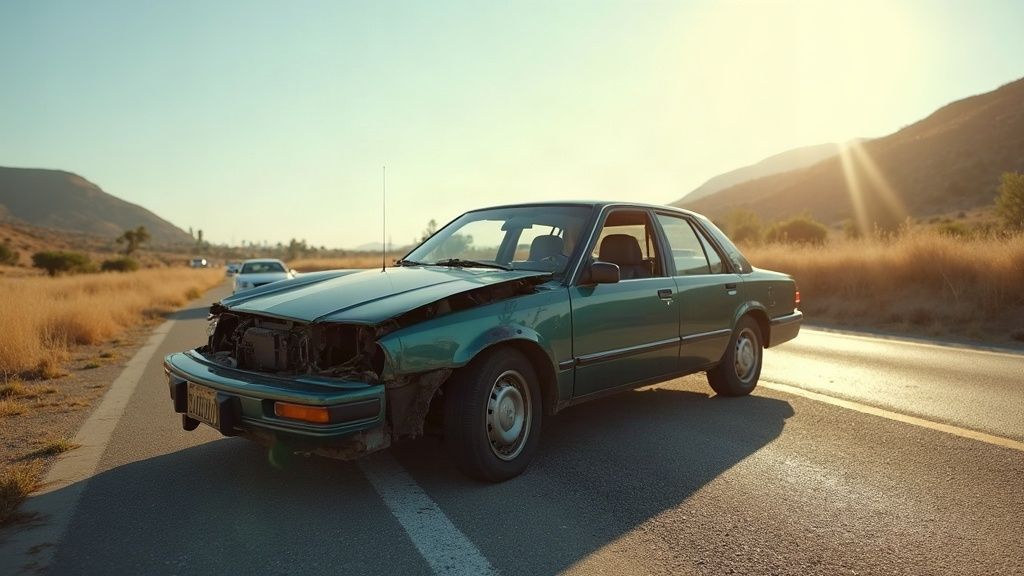
If your car suddenly spun, rolled, or slammed into a barrier after a tire gave out, the first question investigators ask is whether you caused the crash or the tire did. Those two answers lead to completely different legal outcomes. A blowout caused by a defective tire, a negligent repair shop, or a rental company's neglect can shift liability away from you entirely and open the door to claims against manufacturers and other parties you may not have considered.
We've recovered over $150,000,000 for injured Californians, including people whose crashes were initially blamed on driver error before the evidence showed a tire failure was responsible. Here is what the investigation actually looks at.
At a glance: 8 signs the tire failure caused your crash, not you
- The blowout's root cause, whether defective, underinflated, or road-damaged, determines who is liable
- Physical characteristics of the failed tire distinguish driver neglect from a manufacturing defect
- Multiple categories of evidence must be preserved immediately after the crash
- The blown tire itself is the most critical piece of evidence and must not be discarded
- Liable parties may include the manufacturer, a repair shop, a rental company, or another driver
- California's pure comparative fault system can still deliver full or partial recovery even if you share some responsibility
- Specific scene actions protect your claim from day one
- A product liability claim can run alongside your personal injury claim for maximum recovery
1. Common Causes of Tire Blowouts (And Why They Matter for Liability)
In California, a tire manufacturer can be held strictly liable for a blowout crash if the tire had a defect, even without proof of negligence.
Tire blowouts trace to four main causes, and each one points to a different responsible party.
Manufacturing or design defects. A tire that leaves the factory with a hidden flaw in its belts, beads, or sidewall can fail catastrophically even when it is new, properly inflated, and maintained. This is the core of a product liability claim.
Chronic underinflation. A tire running below its recommended pressure builds up excessive heat. Over time, the internal structure breaks down. If the driver knew or should have known the tire was low, responsibility may rest partly with them. If the pressure loss resulted from a defective valve stem or a puncture the owner had no way to detect, the analysis shifts.
Road hazards. Potholes, debris, and poorly maintained pavement can cause or contribute to a blowout. Under California Government Code, a public entity may be liable for a dangerous road condition if it had notice of the hazard and failed to repair it. These claims carry separate deadlines and notice requirements, so they need early attention.
Neglected maintenance. Tires worn beyond their tread-depth limits, improperly rotated, or damaged during a prior repair that was not corrected are preventable failures. A tire shop that missed an obvious defect during service, or made the condition worse, can share in the liability.
Practical takeaway: Identifying the cause of the blowout is not just an academic exercise. It determines who you can sue, what legal theory applies, and what evidence you need to preserve immediately.
2. How to Tell If a Blowout Was Preventable Versus a Manufacturing Defect
The blown tire is the most important piece of evidence in your case; never let it be discarded before an expert examines it.
The difference between a preventable blowout and a defective-tire blowout shows up in the physical evidence on the tire itself, and in the history of the vehicle. Tire forensic experts trained in failure analysis read that evidence the way a physician reads an X-ray.
Signs pointing to a manufacturing or design defect:
- Tread separation from the steel belt structure on a tire with adequate remaining tread depth
- Bead failure, meaning the tire's inner edge separated from the wheel rim without obvious road-damage to that area
- Internal belt edge cracking or oxidation inconsistent with the tire's age and mileage
- Sidewall zipper failure, a sudden rupture along the sidewall caused by internal structural breakdown
- Failure on a tire that was properly inflated, within its load rating, and not visibly worn
Signs pointing to driver or maintenance-related causes:
- Tread worn below [California Vehicle Code] legal minimums
- Evidence of prolonged underinflation, such as severe inner sidewall scuffing
- An unrepaired puncture or prior sidewall damage that was visible before the failure
- Failure at mileage exceeding the manufacturer's rated service life
A qualified tire forensic expert will examine the failed tire, review the vehicle's maintenance history, and produce a report documenting which failure mode the evidence supports. That report becomes a cornerstone of your claim.
Practical takeaway: Do not assume the blowout was your fault because a first responder or an adjuster says so. The physical evidence on the tire is more reliable than any initial impression at the scene.
3. Evidence That Helps Identify What Actually Caused the Blowout
You have two years from the date of your crash to file a personal injury claim in California under Cal. Code Civ. Proc. §335.1.
A tire blowout claim depends on evidence that begins disappearing the moment the crash is over. Knowing what to preserve, and asking for help preserving it immediately, is one of the most consequential things you can do.
The failed tire, wheel, and rim. This is discussed in detail in the next section. It is listed first because it is the most common evidence destroyed by well-meaning vehicle owners who have the damaged tire swapped out at the tow yard.
Scene photographs. Photos of skid marks, gouge marks, tire debris on the roadway, the vehicle's final position, and road conditions document the physical story before it is altered by traffic, weather, or cleanup crews.
Vehicle maintenance records. Service history from dealerships, tire shops, and quick-lube chains shows when the tires were last inspected, whether any pressure or wear concerns were noted, and whether prior repairs were performed correctly.
The vehicle's event data recorder (EDR). Most vehicles manufactured after 2012 carry a black box that records speed, braking, and steering inputs in the seconds before a crash. This data can confirm that the driver was not behaving recklessly when the tire failed, or that an abrupt blowout caused the driver's sudden loss of control.
Surveillance and dashcam footage. Cameras on surrounding businesses, toll plazas, and other vehicles sometimes capture a blowout in progress. This footage is typically overwritten within 24 to 72 hours unless a legal hold is issued.
Tire purchase and warranty records. The tire's manufacture date, lot number, and DOT code, molded into the sidewall, link the specific tire to any existing recall or defect investigation. The National Highway Traffic Safety Administration (NHTSA) maintains a searchable database of tire recalls and complaints.
Practical takeaway: Contact an attorney before the vehicle is released from the tow yard or repaired. A formal evidence preservation letter sent to the tow company, insurance carrier, and any potentially liable party creates a legal obligation to hold the evidence.
4. Why the Tire Itself Must Be Preserved for Inspection
The blown tire is the single most important piece of physical evidence in a California tire blowout case. Courts have repeatedly recognized that without the failed tire, the ability to prove a manufacturing defect or improper repair is severely compromised. Under California's spoliation of evidence doctrine, a party who destroys evidence that the other side needed can face sanctions, adverse inferences, or dismissal in some circumstances.
The danger is practical, not theoretical. After a blowout crash, the most common sequence of events is: vehicle towed to a yard or repair shop, damaged tire removed, new tire installed, destroyed tire sent to recycling. This entire sequence can happen within 48 hours of the crash, before the injured person has even left the hospital.
What to do:
- Tell anyone who has access to the vehicle, including family members, the tow company, and your insurer, that the failed tire is not to be touched, discarded, or recycled under any circumstances.
- Ask the tow company or storage facility to place the tire in a separate bag or container and label it as evidence.
- If you have an attorney, they will send a formal spoliation hold letter immediately.
- If the tire has already been disposed of, tell your attorney right away. There may still be grounds for the claim, depending on what other evidence exists, but the loss of the tire is a serious problem that needs to be addressed honestly and early.
Practical takeaway: Preserving the blown tire is not optional. It is the foundation of your product liability claim and a significant factor in any negligence case against a repair shop.
5. Potential Defendants: Who Can Be Held Liable for a Tire Blowout Crash
A tire shop that improperly mounted or repaired your tire can be held liable for the crash it caused.
One of the advantages of a thorough blowout investigation is that it may identify multiple responsible parties, each of whom may carry separate insurance or assets available to compensate you.
Tire manufacturer. Under California's strict products liability doctrine, a manufacturer is liable for injuries caused by a product with a manufacturing defect, a design defect, or a failure to warn about known dangers, without any requirement that the injured person prove the manufacturer was careless. This principle has been a cornerstone of California law since the California Supreme Court's decision in Greenman v. Yuba Power Products (1963).
Vehicle manufacturer. If the original tires supplied with the vehicle were specified at a load rating or inflation pressure inadequate for the vehicle's design, the vehicle manufacturer may share responsibility.
Tire repair or installation shop. A shop that improperly mounts a tire, fails to seat the bead correctly, over-torques the lug nuts causing vibration damage, or patches a tire outside of accepted repair standards creates a foreseeable risk of blowout. That shop owes a duty of care to anyone who travels in the vehicle afterward.
Rental car company. California law imposes a duty on rental companies to maintain their fleets in a safe operating condition. Cal. Veh. Code §17150 holds the owner of a vehicle liable for injuries caused by the vehicle's operation when the driver had the owner's permission. If a rental company knew or should have known a tire was worn, damaged, or underinflated and placed the vehicle back in service anyway, it can be held directly liable for a resulting blowout.
Another driver. A driver who struck your vehicle, forced you onto a road hazard, or whose cargo debris punctured your tire can be liable for the crash that followed, even if the blowout itself was the proximate cause of the collision.
Government entities. A municipality or state agency responsible for a roadway with a known defect that caused or contributed to the blowout may be liable under California Government Code §835, which addresses dangerous conditions of public property. These claims require a government tort claim filed within six months of the incident.
Practical takeaway: Do not assume only one party is responsible. A complete investigation often reveals a chain of contributing defendants, which improves both your leverage and your total recovery.
6. How Blowout Accidents Affect Standard Fault Determinations in California
California's pure comparative fault system means you can still recover damages even if you were partly at fault for the crash.
California follows a system of pure comparative fault, established in Li v. Yellow Cab Co. (1975) and codified in practice across California courts. Under this system, a jury assigns each party a percentage of fault, and each party's recovery is reduced by their own percentage. A driver who is found 20 percent at fault for a blowout crash can still recover 80 percent of their total damages.
This matters for tire blowout cases in two ways.
First, a blowout caused by a defective tire or a third party's negligence can transfer a significant portion of fault from the driver to the manufacturer, the repair shop, or another driver. The initial police report may list the driver as the at-fault party because the officer observed the vehicle leave its lane before impact. That determination is not binding on a civil claim and can be rebutted with forensic tire evidence.
Second, even if the driver bears some responsibility, such as knowing the tire was worn and not replacing it, the remaining fault attributable to a defective patch or a bead flaw is recoverable. Pure comparative fault does not cut off recovery; it calibrates it.
California's Department of Insurance requires insurers to investigate and evaluate comparative fault fairly. An insurer that assigns 100 percent fault to the driver without investigating a potential tire defect may be handling the claim in bad faith.
Practical takeaway: A police report assigning you fault does not end your claim. Forensic evidence can shift the fault percentages substantially once the tire is examined.
7. What to Do at the Scene If a Tire Failure Caused Your Crash
The decisions you make in the first hour after a blowout crash directly affect your legal claim. These steps are specific to tire failure cases, in addition to the standard actions you would take after any crash.
Call 911. Request both police and medical response. The police report creates a contemporaneous record of the scene. Medical response begins your documented injury record, which matters for both your personal injury claim and, if you were working at the time, any workers' compensation claim that may apply.
Photograph the tire before anything moves. Take close-up photographs of the failed tire from multiple angles, including the sidewall, the tread surface, the inner bead area, and any visible tears or separations. Photograph all four tires, not just the failed one, because the condition of the others supports or undermines arguments about maintenance.
Photograph skid marks and road conditions. The pattern and length of skid marks document what the vehicle did during the blowout sequence. Road hazards such as potholes or debris that may have contributed to the failure should be photographed before they are obscured by traffic.
Do not let the vehicle be towed without documenting the tire. If a tow truck arrives, ask the driver to wait while you photograph the tire, or ask them to store the vehicle without removing or replacing the tire.
Get witness information. Passengers in other vehicles, roadside workers, or bystanders who witnessed the blowout or crash sequence are valuable witnesses to the sudden, uncontrolled nature of the failure.
Do not make statements about what caused the crash. You likely do not know yet whether a defect or another party's negligence caused the blowout. Statements made at the scene can be used against you later.
Practical takeaway: Treat the scene like the product liability crime scene it may be. Everything you document in the first hour can be the difference between a dismissed claim and a full recovery.
8. When a Product Liability Claim May Apply Alongside Your Injury Claim
California product liability law, rooted in Cal. Civ. Code §1714 and developed through decades of California Supreme Court decisions, allows an injured person to hold a tire manufacturer strictly liable for three categories of product defects.
Manufacturing defect. The specific tire that failed deviated from the manufacturer's own design and quality standards. The flaw existed when the tire left the factory.
Design defect. Every tire of that model shares the same dangerous characteristic because the design itself is flawed. This is proven either by showing the design fails to perform as a reasonable consumer would expect, or by demonstrating that a safer alternative design was feasible at a comparable cost.
Failure to warn. The manufacturer knew of a danger associated with the tire, such as a heightened failure rate in certain heat ranges or load conditions, and failed to communicate that danger to consumers or installers.
A product liability claim is separate from, and runs alongside, your personal injury claim for medical expenses, lost wages, pain and suffering, and other damages. Winning on product liability does not require proving anyone was careless. It requires proving the tire was defective and that the defect caused your injury.
How the two claims interact: Your personal injury claim recovers economic and non-economic damages from all responsible parties. Your product liability claim specifically targets the manufacturer or seller of the defective tire. Both claims are governed by California's two-year statute of limitations under Cal. Code Civ. Proc. §335.1, running from the date of the crash.
If you were driving for work when the blowout occurred, a third stream may also apply: a workers' compensation claim for the injury itself, running independently of both civil claims. California law does not require you to choose between them.
Practical takeaway: A product liability claim can significantly increase total recovery by adding a strict-liability defendant who cannot escape responsibility simply by arguing the driver should have checked the tires more often.
A tire blowout crash leaves a narrow window to preserve the evidence that determines whether you recover nothing or everything. If you were hurt in a California crash and believe a tire failure played a role, every day that passes before the tire is examined is a day the evidence degrades.
We've recovered over $150,000,000 for injured Californians, including cases where the initial fault determination was wrong and the real cause was a defective product or a third party's negligence. Call (818) 794-9947 for a free case review. No fee unless we win.
Frequently Asked Questions
Who is liable for an accident caused by a tire blowout in California?
Liability depends on what caused the blowout. If a manufacturing defect caused it, the tire manufacturer can be held strictly liable. If improper installation or repair caused it, the tire shop may be liable. If a rental company's neglect caused it, the rental company can be responsible. If another driver's actions caused or contributed to it, that driver shares liability. California's pure comparative fault system means more than one party can be assigned responsibility at the same time.
Can I sue a tire manufacturer after a blowout accident?
Yes. Under California's strict products liability doctrine, you can sue a tire manufacturer without proving the company was negligent. You need to show the tire had a manufacturing defect, a design defect, or a failure to warn, and that the defect caused your injuries. This claim is separate from any negligence claim you may have against a driver or repair shop, and it runs under the same two-year statute of limitations found in Cal. Code Civ. Proc. §335.1.
Should I keep the blown tire after an accident?
Yes. The blown tire is the most critical piece of evidence in a tire blowout case. A forensic tire expert examines the physical failure characteristics to determine whether a defect or driver error caused the blowout. If the tire is discarded before that inspection happens, the ability to prove a manufacturing or repair defect is severely damaged. Tell everyone with access to the vehicle, including family, the tow company, and your insurer, not to touch or dispose of the tire.
Does a tire shop's bad repair make them liable for my crash?
It can. A tire repair or installation shop owes a duty of care to anyone who rides in the vehicle after a service is performed. If the shop improperly mounted the tire, failed to seat the bead correctly, performed an improper patch repair, or missed visible damage during an inspection, and that failure was a substantial factor in causing the blowout, the shop can be held liable for the resulting crash and injuries.
How long do I have to file a tire blowout injury claim in California?
California's statute of limitations for a personal injury claim is two years from the date of the crash under Cal. Code Civ. Proc. §335.1. A product liability claim against a tire manufacturer carries the same two-year window. If a government entity, such as a city or county responsible for a dangerous road condition, is a potential defendant, you must file a government tort claim within six months of the incident or risk losing that claim entirely.
What if the police report says the crash was my fault?
A police report is not a binding legal determination of fault. Officers document what they observe at the scene, but they typically do not have the forensic equipment or expertise to identify a tire manufacturing defect. A forensic tire analysis completed after the crash can contradict and override the initial fault assessment. Under California's pure comparative fault system, even if you share some responsibility, you can still recover damages reduced by your percentage of fault.