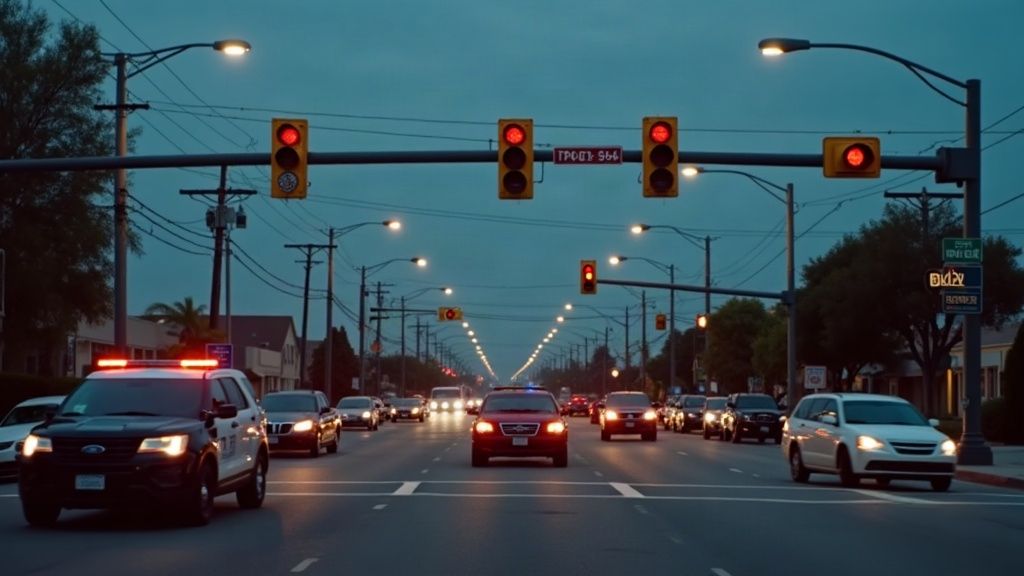
If you were in a California intersection crash and the light was dark, flickering, or frozen on one color, you may be dealing with something more complicated than a simple two-car accident. A malfunctioning traffic signal can shift responsibility from the other driver to a government agency, or spread it across both. The rules for these cases are different, the evidence disappears faster, and the deadlines are shorter than in a standard car accident claim.
We've recovered over $150,000,000 for injured Californians, including victims of intersection crashes caused by infrastructure failures. Here are the eight signs that a signal malfunction was a factor in your crash, and what that means for your claim.
At a glance:
- Signal failures caused by power outages, timing errors, or sensor failures create distinct crash patterns
- A dark signal requires every driver to treat the intersection as a four-way stop under California law
- Caltrans or the city traffic department may share liability if they had notice of the problem
- You have six months to file a Government Tort Claim, not one year, before suing a public agency
- Maintenance logs, camera footage, and witness statements are your most critical evidence
- Witnesses matter more here because physical damage rarely proves who had the right of way
- California's comparative fault rule still applies, even when a government agency is at fault
- The first minutes after the crash determine whether you preserve or lose your best evidence
1. Common Causes of Signal Malfunctions: Power Outages, Timing Errors, Sensor Failures
Traffic signal malfunctions in California fall into three broad categories, and the category determines how the crash happened and who may bear responsibility.
Power outages knock out the signal entirely, leaving every driver facing a blank, dark signal head. These are the easiest malfunctions for witnesses to notice and the easiest for a plaintiff to document, but also the most dangerous because many drivers do not know what the law requires when a signal is dark.
Timing software errors can strand a signal on one color for far longer than its normal cycle, or cause the signal to skip a phase entirely. A driver approaching what appears to be a solid green light may not realize the cross-traffic is also sitting at a solid green. These failures are harder to detect in the moment and harder to prove after the fact because the signal may have been repaired before anyone documents it.
Sensor failures involve the underground inductive loop detectors that sense a waiting vehicle and trigger a signal change. When a sensor fails, a driver may wait through several full signal cycles without ever receiving a green, eventually making a judgment call to proceed, sometimes into live cross-traffic.
Each failure mode produces a different crash pattern. Power-outage crashes tend to be broadside (T-bone) collisions at uncontrolled intersections. Timing-error crashes often look like a standard red-light-running case until the signal data is examined. Sensor-failure crashes can resemble left-turn or right-of-way disputes.
Takeaway: Identifying which failure mode occurred is the first step in building your case, and it requires acting quickly before the agency repairs the signal and the data disappears.
2. How Fault Is Determined When Lights Are Out or Stuck on One Color
The legal framework for a dark or malfunctioning signal is specific, and most drivers do not know the rules.
When a signal is completely dark, Cal. Veh. Code §21800 applies. The intersection is treated as a four-way stop: every driver must yield to any vehicle already in the intersection and to the vehicle to their right if they arrive simultaneously. A driver who treats a dark signal as a free pass to proceed at speed, without stopping, is likely contributorily at fault even if the signal failure was the government's responsibility.
When a signal is stuck on one color, the analysis shifts to what a reasonable driver should have done in the circumstances. A driver facing a signal that has displayed green for an unusually long period has some duty to exercise caution when conflicting traffic is visible. Courts have found fault on the part of drivers who failed to notice obvious warning signs that something was wrong.
Fault is allocated under California's pure comparative fault system, which we cover in detail in item 7. The government agency, the other driver, and you can all share liability in different proportions.
Takeaway: Knowing the dark-signal rule under Vehicle Code Section 21800 is not just academic, a defense attorney will use it against you if you failed to stop, so your attorney needs to know exactly what you did and saw at the intersection.
3. The Role of Caltrans and City Traffic Departments in These Claims
California's traffic signals are maintained by two layers of government, and knowing which one owned your intersection determines who you name as a defendant.
Caltrans (the California Department of Transportation) is responsible for traffic signals installed on state highways, the numbered state routes you see on signs like "SR-14" or "US-101." If your crash happened at a signal on a state route, Caltrans is likely the responsible agency.
City and county traffic engineering departments own and maintain signals on local streets, the named city streets and county roads that do not carry a state highway designation. Los Angeles, for example, operates one of the largest signal networks in the country through its Department of Transportation (LADOT).
Liability attaches when the agency had actual or constructive notice of the defect and failed to repair it within a reasonable time. Actual notice means someone reported the malfunction, a 311 call, an online complaint, a prior incident report. Constructive notice means the defect existed long enough that the agency should have discovered it through reasonable inspection. Under Gov. Code §835, a public entity is liable for a dangerous condition of public property if the entity had notice and failed to protect against the risk within a reasonable time.
Takeaway: Before your attorney files anything, you need to know whether the signal was on a state highway or a local street, that single fact determines which agency to name and which maintenance records to subpoena.
4. Special Government Claim Rules That May Apply to Public Infrastructure
This is the item most injured Californians miss, and it is the most expensive mistake in a signal-malfunction case.
Before you can file a lawsuit against any California government agency, a city, a county, Caltrans, or any other public entity, you must first file a Government Tort Claim under the California Government Claims Act. The deadline is six months from the date of the accident, not one year.
That is half the time you would have for a standard car accident lawsuit against a private driver. The standard personal injury statute of limitations in California is two years under Cal. Code Civ. Proc. §335.1, but that longer deadline does not protect you against a public entity if you miss the six-month government claim deadline.
The Government Tort Claim must be filed with the specific agency, not with the court. It must describe the incident, the injury, and the damages claimed. If the agency rejects the claim (or does nothing for 45 days, which counts as a rejection), you then have six months from the rejection date to file your lawsuit in court.
If you miss the six-month window, California courts have very limited power to grant relief. Late-claim petitions are granted only in narrow circumstances, and judges are not sympathetic when the reason for the delay was simply not knowing about the rule.
Takeaway: The six-month Government Tort Claim deadline runs from the accident date. If a government-maintained signal contributed to your crash, call a personal injury attorney the same week.
5. Evidence That Helps Prove a Malfunction Contributed to the Crash
Proving that a signal was malfunctioning at the moment of impact requires a specific set of evidence, most of which starts degrading or disappearing within days of the crash.
Agency maintenance logs are your first target. Every signal maintenance cycle, every complaint, every prior repair, and every inspection visit is logged. If the agency received a complaint about that signal last week and did not respond, that log entry is worth thousands of dollars to your case. Your attorney can obtain these through a California Public Records Act request or through discovery in litigation.
Intersection camera footage is the second target. Many California intersections have cameras for traffic management or red-light enforcement. That footage may capture the signal's state in the seconds before impact. These systems typically overwrite footage on a 30- to 72-hour loop, so a preservation demand must go out immediately.
Prior complaint records, 311 call logs, Caltrans work orders, emails from neighboring businesses, establish that the agency had actual notice of the defect before your crash.
An independent traffic engineering expert can inspect the signal hardware and software, review maintenance records, and render an opinion about how long the malfunction had existed. This expert is often the difference between settling early and winning at trial.
Physical evidence at the scene, skid mark length, point of impact, vehicle damage profiles, helps reconstruct vehicle speeds and directions but rarely establishes the signal's state without documentary backup.
Takeaway: Photograph the signal head from multiple angles before leaving the scene, and have your attorney send a preservation letter to the agency within 24 hours. Evidence that disappears before litigation cannot be recovered.
6. Why Witness Statements Matter More in These Intersection Cases
In a standard rear-end or lane-change crash, physical evidence often tells the story without witnesses. In a signal-malfunction crash, physical evidence alone usually cannot prove who had the right of way, and that is why a bystander's statement becomes the most valuable piece of evidence in the file.
A pedestrian who was waiting to cross the intersection may have watched the signal cycle several times before your crash and noticed that the east-west phases were both running green simultaneously. A driver who was stopped at the cross-street may have seen the signal head on your approach go dark thirty seconds before impact. A delivery driver who had been sitting at that intersection for ten minutes waiting for a green that never came may have driven through the intersection just before the collision.
None of this information appears in the police report unless the responding officer interviewed those witnesses at the scene. And witnesses scatter quickly, they have jobs, they have errands, and within 48 hours many of them will not remember the details clearly.
Under California Evidence Code Section 240, a witness who is unavailable at trial may have their statement introduced through other means, but only if the statement was properly preserved. A signed, dated written statement or a recorded statement obtained shortly after the crash is significantly stronger than a memory recalled months later in a deposition.
Takeaway: At the scene, ask every bystander what they saw and get a name and phone number. Your attorney can follow up to obtain a formal statement, but only if you preserved the contact information first.
7. How Comparative Fault Still Gets Analyzed Even With a Broken Signal
A malfunctioning government-maintained traffic signal does not automatically hand you a 100 percent recovery. California follows a pure comparative fault rule, established in Li v. Yellow Cab Co. (1975) and codified in practice through Cal. Civ. Code §1714, which means your compensation is reduced by your own share of fault, no matter how small or large.
In a signal-malfunction case, comparative fault analysis typically examines three parties:
The government agency, Did it have notice of the defect? Did it fail to respond within a reasonable time? Did it fail to install backup systems like flashing red modes for power outages?
The other driver, Did the other driver observe any warning signs that the intersection was malfunctioning? Did they proceed at an unreasonable speed given visible conditions?
You, Did you stop at the dark intersection as required by Vehicle Code Section 21800? Did you observe the signal cycling abnormally before you entered? Were you speeding or distracted?
Insurance adjusters and defense attorneys will scrutinize your conduct even when the agency is primarily at fault. A driver who ran a visibly dark intersection at 45 miles per hour without slowing may carry 30 to 40 percent of the fault even when the agency had three prior complaints about the same light and ignored all of them.
This allocation directly reduces your recovery. If your damages are $200,000 and you are found 30 percent at fault, your net recovery is $140,000. That math makes comparative fault defense one of the most important arguments your attorney needs to anticipate and counter with evidence.
Takeaway: Even in a government-liability signal case, your behavior at the intersection matters. Document every step you took, including that you slowed or stopped, through witness statements, your own testimony, and any available camera footage.
8. Steps to Take Right After a Signal-Related Crash
The decisions you make in the first hour after a signal-malfunction crash determine whether your case is worth pursuing and how much it settles for.
Step 1: Call 911. Request both police and medical response. The police report must note the signal's condition at the time of the crash. If the responding officer does not note it, ask them directly, "Officer, can you document that the signal appears to be dark / stuck / malfunctioning?" Get the officer's name and badge number.
Step 2: Photograph the signal head from every angle. Take photos and video of each signal face visible from the intersection. Capture the timestamp in the frame if your phone allows it. If the signal is flashing red or completely dark, capture that clearly.
Step 3: Get every witness's contact information. Name, phone number, what they were doing at the intersection, and what they observed. Ask if they would be willing to give a statement. Do not pressure, a willing witness is far more valuable than a reluctant one.
Step 4: Seek medical care the same day. Even if you feel fine, intersection crashes, especially T-bone impacts, cause injuries that surface hours or days later. A same-day medical record connects your injuries to the crash. A gap in treatment is one of the first things insurance adjusters use to reduce your claim.
Step 5: Do not give a recorded statement to any insurance company before speaking with an attorney. The other driver's insurer and the government agency's risk management team will both want a recorded statement. You are not required to give one, and what you say will be used to argue comparative fault.
Step 6: Call a personal injury attorney before the intersection is repaired. Agencies often repair or replace failed signal equipment within 24 to 72 hours of a crash. Your attorney can send a spoliation letter demanding evidence preservation before the hardware is modified or discarded.
Takeaway: Every step above is time-sensitive. The evidence is there in the first hours; it may be gone in 72. Call (818) 794-9947 immediately after getting medical care.
Frequently Asked Questions
Who is at fault if a traffic light malfunctions in California?
Fault is shared based on the circumstances. The government agency that maintained the signal may be liable if it had notice of the defect and failed to repair it in a reasonable time. The other driver may be liable for how they responded to the malfunction. You may carry some comparative fault depending on your own actions. All three shares are assessed under California's pure comparative fault system.
Can you sue the city for a broken traffic light accident?
Yes, but you must first file a Government Tort Claim with the responsible agency within six months of the accident date under the California Government Claims Act (Gov. Code Section 911.2). If the city denies the claim or takes no action within 45 days, you then have six months from that rejection to file a lawsuit in Superior Court.
What should I do if I crash at an intersection with no working lights?
Call 911, photograph the dark signal head from all angles, collect witness contact information, ask the responding officer to document the signal's condition in the police report, seek medical care the same day, and contact a personal injury attorney before the agency repairs the signal. The six-month Government Tort Claim deadline begins running from the accident date.
How do I prove a traffic signal was malfunctioning?
The strongest evidence is agency maintenance logs showing prior complaints or failed inspections, intersection camera footage from the minutes before the crash, records of prior repair orders for the same signal, witness statements describing the signal's state before impact, and an independent traffic engineering expert's inspection report. Your attorney can obtain maintenance logs through a California Public Records Act request and can send a preservation demand for camera footage within 24 hours of the crash.
Does California's comparative fault rule apply even when a government agency is to blame?
Yes. California's pure comparative fault rule applies in every personal injury case, including those involving government liability. Your recovery is reduced by your own percentage of fault even if a government agency is primarily responsible for the signal failure. If you are found 25 percent at fault and your damages are $300,000, your net recovery is $225,000.
What is the difference between a dark signal and a flashing red signal?
A completely dark signal (all faces blank) is treated as a four-way stop under Vehicle Code Section 21800. A flashing red signal is also treated as a stop sign, every driver must come to a complete stop before proceeding. A flashing yellow signal requires drivers to slow and proceed with caution. A stuck solid-color signal (all faces showing the same color) is the most dangerous failure mode because it gives drivers conflicting green indications simultaneously.
How long does a government claim take in California?
After you file a Government Tort Claim, the agency has 45 days to respond. If it rejects the claim or takes no action, you have six months from the rejection date to file your lawsuit. The overall litigation timeline from filing to resolution varies, but government entity cases often take 18 to 36 months to resolve because of mandatory pre-litigation claim procedures and the agencies' litigation resources.
What if the malfunction was caused by a private contractor who was doing road work?
If a private contractor's work caused the signal to fail, for example, a construction crew severed underground wiring, the contractor and potentially their employer may be liable alongside or instead of the government agency. This can open a standard negligence claim against a private party, which does not require the Government Tort Claim procedure. Your attorney will investigate the maintenance and construction records to identify all responsible parties.
Traffic signal malfunction cases in California are more complex than they look at the scene. They involve government liability rules, compressed deadlines, fast-disappearing evidence, and comparative fault defenses that the other side will use aggressively. We handle every case as if it were going to trial, because insurance carriers and government risk managers settle for more when they know the other side is prepared to fight.
If you were injured at a malfunctioning California intersection, the six-month deadline may already be running. Call (818) 794-9947 for a free case review. No fee unless we win. Available in English and Spanish.
Reviewed by Minas Nordanyan, CA Bar No. 296806. Last updated October 2026. This article is for general informational purposes and does not constitute legal advice. Every case depends on its specific facts. Contact a licensed California attorney to evaluate your situation.