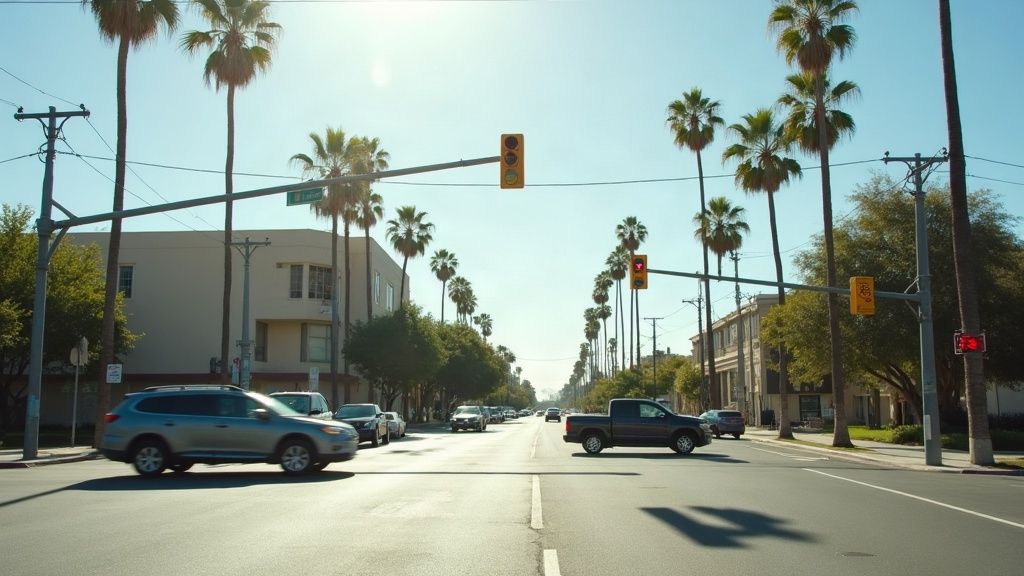
If you were injured in a U-turn crash in California, one of the first questions you're asking is: who is at fault? The answer depends on specific California traffic laws, the evidence at the scene, and whether either driver was doing something they shouldn't have been. Here's what you need to know before you talk to an insurance adjuster or sign anything.
Quick answers:
- U-turning drivers carry an elevated duty of care under California Vehicle Code §22102 and §22103.
- A U-turning driver is often presumed at fault, but the other driver's speed or distraction can shift that.
- Common crash sites include intersections, business districts, and driveways.
- A traffic citation for an illegal U-turn can be used as negligence per se evidence in a civil lawsuit.
- California's pure comparative fault rule means both drivers can share liability.
- U-turn T-bone crashes cause serious injuries including whiplash, brain injuries, and rib fractures.
- The deadline to file most car accident injury claims in California is two years from the date of injury.
- Evidence like dashcam video, traffic cameras, and witness statements is critical to proving fault.
- A personal injury attorney can protect your rights and maximize your recovery.
1. Why U-Turn Accidents Are Treated Differently Under California Traffic Law
Under California Vehicle Code §22102, a driver making a U-turn in a business district must yield to all oncoming traffic and may only complete the turn when it is safe to do so.
California Vehicle Code §22102 covers U-turns in business districts. California Vehicle Code §22103 covers U-turns in residential districts. Both sections require the driver executing the turn to act only when the movement can be made safely, without interfering with other traffic.
This is different from a standard left-turn rule. Ordinary left-turn laws require drivers to yield to oncoming traffic, but U-turns involve a wider, slower arc that blocks a lane for longer. That extended exposure time is why California courts and insurers treat U-turns as a higher-risk maneuver with a corresponding higher standard of care.
Practical takeaway: The legal framework starts with the U-turning driver carrying more responsibility, not less. That matters from the moment you describe the crash to an insurance adjuster.
2. The General Rule That a U-Turning Driver Assumes Extra Duty of Care
California's pure comparative fault rule means that both drivers in a U-turn accident can share liability, and an injured driver's compensation is reduced by their own percentage of fault.
When a U-turning driver causes a crash, California courts apply a heightened duty-of-care analysis. The U-turning driver must have made sure the turn was safe before initiating it. If the evidence shows that a crash occurred during or because of the turn, the burden effectively shifts to the U-turning driver to explain why they were not at fault.
This does not mean the U-turning driver is automatically 100 percent liable. It means they must show affirmative facts, such as the other driver was speeding, ran a red light, or was otherwise negligent, to reduce or eliminate their own share of fault. Without that showing, the default liability finding lands on the driver who made the turn.
Practical takeaway: If you are the driver who made the U-turn, gather every piece of evidence that shows what the other driver was doing before impact. If you are the driver who was struck, document the scene thoroughly, because the law starts on your side.
3. Common Locations Where U-Turn Crashes Happen
U-turn crashes often produce T-bone side-impact collisions, which are among the most dangerous because the vehicle door provides little protection against lateral force.
Most U-turn collisions cluster at specific locations:
- Signalized intersections, Drivers attempt U-turns on green or left-arrow signals, sometimes misjudging the gap in oncoming traffic.
- Business districts, Blocked sight lines from parked delivery trucks, signs, and storefronts make it hard to see approaching vehicles.
- Residential streets, Narrower lanes and parked cars on both sides reduce the turning radius and create blind spots.
- Driveways and parking lot entrances, Vehicles making U-turns to re-enter driveways they missed are moving slowly while oncoming cars maintain speed.
- Highway on-ramps and medians, Some drivers illegally attempt U-turns where posted signs prohibit them entirely.
Location matters because California Vehicle Code §22105 prohibits U-turns where the driver does not have an unobstructed view of at least 200 feet in each direction. If the crash happened at a location with a known sight-line obstruction, that obstruction becomes evidence.
Practical takeaway: Photographs of the crash location taken within hours of the collision, before cars are moved or conditions change, are some of the most valuable evidence in a U-turn case.
4. How the Other Driver's Speed or Distraction Can Shift Fault
If the approaching driver was speeding or running a red light, California's comparative fault system can reduce the U-turning driver's share of liability accordingly.
A U-turning driver is not automatically at fault just because an accident happened. California Civil Code §1714 holds every person responsible for the results of their own negligence. That includes the driver who struck the turning vehicle.
Fault can shift meaningfully when the approaching driver:
- Was exceeding the posted speed limit. A driver traveling 50 mph in a 35-mph zone dramatically shortens the time a U-turning driver has to complete the turn safely.
- Ran a red light or stop sign. If the U-turning driver had a green arrow and the other driver entered the intersection on red, liability may fall primarily on the driver who ran the light.
- Was texting or otherwise distracted. Evidence from cell phone records showing a call or text at the time of impact can establish that the approaching driver failed to maintain reasonable lookout.
- Was driving under the influence. A DUI conviction or blood alcohol content result from the other driver is powerful evidence of negligence.
Practical takeaway: Never assume the other driver was doing nothing wrong simply because you were turning. Request the police report and check whether the officer noted the other driver's speed or any citations issued.
5. Evidence That Supports or Defends a U-Turn Claim
Key evidence in a U-turn accident claim includes traffic camera footage, dashcam video, skid-mark measurements, witness statements, and the police accident report.
Strong U-turn cases are built on specific, time-stamped proof. Here is what to gather or preserve:
- Traffic and surveillance camera footage. California municipalities and many private businesses retain footage for 30 to 90 days. Request it in writing immediately, because it is often overwritten on a rolling schedule.
- Dashcam video. Your own dashcam, the other driver's dashcam, or a nearby commercial vehicle's camera may have captured the crash from a clear angle.
- Skid marks and vehicle positions. Photographs taken at the scene before vehicles are moved document where each car came to rest and the direction of the skid. Accident reconstruction experts use this data to calculate pre-impact speeds.
- Witness statements. Pedestrians, cyclists, and occupants of stopped vehicles often have the clearest view of a U-turn crash. Names and contact information collected at the scene are frequently lost once police disperse traffic.
- Cell phone records. If distracted driving is alleged, your attorney can subpoena the other driver's carrier records to show active data or call use at the time of the crash.
- Police accident report. The DWC and WCAB handle work-injury claims, but for a standard vehicle crash the California Highway Patrol or local police generate a traffic collision report (CHP 555) that documents vehicle positions, damage, citations, and officer observations.
Practical takeaway: Evidence degrades fast. If you can safely do so at the scene, photograph everything and ask bystanders for their contact information before they leave.
6. How a Traffic Citation for an Illegal U-Turn Affects a Civil Claim
A traffic citation for an illegal U-turn can be used as evidence of negligence per se in a California civil lawsuit, creating a presumption that the cited driver was negligent.
If a police officer issues a citation for an illegal U-turn under California Vehicle Code §22102, that citation becomes powerful civil evidence. California applies the negligence per se doctrine: when a driver violates a traffic statute designed to protect other motorists, and that violation causes the kind of harm the statute was meant to prevent, the driver is presumed negligent.
What that means in practical terms:
- The injured party does not have to prove the U-turning driver acted unreasonably. The citation proves it for them.
- The cited driver can still rebut the presumption by showing an excuse recognized under California Evidence Code §669, such as a sudden emergency that was not the driver's own fault.
- The citation does not guarantee a civil judgment. The injured party must still prove damages and causation.
- Paying a traffic fine is often treated as an admission of the underlying violation, which can be used against the driver in a civil proceeding.
Practical takeaway: If you received a citation, do not pay it without speaking to an attorney first. Paying the fine may create an admission that is used against you in a civil lawsuit for much larger damages.
7. Common Injuries from U-Turn Collisions
U-turn crashes frequently produce T-bone and side-impact collisions that cause cervical whiplash, rib fractures, traumatic brain injuries, and knee injuries.
A driver completing a U-turn moves slowly. The vehicle that strikes them is typically traveling at road speed. The result is often a T-bone or side-angle impact, which is one of the most dangerous crash configurations because the door panel and side frame offer far less crush protection than the front or rear of a vehicle.
Common injuries include:
- Cervical whiplash. Lateral force whips the head sideways, straining the muscles, ligaments, and discs of the cervical spine. Symptoms may not appear for 24 to 72 hours after the crash.
- Traumatic brain injury (TBI). When the head strikes the door window, pillar, or an inflating curtain airbag, the brain can sustain a concussion or more severe injury. Even a mild TBI can produce cognitive symptoms lasting months.
- Rib fractures. The seatbelt loads the chest during a lateral impact, and the door may compress inward against the torso. Broken ribs are painful and can take six to eight weeks to heal, limiting work capacity significantly.
- Knee injuries. The knees often strike the door or center console during a side crash, causing meniscal tears, ligament damage, or patellar fractures.
- Shoulder injuries. The shoulder on the impact side absorbs force directly through the door, producing rotator cuff tears or acromioclavicular joint injuries.
Under California Labor Code §3208, injuries that occur while a worker is driving in the course and scope of employment may also trigger a workers' compensation claim in addition to a third-party civil claim.
Practical takeaway: See a doctor on the same day as the crash, even if you feel only mild discomfort. A medical record created at the time of the collision is far stronger evidence than a record created days later.
8. How Comparative Fault Can Split Liability Between Both Drivers
California follows a pure comparative fault rule, meaning a jury can assign any percentage of fault to each driver and reduce the injured party's damages by their own share.
California Civil Code §1714 and the California Supreme Court's decision in Li v. Yellow Cab Co. (1975) established pure comparative fault statewide. Here is how it works in a U-turn accident:
- A jury (or insurance adjuster in a settlement) assigns fault percentages that must add up to 100 percent.
- The injured party's total damages are reduced by their own percentage of fault.
- Example: You were struck by a U-turning driver and suffered $200,000 in medical bills and lost wages. The jury finds the U-turning driver 75 percent at fault and you 25 percent at fault for exceeding the speed limit. You recover $150,000 (75 percent of $200,000).
- Under pure comparative fault, you can recover something even if you were 99 percent at fault, though practically that recovery will be small.
Insurance adjusters use comparative fault aggressively to reduce settlements. If there is any suggestion that the injured driver was speeding or inattentive, the adjuster will use that to cut the offer.
Practical takeaway: Never tell an insurance adjuster that you may have been going too fast or that you did not see the other vehicle coming. Those statements become admissions used to reduce your recovery. Speak with an attorney before giving a recorded statement.
9. When to Consult a Lawyer About a U-Turn Accident Claim
The statute of limitations for most car accident injury claims in California is two years from the date of injury under Code of Civil Procedure §335.1.
Under California Code of Civil Procedure §335.1, you generally have two years from the date of a car accident to file a personal injury lawsuit. Miss that deadline and the court will dismiss your case regardless of how strong the evidence is.
There are situations where you should consult a lawyer immediately, not later:
- Your injuries required emergency care. Medical bills accumulate fast, and insurers begin building a file against you from day one.
- The other driver's insurer contacts you. Adjusters are trained to gather statements and settle claims quickly, before the full extent of injuries is known.
- Fault is disputed. When both drivers blame each other, you need someone who can gather and preserve evidence before it disappears.
- A government vehicle or government-owned road defect was involved. Claims against California government entities require a government tort claim filed within six months under Government Code §911.2, which is far shorter than the standard two-year window.
- The crash happened while you were working. If you were driving for work at the time, you may have both a workers' compensation claim and a third-party personal injury claim. Coordinating those two claims correctly maximizes your total recovery. Visit our personal injury practice area or our workers' compensation practice area to learn how both claims work together.
We've recovered over $150,000,000 for injured clients across Southern California. We handle every case as if it were going to trial, because insurance carriers settle for more when they know the other side is prepared to fight.
Practical takeaway: The free consultation costs you nothing. The evidence you lose while waiting could cost you everything. Call (818) 794-9947 today for a free case review. No fee unless we win.
Frequently Asked Questions
Who is usually at fault in a U-turn accident in California?
The driver making the U-turn is most often found at fault in California because California Vehicle Code §22102 and §22103 require that driver to yield to all oncoming traffic and complete the turn only when it is safe. However, if the approaching driver was speeding, ran a red light, or was distracted, California's pure comparative fault rule allows liability to be shared between both drivers based on their respective percentages of negligence.
Is it illegal to make a U-turn in California?
U-turns are not always illegal in California, but they are prohibited in many specific situations. Under California Vehicle Code §22102, U-turns are restricted in business districts to intersections or openings in a divided highway. Vehicle Code §22105 bans U-turns anywhere the driver cannot see at least 200 feet in each direction. U-turns are also prohibited where a "No U-Turn" sign is posted, on divided highways through openings not designated for turns, and in front of fire stations.
Can you get a ticket and still win a U-turn accident claim?
Yes. A traffic citation for an illegal U-turn is evidence of negligence in a civil lawsuit, but it is not the final word on civil liability. The cited driver can present evidence that the other driver contributed to the crash through speeding, distraction, or running a signal. California's comparative fault system allows the jury to assign percentages of fault to both drivers regardless of who received a citation. If the ticket is successfully challenged or dismissed in traffic court, that outcome can also be introduced as evidence in the civil proceeding.
What evidence helps prove fault in a U-turn crash?
The strongest evidence in a California U-turn accident claim includes traffic camera and dashcam footage, the police traffic collision report noting vehicle positions and any citations, photographs of skid marks and vehicle damage taken at the scene, witness contact information and statements, cell phone records showing distraction, and, where speed is disputed, an accident reconstruction expert's analysis of physical evidence. Preserving this evidence quickly matters because surveillance footage is often overwritten within 30 to 90 days.
Does comparative fault apply if I was the one making the U-turn?
Yes. Under California's pure comparative fault rule, even if you were the U-turning driver and primarily at fault, you can still recover damages from the other driver if that driver also did something negligent, such as speeding or running a red light. Your recovery will be reduced by your own percentage of fault. For example, if you are 80 percent at fault and the other driver is 20 percent at fault, you can still recover 20 percent of your proven damages.
How long do I have to file a lawsuit after a U-turn accident in California?
For most car accident injury claims, California Code of Civil Procedure §335.1 gives you two years from the date of injury to file a lawsuit. If a government-owned vehicle or a defective public road contributed to the crash, you must file a government tort claim within six months of the incident under Government Code §911.2 or you lose the right to sue. These deadlines are strict, and courts rarely grant extensions.
If you've been injured in a U-turn accident in California, every day you wait is a day the evidence gets harder to recover. Call (818) 794-9947 for a free case review. No fee unless we win.