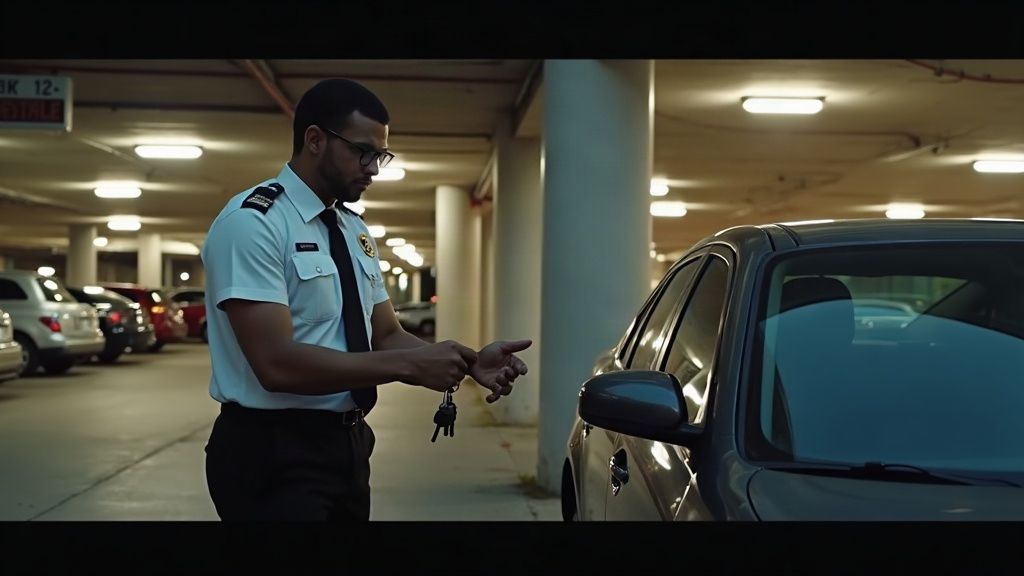
If you've been hurt in a parking structure or by a valet driver in California, you've probably already heard something that isn't quite right. Myths about waivers, liability, and who pays for what circulate constantly, and they cost injured people real money when they walk away from valid claims.
Below are the ten most common misconceptions about valet and parking structure accident claims in California, corrected with the actual law.
Quick-scan summary:
- The valet company is liable for its driver's negligence, not just for "theft."
- Valet claims involve a bailment relationship that standard lot accidents don't.
- Waiver language on your ticket rarely bars an injury claim under California law.
- The property owner can be independently liable for structural hazards.
- Poor lighting, blind ramps, and low clearance are legitimate legal theories.
- Your valet ticket, surveillance footage, and claim slips are critical evidence.
- Signing the claim check to get your car back does NOT release injury claims.
- California's pure comparative fault lets you recover even if you share some blame.
- Car damage and personal injury are two separate tracks with different insurance policies.
- There are specific steps to take immediately after a valet injury, and skipping them hurts your case.
1. Who Is Liable When a Valet Causes a Crash
When a valet driver causes a crash, the valet company is liable for the driver's negligence under the doctrine of respondeat superior, the legal rule that an employer answers for an employee's wrongful act committed within the scope of employment. This applies whether the valet driver scrapes a pillar in the garage, strikes another car on exit, or hits a pedestrian while pulling the vehicle around.
The valet-customer relationship is also a bailment: the company temporarily takes legal custody of your property. Under California law, a bailee (the valet company) owes a duty of reasonable care to the bailor (you), and if the property is returned damaged or someone is hurt in the process, the company must show it exercised that care.
If the valet operates under a contract with a hotel, restaurant, or mall, the property owner may also share liability depending on how much control it exercised over the valet operation. More on that in item 8.
Takeaway: The valet company, not you, carries the burden once they take your keys.
2. How Valet Claims Differ from Standard Parking Lot Accidents
In an ordinary parking lot accident between two drivers, liability is decided the same way as any car crash: police report, insurance carriers, comparative fault. No special duty of care beyond Cal. Lab. Code §3208 (if a worker is involved) or general negligence law applies.
A valet claim is different because the bailment relationship is active the entire time the company has your keys. That means:
- The company has an elevated duty of care for the vehicle itself.
- Any negligence by the valet driver, not just a collision, can trigger liability.
- The claim can involve the valet company's commercial general liability policy AND its commercial auto policy.
- The written valet agreement (on the ticket) becomes a contract document, subject to California contract and tort law.
The practical difference: valet victims often have more legal leverage than they realize, because the company cannot simply say "we don't know what happened."
Takeaway: A bailment is a legally recognized custody relationship, and it shifts the burden of proof toward the valet company.
3. What Valet Liability Waivers Actually Cover, and What They Don't
The small print on most valet tickets says something like "not responsible for damage to vehicles or personal property." California courts routinely refuse to enforce such clauses when the company's own negligence caused the harm.
California Civil Code §1668 provides that all contracts that exempt a party from responsibility for their own fraud, willful injury to another person, or violations of law are void as against public policy. Courts have extended this principle broadly: a disclaimer cannot function as a license to behave negligently and then escape the consequences.
Even where a waiver is not flatly void under §1668, California courts apply a multi-factor test before enforcing any pre-injury release of negligence. For a valet disclaimer to be enforceable, it would typically need to:
- Be clear and unambiguous about what rights are being waived.
- Be presented so the customer had a genuine opportunity to read it.
- Not violate public policy given the nature of the transaction.
A printed line on the back of a ticket handed to you at the curb rarely satisfies any of these factors.
Takeaway: Waiver language on a valet ticket does not prevent you from pursuing an injury or damage claim under California law.
4. Premises Liability Issues Specific to Parking Structures
A parking structure's owner or operator owes every lawful visitor a duty of reasonable care under California Civil Code §1714. This is the foundational premises liability statute in California, and it applies to hotels, malls, hospitals, and any other property where parking structures are maintained.
Parking structures create hazards that open-air lots do not:
- Enclosed ramps where pedestrians and vehicles share the same narrow path.
- Structural deterioration that produces cracked or uneven walking surfaces.
- Drainage failures that leave standing water on driving and walking lanes.
- Automatic gate malfunctions that can strike pedestrians or vehicles.
- Noise levels that prevent drivers and pedestrians from hearing each other.
The owner is liable when it knew or should have known about a dangerous condition and failed to repair it or warn visitors. A prior incident report, a maintenance log showing a known hazard, or a building code violation are all evidence that puts the owner on constructive notice.
Takeaway: The property owner can be independently liable for structural hazards, separate from any claim against the valet company.
5. Common Hazards: Low Clearance, Poor Lighting, Blind Ramps
Three physical features of parking structures generate a disproportionate share of injury claims in California:
Low overhead clearance. Structures built decades ago often do not accommodate the height of modern SUVs and trucks. A driver who cannot safely navigate the structure because the clearance is inadequate, and is not clearly warned, may have a claim against the property owner.
Poor lighting. The Illuminating Engineering Society publishes minimum footcandle recommendations for parking structures. When a garage falls materially below those standards and a pedestrian trips, falls, or is struck because a driver could not see them, inadequate illumination is a direct theory of liability.
Blind ramps. Curved entry and exit ramps with no visibility mirrors and no warning signage are a known hazard. If a driver coming down a ramp cannot see pedestrians at the bottom, and no warning system exists, that is a condition the owner should have addressed.
Each of these hazards requires evidence that the owner had notice of the problem and failed to act. Photographs, maintenance records, and expert testimony on engineering standards build that proof.
Takeaway: Document every physical condition at the scene immediately, poor lighting and design defects are provable claims against the property owner.
6. Evidence to Gather: Valet Tickets, Surveillance Footage, Claim Slips
Evidence preservation is time-sensitive. Here is what matters most:
Valet ticket. This is your proof of the bailment. It shows the time of drop-off, the location, and often the attendant's name or code. Do not surrender it without keeping a photo copy.
Surveillance footage. Parking structures are among the most heavily surveilled commercial properties in California. Camera footage typically overwrites on a 30- to 72-hour loop. A written demand to preserve surveillance footage, sent to the property owner and the valet company on the day of the incident, is critical. An attorney can send a formal litigation hold letter that prevents spoliation.
Written claim slip. If the valet company asked you to complete a damage report, keep your copy. What you write on that form can affect your claim, so do not admit fault or downplay injuries.
Photographs. Photograph your vehicle, any visible damage to the structure, the lighting conditions, any posted signage (or the absence of it), and any visible injuries to your person.
Witness information. Other valets, bystanders, and other drivers are witnesses. Collect names and phone numbers before leaving.
Medical records. Seek treatment the same day if you are hurt. A gap in treatment is a gap in your case.
Takeaway: Send a written preservation demand for surveillance footage immediately, waiting even 48 hours can mean that footage is gone.
7. The Myth That Signing a Valet Claim Check Waives Your Injury Rights
This is one of the most persistent myths, and it costs injured people real compensation.
When you sign the claim check to retrieve your vehicle, you are acknowledging that you received the car. You are NOT signing a release of legal claims. Under California law, a valid release of tort claims requires:
- A clear, explicit statement of what rights are being waived.
- Adequate consideration (something of value exchanged for the release).
- A knowing and voluntary agreement to waive those rights.
A claim check at a valet stand satisfies none of these requirements. Courts treat it as a delivery receipt, not a legal settlement. If a valet company ever tells you that signing the claim check closed your case, that statement is inaccurate.
Takeaway: Sign the claim check to get your car, then contact an attorney, your legal rights are intact.
8. How Fault Is Split Between the Valet Company and the Property Owner
California follows a system of pure comparative fault, established in Li v. Yellow Cab Co., 13 Cal.3d 804 (1975), and codified in California Civil Code §1714. Under this rule, a jury can assign a percentage of fault to each party whose negligence contributed to the harm, and the plaintiff recovers damages reduced by their own percentage of fault, if any.
In a typical valet-plus-parking structure case, fault might be distributed among:
- The valet driver (directly negligent act).
- The valet company (respondeat superior, negligent training, inadequate supervision).
- The property owner (dangerous condition of the premises, failure to maintain, failure to warn).
- In some cases, a vehicle manufacturer (if a mechanical defect contributed).
The valet company and the property owner may each carry separate insurance policies, and both can be named as defendants. The practical benefit to an injured person is that multiple solvent defendants increase the likelihood of full recovery.
Takeaway: Name every party whose negligence contributed to your injury, California's comparative fault system allows recovery from each, proportionate to their share of responsibility.
9. What Happens If Your Car Is Damaged Versus If You're Actually Injured
These are two separate legal tracks:
Vehicle damage. A damage-only claim proceeds under the bailment relationship and is typically submitted to the valet company's commercial auto insurer. The company's liability for the vehicle is relatively well-established once you prove the damage occurred during their custody. This track resolves faster and does not require a lawsuit in most cases.
Personal injury. If you are hurt, whether struck by the valet vehicle, injured in a fall caused by a structural hazard, or hurt as a passenger during a valet-caused collision, you have a personal injury claim. That claim can include:
- Past and future medical expenses.
- Lost wages and loss of future earning capacity.
- Pain and suffering.
- Emotional distress.
Personal injury claims involve different policy limits, different adjusters, and a different valuation process. The insurance carrier handling your car damage has no authority over your injury claim and cannot close it.
Takeaway: Do not let a quick vehicle-damage settlement close your injury claim, they are different claims under different policies, and you have the right to pursue both.
10. Steps to Take If You're Hurt in or by a Valet-Operated Vehicle
Follow these steps in order to protect your health and your claim:
1. Call 911. Even in a low-speed parking structure collision, a police report creates an official record that is far more useful than a valet company's internal incident form.
2. Keep your valet ticket. Photograph it immediately and keep the original. This is your proof of bailment.
3. Do not sign any release. The valet company may present paperwork in the moments after an incident. Do not sign anything beyond an acknowledgment that you received your vehicle.
4. Request insurance information. Ask the valet company for the name of their commercial general liability carrier and commercial auto carrier.
5. Photograph everything. The vehicle, the scene, the lighting, the ramp geometry, any posted signs, and any visible injuries.
6. Get medical care the same day. Adrenaline masks pain. What feels like soreness at the scene can be a soft-tissue injury or, in a more serious collision, a head injury. Document your condition promptly.
7. Send a preservation demand for surveillance footage. Do this in writing, that day, to both the property owner and the valet company. An attorney can send a formal litigation hold letter if you act quickly.
8. Contact a personal injury attorney before speaking with any adjuster. Insurance adjusters, even friendly ones, are documenting what you say. An attorney protects your right to maximum compensation before you say anything that can be used to reduce your recovery.
California's general personal injury statute of limitations is two years from the date of the incident under Cal. Code Civ. Proc. §335.1. If the parking structure or valet operation is run by a government entity, a city-owned garage or a public hospital valet, a shorter government tort claim deadline applies under Cal. Gov. Code §911.2. Missing these deadlines eliminates your right to recover.
Takeaway: Speed matters. Preserve evidence the same day, get medical care, and contact an attorney before the insurance company shapes the narrative.
When a valet driver crashes your car, the valet company is typically liable under respondeat superior, the legal rule that holds an employer responsible for an employee's negligent acts on the job.
California Civil Code §1668 means a boilerplate valet waiver rarely prevents you from recovering for injuries caused by the company's own negligence.
Property owners of parking structures owe every lawful visitor a duty of reasonable care under California Civil Code §1714, and they can be held liable for hazards like broken lighting, unmarked ramps, and crumbling concrete.
Signing the claim check when you retrieve your car does not release the valet company from liability for injuries or damage that occurred while they had custody of your vehicle.
California uses a pure comparative fault system, so fault can be split among the valet company, the property owner, and anyone else whose negligence contributed to your injury.
A valet ticket is legal proof of the bailment, it establishes when and where the company took custody of your vehicle, which is critical evidence in any valet accident case.
Frequently Asked Questions
Is a valet company liable if they crash my car in California?
Yes. When a valet driver causes a collision or damage while your vehicle is in their custody, the valet company is liable under respondeat superior, which holds employers responsible for their employees' negligent acts performed within the scope of employment. The valet-customer relationship also creates a bailment, which independently obligates the company to exercise reasonable care.
Do valet waivers really protect against injury claims?
Rarely. California Civil Code §1668 voids contractual clauses that attempt to exempt a party from liability for their own negligence in many circumstances. Boilerplate disclaimer language printed on a valet ticket, especially when it was never clearly presented to you before the transaction, is unlikely to bar your injury or damage claim.
Who is responsible for accidents inside a parking garage?
Responsibility depends on the facts. The valet company is liable for its drivers' negligence. The property owner is liable for structural hazards under California Civil Code §1714. Both can be liable at the same time, with fault apportioned by the jury under California's pure comparative fault system.
Can I sue a mall or hotel for a valet accident?
Yes, if the property owner's negligence contributed to the harm. A property owner who contracts with a valet company and retains control over the premises remains subject to premises liability for dangerous conditions on the property, inadequate lighting, deteriorated pavement, blind ramps, or malfunctioning gates.
Does signing the claim check when I pick up my car close my legal claim?
No. Signing the claim check is an acknowledgment that you received your vehicle, not a release of legal claims. A valid legal release requires a clear statement of what rights are being waived, adequate consideration, and a knowing and voluntary agreement, none of which a standard valet claim check provides.
What is the deadline to file a parking structure injury claim in California?
For a claim against a private party, the general personal injury statute of limitations is two years from the date of injury under Cal. Code Civ. Proc. §335.1. If a government entity owns or operates the parking structure, you must present a government tort claim within six months of the incident under Cal. Gov. Code §911.2 before you can file a lawsuit. Missing either deadline bars your claim.
What evidence is most important in a valet accident case?
The three most critical pieces of evidence are the valet ticket (proof of bailment and custody), surveillance footage from the structure's cameras (which overwrites quickly, preserve it in writing the same day), and any written claim slip completed at the scene. Photographs, witness contact information, and same-day medical records are also essential.
If you've been hurt in a parking structure or by a valet-operated vehicle anywhere in Southern California, the clock on your evidence is already running. Call (818) 794-9947 for a free case review. No fee unless we win.
We've recovered over $150,000,000 for injured Californians, and we handle every case as if it were going to trial, because insurance companies pay more when they know the other side is prepared to fight.
Your Injury. Your Rights. Our Fight.
Reviewed by Minas Nordanyan, CA Bar #296806. Last updated 2026-10-06. This article is for general information only and does not constitute legal advice. The facts of your specific incident determine your rights.