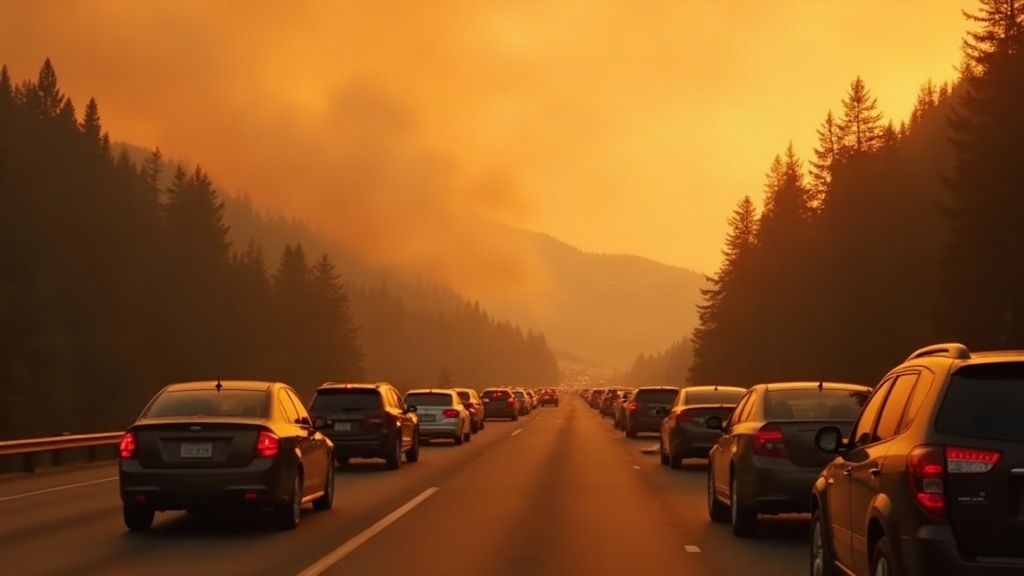
If you were in a car accident while fleeing a California wildfire evacuation zone, you are dealing with a situation most drivers, insurers, and even some attorneys have never encountered. The roads are choked. Smoke cuts visibility to almost nothing. Evacuees are panicked. And once the chaos clears, the question becomes: who is responsible?
This guide answers that question under California law, section by section. It covers driver negligence, government agency liability, insurance coverage, and the deadlines that can end your claim before it starts.
If you were hurt in an evacuation crash, call (818) 794-9947 for a free consultation. No fee unless we win.
Quick-Answer Summary
- A wildfire evacuation does not suspend the rules of the road. Drivers still owe each other a duty of care under Cal. Civ. Code §1714.
- Smoke, ash, and gridlock are circumstances, not excuses. A driver must adjust their speed and following distance to match visibility conditions.
- If a poorly maintained or negligently managed road contributed to the crash, the responsible public agency may share liability.
- Government claims require a separate notice filed within six months. Missing that window usually bars your lawsuit entirely.
- California is a pure comparative fault state. You can recover even if you were partially at fault.
- Your auto insurance policy very likely covers an evacuation crash. Wildfire damage to a parked vehicle is a separate issue covered under comprehensive.
- Document everything you safely can, even if the scene has to be abandoned quickly.
Why Evacuation-Zone Crashes Create Unusual Liability Questions
A mandatory wildfire evacuation creates road conditions that almost never exist under normal circumstances: extreme traffic density, panic-driven behavior, smoke reducing visibility to a few car lengths, ash on the pavement, and emergency vehicles weaving through lanes. Drivers are stressed, navigation apps are routing everyone onto the same two-lane roads, and intersections go dark when power lines burn down.
None of that changes the legal foundation. Under Cal. Civ. Code §1714, every person is responsible for their own negligence and for the resulting harm to others. That standard does not pause during a declared emergency. What it does do is shift what a "reasonable person" would have done in those exact conditions. A reasonable person driving through 100-foot visibility smoke is expected to slow significantly below the posted limit, increase following distance, and use hazard lights. A driver who does none of that and rear-ends the car in front of them is likely negligent, emergency or not.
What makes evacuation crashes unusual is that the pool of potential defendants is broader than a typical two-car collision. It can include:
- The other driver, under ordinary negligence principles.
- A government agency, if a road hazard, missing sign, or failure to open an alternate route contributed.
- A utility company, if downed power lines or debris created the specific hazard that caused the crash.
- An employer, if the driver was on the clock when the crash occurred.
Identifying all of them quickly matters, because each one has a different deadline.
How Panic, Congestion, and Low Visibility Affect the Standard of Care
California courts measure driver conduct against what a reasonably prudent person would do under the same conditions. That standard is flexible by design. The same speed that is safe on a clear freeway is negligent in evacuation smoke.
Cal. Veh. Code §22350 codifies this directly. Known as the Basic Speed Law, it states that no person shall drive at a speed greater than is reasonable or prudent, having due regard for the weather, visibility, traffic, and road conditions. This statute gives attorneys and juries a concrete hook when arguing that a driver should have slowed during an evacuation, regardless of what the posted sign said.
Specific behaviors that commonly generate fault in evacuation crashes:
- Tailgating in stop-and-go traffic. When evacuation routes are gridlocked, following distances shrink and tempers rise. A driver who stays two car lengths behind in bumper-to-bumper conditions is exercising reasonable care. One who rides the bumper of the car ahead until a sudden stop causes a collision is not.
- Failing to use headlights in smoke. Under Cal. Veh. Code §24400, headlights are required when visibility is 1,000 feet or less. Smoke routinely reduces visibility far below that threshold during major fires. A driver without lights in those conditions has violated a traffic statute, which is evidence of negligence per se.
- Illegal passing or lane changes. Panic often drives people to cut across lanes or use shoulders. Those maneuvers carry the same legal consequences during an evacuation as on any other day.
- Driving into dense smoke at speed. Courts have found drivers negligent for entering a zone of known, obvious danger at unsafe speeds. If smoke is visibly thick and a driver does not reduce speed, that failure is actionable.
Smoke-reduced visibility is a recognized factor in fault analysis. A driver who fails to slow to a safe speed for conditions can be found negligent even if the posted speed limit is higher.
Comparing Driver Negligence Versus Dangerous-Condition Claims Against Public Agencies
Evacuation routes are, by definition, public roads managed by government agencies. Cal. Gov. Code §835 (the Government Claims Act) allows injury victims to sue a public entity if a dangerous condition of public property caused the injury, the public entity had notice, and the risk created a reasonably foreseeable risk of the kind of harm that occurred.
In a wildfire evacuation context, potential dangerous-condition claims include:
- Failure to open alternate routes or contraflow lanes in time, leaving evacuees funneled onto roads too narrow for the volume of traffic, and a bottleneck causing a rear-end pileup.
- Missing or damaged road signs that caused drivers to misjudge intersections or turns.
- Pre-existing pavement hazards (potholes, unmarked construction zones) that become collision factors when drivers swerve to avoid debris.
- Negligent signal management, such as leaving traffic lights in normal cycle mode when they should have been switched to flashing or manual control.
These claims are harder to win than standard driver-negligence claims, but they are real. The critical point is that government liability comes with a separate and much shorter deadline.
If a dangerous road condition on a public road contributed to your evacuation crash, you may have a claim against the responsible government agency, but you must file a government tort claim within six months of the incident.
Special Deadlines and Notice Rules When a Government Entity May Be Involved
This section is worth reading carefully because the government claim deadline is a hard bar. Miss it, and your lawsuit against the agency is almost certainly over before it starts.
Under Cal. Gov. Code §911.2, a claim for personal injury against a public entity must be presented within six months of the date of the incident. This is not a statute of limitations in the traditional sense. It is a notice prerequisite. You cannot file a lawsuit against Caltrans, a county road department, or a city without first presenting a timely government tort claim.
Compare that to the standard personal injury statute of limitations for claims against private defendants: two years from the date of injury under Cal. Code Civ. Proc. §335.1.
If a government entity may share responsibility for your evacuation crash, you are operating on two simultaneous clocks:
- Six months from the crash date to file the government tort claim with the correct agency.
- Six months from a denied government claim to file suit against the agency.
An attorney needs to analyze whether a government entity is potentially liable as early as possible. If you wait a year to call a lawyer because you assumed the other driver was solely responsible, and then discover a road defect contributed, the government claim window may already be closed.
If a government entity is involved in your evacuation crash claim, you must file a government tort claim within six months of the incident or risk losing your right to sue entirely.
Smoke, Ash, and Reduced-Visibility Factors in Fault Determinations
Insurance adjusters and defense attorneys will sometimes argue that an evacuation crash was an "act of God" or an unforeseeable event that no driver could have prevented. California law does not support that framing cleanly.
An act of God defense requires that the event was both unforeseeable and entirely outside human control. A wildfire that has been burning for three days and generating evacuation orders is, by definition, known. The smoke conditions on the evacuation routes are known. Drivers and agencies with advance notice of those conditions are expected to respond to them. The act-of-God defense is essentially unavailable when the hazard was disclosed to everyone on those roads.
What smoke and ash DO affect is how courts and juries allocate fault. A driver who rear-ended you while both of you were driving through zero-visibility smoke may carry less than 100% of the fault if you, too, were traveling faster than conditions warranted. That is where California's pure comparative fault system becomes relevant.
Under Cal. Civ. Code §1431.2, each defendant is responsible for their proportionate share of non-economic damages. And under the broader comparative fault framework established in Li v. Yellow Cab Co. (1975) 13 Cal.3d 804, a plaintiff's recovery is reduced by their own percentage of fault. If you were 20% at fault because you, too, were driving too fast for the smoke conditions, your recovery is reduced by 20%.
California's comparative fault rule means that even if you were partly at fault for an evacuation crash, you may still recover damages reduced by your share of responsibility.
This is not an argument to avoid. It is an argument to manage through proper documentation of what the road conditions actually were, what speeds the vehicles were traveling, and what each driver knew at the time.
Insurance Considerations When Fleeing a Declared Emergency Area
One of the first questions injured evacuees ask is whether their auto insurance covers what happened. The general answer is yes, with important distinctions.
Liability coverage: If the other driver caused the crash, you pursue their liability insurance. The emergency context does not trigger a coverage exclusion. Standard California auto liability policies do not contain evacuation carve-outs.
Collision coverage: If you carry collision coverage on your own policy, it covers damage to your vehicle from the crash regardless of who was at fault, minus your deductible.
Comprehensive coverage: This is the coverage that applies to wildfire damage to a parked vehicle, such as a car that burned when you could not reach it in time. Comprehensive is a separate line item from collision. If you dropped comprehensive to save money and your car burned, the auto policy does not pay for that loss.
Uninsured/underinsured motorist (UM/UIM): If the driver who hit you was uninsured, or their policy limits are too low to cover your injuries, your own UM/UIM coverage steps in. California requires insurers to offer UM/UIM coverage, though policyholders can reject it in writing. Check your declarations page.
Workers' compensation: If you were driving as part of your job duties when the evacuation crash happened, your injuries may also qualify as a work injury under Cal. Lab. Code §3600. That could mean workers' comp benefits in addition to a third-party auto claim against the at-fault driver. The two systems can run simultaneously. See our workers' compensation practice area for more on how that works.
Standard California auto insurance policies generally cover accidents during wildfire evacuations because the evacuation itself is not a standard policy exclusion.
One additional issue: insurers sometimes attempt to invoke a "war or civil unrest" exclusion for disaster-related claims. California wildfires do not qualify as war or civil unrest. That argument has no basis in standard California policy language and should be challenged immediately if an adjuster raises it.
Documenting an Evacuation-Related Crash When Scenes Are Chaotic
The standard car accident documentation checklist assumes a stable scene. An evacuation crash does not offer that. Fires may be approaching. CHP or local law enforcement may be directing traffic rather than taking accident reports. You may need to leave the scene to reach safety.
That does not eliminate your ability to document and claim. Here is how to protect your case under difficult conditions:
Do what you safely can at the scene. If you can stop without endangering yourself or others, photograph the vehicles, the road, the smoke, any traffic control devices, and the surrounding conditions. A photograph of the sky showing smoke density at the time of the crash is powerful evidence of the visibility conditions.
Exchange information if at all possible. Name, license, insurance card, and license plate number. If the other driver refuses and law enforcement is not available, photograph their plate before leaving.
Report to law enforcement as soon as it is safe. Under Cal. Veh. Code §20008, if a crash results in injury or death, the driver must report it to local law enforcement or CHP as soon as it is reasonably possible. Do not delay this step once you are out of the danger zone.
Seek medical care promptly. Adrenaline during an evacuation masks pain. Injuries that feel minor in the moment can prove serious days later. Medical records establishing the connection between the crash and your injuries are foundational to any claim. A gap in treatment is an argument the insurance carrier will use against you.
Preserve your own records. Save any emergency alerts, evacuation orders, news reports, and air quality notices from the date of the crash. These establish the conditions that existed and can support your account of what visibility was like.
Write down what you remember. As soon as you are safe, write a detailed account of what happened: the route you were on, the approximate time, what you could see, what the other vehicle did, where you were going. Memories fade, and a contemporaneous written account is admissible evidence.
Comparing Driver Negligence Versus Government Agency Claims: A Summary
| Situation | Potential Defendant | Key Law | Deadline |
|, |, |, |, |
| Other driver's negligence caused the crash | At-fault driver (and their insurer) | Cal. Civ. Code §1714 | 2 years from crash (Cal. Code Civ. Proc. §335.1) |
| Road defect or missing sign contributed | City, county, or Caltrans | Cal. Gov. Code §835 | 6 months to file government tort claim (Cal. Gov. Code §911.2) |
| You were working when the crash happened | Employer (workers' comp) + at-fault driver | Cal. Lab. Code §3600 | 1 year to file WC claim (Cal. Lab. Code §5405) |
| At-fault driver had no insurance | Your own UM/UIM insurer | Insurance contract | Per policy terms; notify promptly |
FAQ
Who is liable for a car accident during a mandatory wildfire evacuation in California?
Liability depends on the specific facts. The at-fault driver is the most common defendant, held to the ordinary reasonable-person standard under Cal. Civ. Code §1714. If a dangerous road condition contributed, the responsible government agency may share liability under Cal. Gov. Code §835. If a utility company's downed lines created the hazard, they may be liable as well. Multiple defendants are possible.
Does smoke-reduced visibility change who is at fault in a California car accident?
Smoke does not eliminate fault, but it shapes what a reasonable driver should have done. Under Cal. Veh. Code §22350, drivers must travel at a speed that is safe for actual visibility conditions, not just the posted limit. A driver who ignores smoke and drives at normal highway speed may be found negligent even if the other vehicle did something unexpected.
Can I sue a government agency over an evacuation route crash in California?
Yes, if the public agency's negligent design, maintenance, or management of the road contributed to the crash. The process starts with a government tort claim under Cal. Gov. Code §911.2, which must be filed within six months of the incident. If the agency denies the claim, you then have six months to file suit.
Does my auto insurance cover an accident that happens while I am evacuating a wildfire zone?
Generally, yes. Liability, collision, and UM/UIM coverages apply to crashes during evacuations in the same way they apply to any other crash. The emergency does not trigger standard exclusions. Wildfire damage to a parked vehicle that burned is a different matter, covered only under comprehensive.
What if the other driver fled the scene during the evacuation?
A hit-and-run during an evacuation is handled like any other hit-and-run in California. Report the incident to law enforcement as soon as safely possible under Cal. Veh. Code §20008. Your own uninsured motorist coverage may compensate you for your injuries. Photograph the vehicle's plate before it leaves if you can do so safely.
How does California's comparative fault rule affect an evacuation crash claim?
California follows pure comparative fault. Under Li v. Yellow Cab Co. and Cal. Civ. Code §1431.2, your damages are reduced by your own percentage of fault. If a jury finds you 25% at fault for driving too fast in the smoke and the other driver 75% at fault, you recover 75% of your total damages. You are not barred from recovery just because you share some responsibility.
What is the deadline to file a personal injury lawsuit after a wildfire evacuation crash?
If the defendant is a private individual or company, the standard statute of limitations is two years from the date of injury under Cal. Code Civ. Proc. §335.1. If a government agency is involved, you must file a government tort claim within six months of the incident as a prerequisite to suing. Missing the government claim deadline can permanently bar your lawsuit against that agency.
Should I accept the first settlement offer from the insurance company after an evacuation crash?
Do not accept any settlement offer before speaking with an attorney. First offers typically do not account for the full value of your injuries, future medical treatment, or lost wages. Signing a release closes your claim permanently, even if your injuries prove more serious than they appeared at first. Call (818) 794-9947 for a free review of any offer you have received.
What if I was driving for work purposes when the evacuation crash happened?
If you were driving as part of your job duties at the time of the crash, you may have both a workers' compensation claim for your injuries and a personal injury claim against the at-fault driver. The two claims can run simultaneously. Workers' comp covers your medical bills and a portion of lost wages regardless of fault. The personal injury claim pursues full compensation from the at-fault driver. See our workers' compensation practice area page for how these interact.
What documentation should I gather after an evacuation crash?
Gather everything you safely can at the scene: photos of vehicles, road conditions, smoke, and traffic signs. Exchange insurance and driver information with the other party. Report the crash to law enforcement as soon as safely possible. Keep all emergency alerts, evacuation orders, and news reports from that date. Seek medical care promptly and preserve all medical records.
The Bottom Line
Car accidents during California wildfire evacuations involve overlapping legal systems, shortened government deadlines, insurance coverage questions, and fault analysis that must account for conditions most adjusters have never handled before. The ordinary rules still apply, but the facts are anything but ordinary.
If you were hurt in an evacuation crash, the deadlines start running immediately, especially if a government agency may bear any responsibility. Six months passes faster than you expect when you are recovering from injuries and trying to rebuild after a disaster.
We've recovered over $150,000,000 for injured Californians across a range of cases. We handle every case as if it were going to trial, because that preparation is exactly what changes the number an insurance carrier is willing to offer.
Call (818) 794-9947 for a free consultation. No fee unless we win. Available in English and Spanish.
Reviewed by Minas Nordanyan, CA Bar #296806. This article is for general informational purposes and does not constitute legal advice. The facts of your specific case govern the outcome. Contact a licensed California attorney to evaluate your situation.