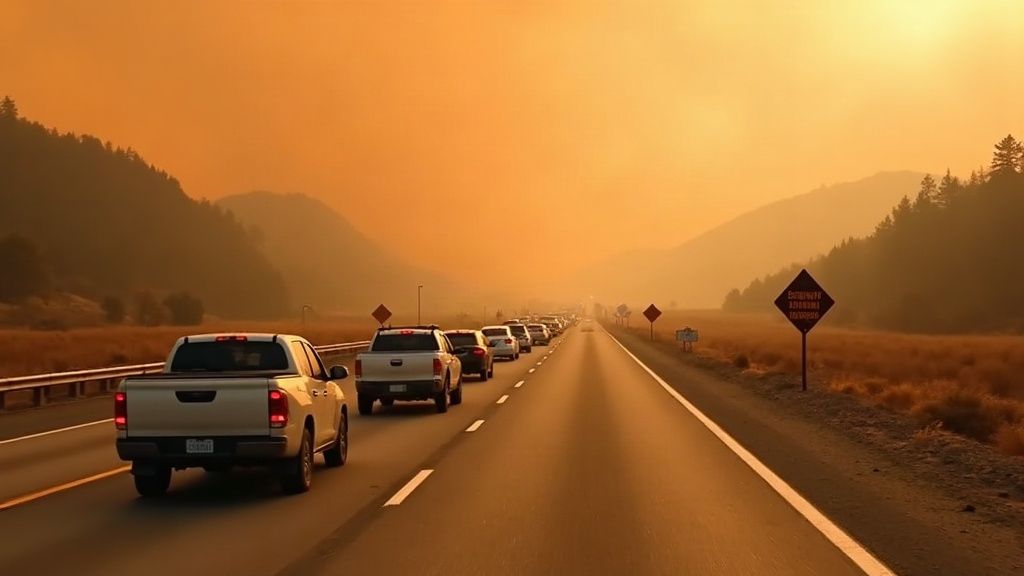
If you've been in a car accident during a California wildfire evacuation, you're dealing with two crises at once. You were already fleeing danger when the crash happened, and now you have injuries, a damaged vehicle, and questions about who pays. California law still provides a path to compensation, but evacuation crashes come with specific legal complications that ordinary collision claims don't have.
Here are nine questions that injured drivers, passengers, and families ask after evacuation-related crashes, answered with the statutes and practical steps that actually matter.
Quick answers, what this article covers:
- Why evacuation crashes have increased with California's fire seasons
- The most common causes: smoke, panic, and stopped traffic
- Who can be held legally responsible
- When a government agency might share liability
- How comparative fault works in emergency conditions
- Insurance coverage issues specific to disaster evacuations
- How to document a crash when everything is chaotic
- The steps to take immediately after an evacuation injury
- When and why to consult a personal injury attorney
1. Why Evacuation-Related Crashes Have Become More Common
California wildfires have grown dramatically in scale and speed, and mass evacuations are now a recurring part of life in Southern California, the Central Valley, and the Sierra Nevada foothills. When a fire moves fast, tens of thousands of residents receive evacuation orders at the same moment.
The result is predictable: high-volume vehicle traffic funneled onto roads that were never designed for emergency capacity. State and county evacuation routes are often two-lane rural highways with no shoulders, steep grades, and limited lighting. In a large evacuation, those roads fill to a standstill within minutes. Add smoke, darkness, and drivers who are frightened and unfamiliar with the route, and the collision risk rises sharply.
The DWC and DIR have documented wildfire-related injuries across multiple industries, and California's workers' compensation system has expanded presumptions for first responders injured during wildfire events. But civilian evacuation crash injuries fall primarily under personal injury law, not workers' comp, unless the injured person was driving as part of their job duties.
Takeaway: The same conditions that make wildfires more dangerous also make evacuation routes more dangerous. The legal system has not kept pace with that reality, which is why knowing your rights matters.
2. Common Causes: Smoke, Panic, and Gridlocked Roads
The three most consistent contributors to evacuation crashes are reduced visibility from smoke, driver panic leading to sudden maneuvers, and the stop-and-go dynamics of gridlocked evacuation corridors.
Smoke visibility: Wildfire smoke can reduce visibility to near zero within minutes, even on highways miles from the fire line. A driver who continues at unsafe speeds in smoke conditions can be found negligent under California's basic speed law (Cal. Veh. Code §22350), which requires a speed safe for current conditions regardless of posted limits.
Panic driving: Abrupt lane changes, failure to yield, running stop signs or red lights at intersections, and driving on the wrong side of the road to bypass traffic are all documented evacuation behaviors. Each one is a potential basis for a negligence finding.
Gridlock rear-ends: When thousands of cars are moving at five miles per hour and then stopping suddenly, rear-end collisions become highly predictable. Under California law, a driver who strikes the car in front of them bears a presumption of negligence, though that presumption can be rebutted.
Takeaway: The cause of the crash determines who is liable. Documenting what happened, how visibility was, and what the roads looked like is essential to connecting a specific driver's conduct to your injuries.
3. Who Can Be Liable in an Evacuation Traffic Accident
Liability in an evacuation crash follows the same legal framework as any California personal injury case: the party whose negligence caused or contributed to your harm is financially responsible for your damages.
Potential liable parties include:
- Another driver who was speeding, distracted, or making reckless maneuvers in the evacuation corridor
- The vehicle's owner, if the at-fault driver was not the registered owner and was driving with permission (Cal. Veh. Code §17150 imposes liability on owners who permit another person to drive)
- An employer, if the at-fault driver was operating a commercial vehicle or was on the clock during the evacuation
- A government agency, if negligent traffic control or road management contributed to the crash (discussed in item 4 below)
California law does not create a special exemption from negligence liability because a driver was frightened or acting under emergency pressure. An evacuation is not a legal defense to running into another car. Courts apply the ordinary reasonable-person standard, adjusted for the actual conditions the driver faced.
Takeaway: Emergency conditions narrow the space for reasonable driver behavior, but they do not eliminate it. Identifying every potentially liable party is one of the first things an attorney does in an evacuation crash case.
4. How Road Closures and Government Agencies Factor In
Government agencies, including Caltrans, county departments of public works, and local law enforcement, control evacuation route management. When those agencies act negligently and that negligence contributes to a crash, they can be held liable under Cal. Gov. Code §815.2, which holds public entities vicariously liable for employee negligence within the scope of employment.
Examples of potential government negligence in evacuation contexts include inadequate warning signs, failure to staff intersections during a known high-volume event, poorly timed traffic signal changes, or road closure decisions that forced vehicles into an unsafe single-lane corridor without proper traffic control.
However, government liability comes with strict procedural requirements. Under the California Tort Claims Act (Cal. Gov. Code §911.2), you must file a written government tort claim with the responsible agency within six months of the incident. This is not the lawsuit itself. It is a mandatory pre-filing notice. Miss it, and you lose your right to sue the government entity, full stop.
Government agencies also have defenses available that private defendants do not, including design immunity for road features that were approved in advance and discretionary function immunity for policy-level decisions about how to conduct an evacuation. Whether those defenses apply depends on the specific facts.
Takeaway: If a government agency's conduct contributed to your evacuation crash, the six-month government tort claim deadline under Cal. Gov. Code §911.2 is the most urgent deadline in your case. Do not wait.
5. Comparative Fault Considerations in Emergency Conditions
California follows a pure comparative fault rule. This means your compensation is reduced by whatever percentage of fault is attributed to you, but you can still recover something even if you were 99% at fault. No California court bars your recovery entirely because you shared some responsibility.
In evacuation crash cases, comparative fault arguments tend to focus on:
- Whether you were following too closely in stop-and-go traffic
- Whether you were driving faster than conditions allowed given smoke visibility
- Whether you made a lane change or turn without signaling
- Whether you had an opportunity to avoid the collision and failed to take it
The emergency situation does not shield you from a comparative fault finding, but it does provide context. A driver who was navigating a completely smoke-obscured road will be judged against what a reasonable driver would have done in that same smoke. The standard is relative to the conditions, not to a clear-day driving norm.
Takeaway: Your percentage of fault directly reduces your recovery. Preserving evidence that shows what the conditions actually were, and what any reasonable driver would have done, is how you manage a comparative fault defense against your claim.
6. Insurance Issues That Come Up During Disaster Evacuations
Standard California auto insurance policies cover crashes during evacuations the same way they cover any other collision. There is no blanket "natural disaster" or "act of God" exclusion that cancels another driver's liability coverage or your own collision coverage simply because the crash happened during a wildfire event. The fire did not cause the crash. Another driver's negligence did.
That said, specific insurance disputes frequently arise in evacuation crash cases:
Underinsured drivers: As of January 1, 2025, California's minimum bodily injury liability limits are $30,000 per person and $60,000 per occurrence under Cal. Veh. Code §16056, revised by SB 1107. For a serious injury requiring surgery, hospitalization, or extended treatment, those limits may be exhausted quickly. If the at-fault driver's policy is insufficient, your own uninsured/underinsured motorist (UM/UIM) coverage, required to be offered at the same limits under Cal. Ins. Code §11580.2, becomes the critical backstop.
Uninsured drivers: Evacuation zones include drivers who are uninsured. California law requires insurers to offer UM coverage, and if you have it, it applies to crashes caused by an uninsured driver.
First-party bad faith: If your own insurer delays, underpays, or improperly denies your UM/UIM claim, California's insurance bad-faith doctrine, grounded in Cal. Ins. Code §790.03, provides a separate basis for a claim against your own carrier.
Takeaway: Check your UM/UIM limits before wildfire season. If the at-fault driver is underinsured or uninsured, those limits are often the only realistic source of full compensation.
7. Documenting the Scene When Conditions Are Chaotic
Evidence is what separates a provable injury claim from an uncollectible one. In a wildfire evacuation, conditions make documentation harder: smoke, darkness, moving traffic, and the pressure to keep evacuating all work against thorough scene preservation. Do what you safely can.
What to capture if you are physically able and it is safe:
- Photos or video of the vehicles' positions, visible damage, road conditions, and smoke visibility at the scene
- The other driver's name, license number, vehicle registration, and insurance information
- Names and phone numbers of any witnesses who stopped or were nearby
- The California Highway Patrol (CHP) or local law enforcement report number
- Your own dashcam footage, if your vehicle has one, before it is lost or overwritten
- GPS location data or a screenshot of your map application showing where you were when the crash occurred
If you are too injured to document, or if conditions force you to leave the scene immediately, note the time and location as precisely as you can and call CHP to report the crash as soon as you reach safety. Under Cal. Veh. Code §20008, drivers must report crashes involving injury to authorities as soon as reasonably possible.
Medical records also serve as evidence. Every complaint you make to an emergency room physician, urgent care provider, or your primary doctor becomes part of a documented injury timeline that supports your claim.
Takeaway: Do what you can at the scene. Do everything else as soon as you reach safety. Gaps in documentation are exploited by insurance adjusters to dispute the severity or cause of your injuries.
8. Steps to Take If You're Hurt While Evacuating
The steps you take in the hours and days after an evacuation crash directly affect the strength of your injury claim.
1. Get medical attention first. Even if you feel functional after the crash, adrenaline masks pain. Injuries like whiplash, internal bleeding, and traumatic brain injury may not present symptoms until hours or days later. Go to an emergency room or urgent care center and tell the treating physician exactly how the crash happened. Do not minimize symptoms.
2. Report the crash to law enforcement. Call CHP (1-800-TELL-CHP) or the local police department. A police report establishes the basic facts of the collision, time, location, vehicles involved, and any citations issued, independently of what any party later claims.
3. Notify your own insurance company. Report the crash promptly. Failure to provide timely notice can give your insurer grounds to dispute coverage, though California courts generally require actual prejudice to the insurer before a late-notice defense succeeds.
4. Do not give a recorded statement to the at-fault driver's insurer without legal advice. That adjuster represents the insurance company, not you. A recorded statement taken before you understand the full scope of your injuries can be used to limit your claim.
5. Preserve all documentation. Keep every medical bill, receipt for out-of-pocket expenses, pay stub or earnings record showing lost wages, and any communication from any insurance company.
6. Consult a personal injury attorney. Evacuation crashes often involve multiple liable parties, government entities, and coverage disputes that make them more complex than standard two-car collisions. An attorney can identify every avenue of recovery before deadlines close them off.
Takeaway: Medical care and a police report are the two most important immediate steps. Everything after that protects the financial recovery you are entitled to.
9. When to Talk to a Lawyer About an Evacuation-Related Crash
The right time to talk to a personal injury attorney is as soon as possible after the crash, not after you have finished treating or after the insurance company has made an offer.
Here is why timing matters:
The two-year statute of limitations: Under Cal. Code Civ. Proc. §335.1, you have two years from the date of the crash to file a personal injury lawsuit against a private party. Two years sounds like a long time. It is not, once you account for investigation, medical records gathering, expert retention, and negotiation.
The six-month government tort claim deadline: If any part of your case involves a government agency, the deadline to file a government tort claim under Cal. Gov. Code §911.2 is six months from the date of the incident. An attorney identifies government-party issues quickly, before that window closes.
Evidence deteriorates: Dashcam footage is overwritten. Witnesses become hard to locate. Road conditions change. The earlier an attorney can begin preserving evidence and identifying liable parties, the stronger your case is.
Insurance companies move fast: Adjusters often contact injured parties within days of a crash, sometimes with a quick settlement offer designed to resolve the claim before the full scope of injuries is known. An attorney can evaluate whether any offer reflects the actual value of your damages.
At Nordanyan Law, we handle personal injury cases arising from wildfire-related events, including evacuation crashes. We've recovered over $150,000,000 for injured clients across Southern California. If you or someone in your family was hurt in an evacuation crash, we'll review your case for free. No fee unless we win.
Call (818) 794-9947 for a free consultation. We're available in English and Spanish.
Frequently Asked Questions
Who is at fault for an accident during a wildfire evacuation in California?
Fault is determined using California's standard negligence rules. The driver whose conduct fell below what a reasonable person would do under the actual conditions at the time, including reduced visibility, gridlock, and road hazards, can be held liable. Government agencies may also share fault if negligent traffic management contributed to the crash. Emergency conditions provide context for what was reasonable, but they do not eliminate fault.
Can you sue the government for evacuation traffic accidents in California?
Yes, under certain circumstances. Public entities can be liable for employee negligence under Cal. Gov. Code §815.2. However, you must file a government tort claim with the responsible agency within six months of the incident under Cal. Gov. Code §911.2 before filing any lawsuit. Government agencies also have defenses such as design immunity and discretionary function immunity that do not apply to private defendants.
Does insurance cover accidents during mandatory evacuations?
Standard California auto liability and collision insurance applies to crashes during mandatory evacuations. There is no universal "act of God" exclusion that removes coverage for a crash caused by another driver's negligence. The fire itself did not cause the crash. If the at-fault driver is underinsured, your own UM/UIM coverage under Cal. Ins. Code §11580.2 is the next source of recovery.
What should I do if I'm in a crash while evacuating a wildfire?
Move to safety first. Then: get medical care, report the crash to CHP or local police, document the scene as conditions allow, notify your own insurer, and consult a personal injury attorney before providing any recorded statement to the other driver's insurance company. Preserve all medical records, receipts, and communications.
How long do I have to file a car accident claim after a wildfire evacuation crash in California?
Two years from the date of the crash for a personal injury claim against a private party under Cal. Code Civ. Proc. §335.1. If a government agency is involved, you must file a government tort claim within six months under Cal. Gov. Code §911.2 before any lawsuit can be filed.
What if the at-fault driver doesn't have enough insurance to cover my injuries?
California's minimum liability limits under Cal. Veh. Code §16056 are $30,000 per person for bodily injury as of January 1, 2025. For serious injuries, those limits may be insufficient. Your own uninsured/underinsured motorist coverage, which California law requires insurers to offer, is typically the next source of compensation. Your attorney can also evaluate whether other parties share liability.
Can I recover compensation if I was partly at fault for an evacuation crash?
Yes. California's pure comparative fault rule reduces your recovery by your percentage of fault, but it does not bar your claim entirely. If you were 30% at fault and your damages are $100,000, you can still recover $70,000.
Does workers' compensation cover evacuation crashes?
Workers' compensation may apply if you were driving as part of your job duties at the time of the crash, for example, a delivery driver or a field worker evacuating on assignment. If you were evacuating in your personal vehicle on personal time, the claim falls under personal injury law, not workers' comp. Some workers in the fire and emergency services fields have additional presumption protections under Cal. Lab. Code §3212 for certain work-related injuries and illnesses.
Reviewed by Minas Nordanyan, CA Bar #296806. This article is for general informational purposes and does not constitute legal advice. Every case depends on its specific facts. Call (818) 794-9947 for a free consultation about your situation.