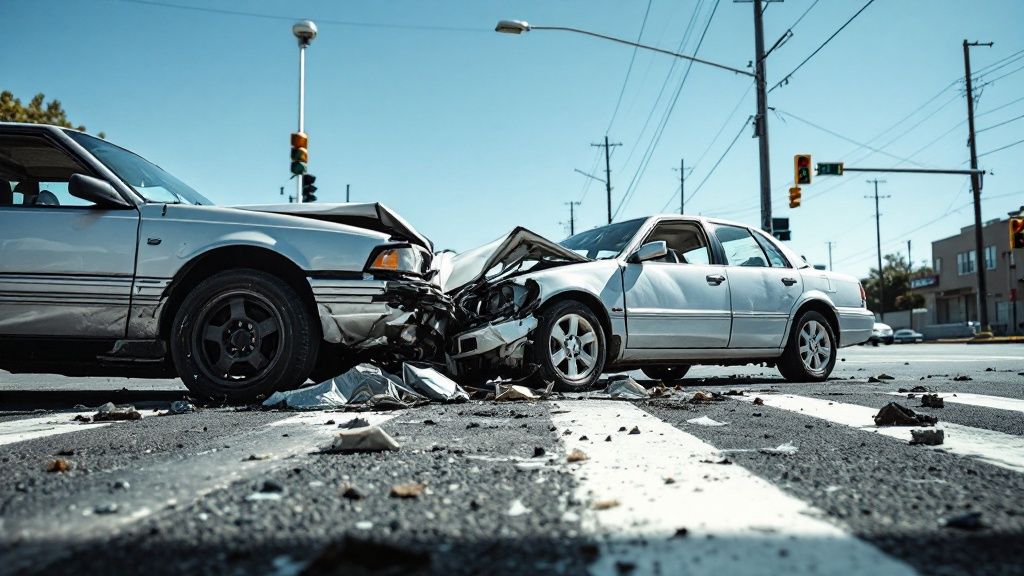
If you were hurt in a car accident while working in California, you are probably asking two questions at once: "Does workers' comp cover this?" and "Can I sue the other driver?"
The answer to both is often yes — and running both claims at the same time is usually the highest-net pathway for an injured worker.
We've recovered over $150,000,000 for injured California workers. Cross-claim cases — where a worker has both a workers' comp claim and a personal injury claim from the same crash — are among the highest-value cases we handle. This guide explains exactly how each claim works, how they interact, and what the math looks like when both run simultaneously.
If you've been in a work-related vehicle accident, call (818) 794-9947 for a free consultation. No fee unless we win.
Quick-Answer Summary
- Workers' comp always applies if you were injured in a vehicle while performing job duties — it is no-fault under Cal. Lab. Code §3600.
- A personal injury (PI) claim also applies when a third party — another driver, a defective vehicle manufacturer, or a negligent property owner — caused or contributed to the crash.
- Both claims can run at the same time. This is the highest-net pathway because PI pays pain and suffering and full lost wages that WC does not.
- The WC carrier holds a lien on your PI settlement under Cal. Lab. Code §3856 — they get repaid out of what you recover from the at-fault party.
- That lien can be negotiated down, which directly increases what you net.
- Gig workers (Uber, Lyft, Amazon Flex) face additional complexity under California Proposition 22.
- Report to your employer within 30 days under Cal. Lab. Code §5400 — missing this deadline can jeopardize your WC claim.
The 3 Pathways After a Car Accident on the Job
Not every work-related crash opens the same set of doors. Which pathway applies to you depends on one core question: Was anyone other than you or a co-worker at fault?
Pathway: 1 — Workers' comp only · When it applies: You caused the crash, or it was a single-vehicle accident with no third-party fault · What you recover: Medical bills + partial lost wages + permanent disability if applicable
Pathway: 2 — PI only · When it applies: Extremely rare; almost never applies when you were working at the time · What you recover: Pain and suffering + full lost wages + economic damages
Pathway: 3 — Both claims · When it applies: Another driver, a defective vehicle, or a negligent third party was at fault · What you recover: WC benefits plus the full PI damages — the highest net recovery
The overwhelming majority of work-related car accidents that involve another vehicle fall into Pathway 3. If another driver ran a red light and hit your delivery van, or a vehicle defect caused you to crash, you almost certainly have both claims.
Path 1 — Workers' Comp Only (When Nobody Else Is at Fault)
Under Cal. Lab. Code §3600, workers' compensation applies to any injury that arises out of and in the course of employment — regardless of fault. That means even if you caused the accident, you are still entitled to WC benefits.
Workers' comp pays:
- All reasonable medical treatment — emergency care, surgery, physical therapy, prescription drugs — with no out-of-pocket costs to you.
- Temporary total disability (TTD) — two-thirds of your average weekly wage, up to a state-set weekly maximum, while you cannot work. Cal. Lab. Code §4653 governs TTD payments.
- Permanent disability (PD) — a lump-sum or scheduled payment if your injury leaves you with a lasting impairment, rated under the AMA Guides as adopted in California.
- Supplemental Job Displacement Benefits (SJDB) — a voucher for retraining if you cannot return to your previous job, governed by Cal. Lab. Code §4658.7.
- Death benefits — paid to dependents if a worker dies from job-related injuries, under Cal. Lab. Code §4700.
What WC does NOT pay: pain and suffering, emotional distress, full lost wages (only two-thirds, up to the cap), or future economic losses beyond the PD rating. Those gaps are exactly what a PI claim fills.
Path 2 — Personal Injury Only (Almost Never the Right Choice)
If you were working when the accident happened, you almost always have a valid WC claim — and California law makes it difficult to opt out of the WC system in favor of a PI-only approach against your employer.
Cal. Lab. Code §3602 makes workers' comp the exclusive remedy against your employer for most work injuries. That means you generally cannot sue your employer in civil court for a crash that happened while you were on the clock.
However: The exclusive remedy rule does not protect third parties. The other driver is not your employer. The truck manufacturer is not your employer. The road contractor who left a dangerous hazard is not your employer. So while a PI-only case against your employer is rarely possible, a PI case against a negligent third party is entirely separate.
In practice, "PI only" applies to a narrow set of situations — for example, a passenger in a personal vehicle who was asked to run a quick errand and whose employer does not carry WC insurance (illegal, but it happens). If that describes your situation, call us. These cases have real complexity.
Path 3 — Both Claims at Once (The Highest-Net Pathway)
In California, if you are injured in a car accident while working, you can file a workers' compensation claim and a personal injury lawsuit at the same time — these are called parallel claims.
Here is what each claim contributes:
Workers' comp pays immediately and automatically:
- Medical bills from day one, with no waiting for a civil case to resolve.
- TTD payments — usually within 14 days of the employer accepting the claim — to replace two-thirds of lost wages while you recover.
- This matters because PI cases take 12-36 months to resolve. WC keeps you financially alive in the meantime.
The PI claim adds what WC cannot pay:
- Pain and suffering — WC pays zero dollars for pain and suffering. A PI verdict or settlement can add tens of thousands to hundreds of thousands of dollars on top of your WC benefits.
- Full wage loss — not just two-thirds. If your TTD is capped or your injury affects your earning capacity for years, the PI claim can recover the remaining one-third plus future lost earnings.
- Property damage — your vehicle, your tools, your personal property in the vehicle.
- Loss of consortium — damages for the effect of your injuries on your family, recoverable only in civil court.
The net result: Most workers who run both claims net materially more than WC alone — even after the WC lien is repaid. The next section explains exactly how the lien math works.
What WC Pays vs. What PI Pays (Side by Side)
Benefit: Medical bills · Workers' Comp: ✅ All reasonable treatment · Personal Injury: ✅ All medical expenses
Benefit: Lost wages · Workers' Comp: ✅ ~2/3 of wages (capped) · Personal Injury: ✅ 100% of lost wages
Benefit: Pain and suffering · Workers' Comp: ❌ Not covered · Personal Injury: ✅ Full recovery
Benefit: Permanent disability · Workers' Comp: ✅ PD rating under CA schedule · Personal Injury: ✅ Future earning capacity loss
Benefit: Emotional distress · Workers' Comp: ❌ Not covered · Personal Injury: ✅ Available
Benefit: Property damage · Workers' Comp: ❌ Not covered · Personal Injury: ✅ Vehicle + belongings
Benefit: Punitive damages · Workers' Comp: ❌ Not available · Personal Injury: ✅ If conduct was egregious
Benefit: Speed of payment · Workers' Comp: ✅ Begins within days/weeks · Personal Injury: ⏳ 12-36 months to resolve
The table makes the strategy clear: WC is your cash-flow lifeline while you recover. PI is where the full compensation lives. Both together is how injured workers recover the most.
Subrogation: How the WC Carrier Claws Back From Your PI Settlement
When you settle a personal injury case while receiving workers' comp benefits, the workers' comp carrier has a lien — a legal right to be repaid — out of your PI settlement under Cal. Lab. Code §3856.
Here is how subrogation works step by step:
- Your employer's WC carrier pays your medical bills and TTD while your PI case is pending.
- You (through your PI attorney) sue the at-fault driver and recover a settlement or verdict.
- Before you receive the net proceeds, the WC carrier is entitled to be reimbursed for what it paid out — this is the lien.
- After the lien is repaid, the remaining amount is yours.
A simplified example:
- WC carrier paid: $80,000 in medical bills + $25,000 in TTD = $105,000 lien.
- PI settlement: $350,000.
- After attorney fees (33%): $234,500 net to client before lien.
- If lien is paid in full: $234,500 − $105,000 = $129,500 to the injured worker.
That is a meaningful recovery — but the lien negotiation is where the real leverage lives.
How a 99.9%-Win Specialist Negotiates the Lien Down
A workers' comp attorney who also handles personal injury can negotiate the WC lien down, which directly increases the net dollar amount you walk away with.
Under Cal. Lab. Code §3856, a court can apportion the WC carrier's lien to account for the cost of obtaining the PI recovery. In practice, WC carriers regularly accept a reduced lien amount — especially when:
- The PI case involved real litigation risk (i.e., liability was disputed).
- Attorney fees and litigation costs were high.
- The injured worker can demonstrate that the WC carrier benefited from the PI attorney's work.
- The total PI recovery was limited by the at-fault driver's insurance policy limits.
Real-world reduction range: In our experience handling dual-claim cases in Southern California, WC liens are frequently negotiated to 50%-70% of face value — and sometimes lower. Using the same example above:
- Lien face value: $105,000.
- Negotiated lien (60%): $63,000.
- Net to injured worker: $234,500 − $63,000 = $171,500 — a $42,000 improvement over paying the lien in full.
This is why hiring a firm that handles both workers' comp and personal injury matters. Two separate attorneys — one for WC and one for PI — often leave money on the table because neither has full visibility into the other claim. We handle both under one roof, which means we control the lien negotiation strategy from the beginning.
What If You Were Driving for Uber, Lyft, or Amazon Flex?
If you drive for Uber, Lyft, or Amazon Flex and are injured on the job, whether you qualify for workers' comp depends on your status under California Proposition 22 and the platform's insurance tiers.
California Proposition 22, passed by voters in November 2020, classified app-based delivery and rideshare drivers as independent contractors rather than employees — which generally removes them from the standard WC system.
What that means in practice:
- Uber and Lyft: Rather than WC coverage, Prop 22 requires the platforms to provide an occupational accident insurance policy when drivers are actively engaged on the app. This policy covers medical expenses and some income replacement — but typically pays less than full WC and has strict coverage tiers based on whether the app was active, whether you had accepted a ride, and whether you were en route.
- Amazon Flex: Similar structure — Amazon provides occupational accident coverage rather than WC, with limits that vary by tier.
- Third-party PI claims still apply. Prop 22 does not eliminate your right to sue the at-fault driver in a PI case. If another driver caused the crash, you can still bring a full PI lawsuit regardless of your gig-worker status.
- The Prop 22 constitutional fight is ongoing. California courts and the legislature have continued to contest the validity of Prop 22 since it passed. The legal landscape for gig workers' benefits may shift. If you drive for a platform and were injured, call us — we track these changes in real time.
If you believe you were misclassified as an independent contractor by your employer (not a gig platform, but a traditional employer who calls you a "contractor" to avoid paying WC premiums), you may have a full WC claim regardless of what your contract says. Misclassification cases are evaluated individually.
5 Things to Do in the First 7 Days After a Work-Related Crash
The most important thing to do after a work-related car accident in California is to report the injury to your employer within 30 days, as required by Cal. Lab. Code §5400.
Here is the full first-week checklist:
Day 1-2: At the scene and immediately after
- Call 911. Get a police report. The report number and officer narrative are essential evidence in your PI case.
- Gather information. The other driver's name, license, insurance, license plate, and contact information. Witness names and phone numbers. Photos of all vehicles, the road, the intersection, and your injuries.
- Seek medical care immediately. Go to the emergency room or urgent care that day. A gap in treatment is one of the first things an insurance adjuster will use to minimize your claim.
Day 2-5: The reports
- Report to your employer in writing. Under Cal. Lab. Code §5400, you must notify your employer of a work injury within 30 days. Do not wait. Put it in writing — email or text creates a timestamp. Your employer is then required to provide a DWC-1 claim form within one working day under Cal. Lab. Code §5401.
- Do not give a recorded statement to any insurance carrier — not the other driver's carrier, not your employer's WC carrier — before speaking with an attorney. Insurance adjusters are trained to elicit statements that minimize your claim.
Day 5-7: Get legal help
Dual-claim cases move on two separate timelines. The PI statute of limitations in California is generally two years from the date of injury under Cal. Civ. Code §335.1. The WC filing deadline is one year from the date of injury under Cal. Lab. Code §5405. Missing either deadline can eliminate that claim entirely.
Call (818) 794-9947 for a free consultation. No fee unless we win. We handle both claims under one roof so nothing falls through the gap between them.
Working the Numbers: A Real Cross-Claim Scenario
Here is how a dual-claim case actually flows from injury to final check — using realistic but illustrative numbers for a Southern California construction materials driver who was T-boned at an intersection.
The injury: Lumbar disc herniation and torn rotator cuff. Surgery required. Four months off work.
WC pays during recovery:
- Medical and surgical bills: $95,000
- TTD at two-thirds of $1,400/week for 17 weeks: $15,867
- Permanent disability award (10% WPI rating): $26,250
- Total WC outlay: approximately $137,117
PI case against the at-fault driver (policy limits: $500,000):
- Settlement: $420,000
- Attorney fees (33%): $138,600
- Litigation costs: $12,000
- Net before lien: $269,400
WC lien negotiation:
- Lien face value: $110,750 (medical + TTD paid; PD is excluded from the lien calculation)
- Negotiated lien (55%): $60,913
- Net to injured worker after lien: $208,487
Total net recovery (WC PD award + PI net): $26,250 + $208,487 = $234,737
A worker who had filed WC only would have received roughly $137,117 in total benefits. By running both claims and negotiating the lien, this worker netted $234,737 — more than 70% more — after all fees and the lien repayment.
Every case is different. The numbers above are illustrative, not a guarantee of any specific outcome. Call us to walk through the math on your specific facts.
FAQ
Can I file both workers' comp and personal injury for a car accident on the job?
Yes. In California, these are two separate legal systems that can run at the same time. Workers' comp is a no-fault system that covers you regardless of who caused the crash. A personal injury claim runs against the at-fault third party. Filing both is the standard approach when another driver or a defective vehicle caused the accident.
Who pays if I get in a car accident while working?
Your employer's workers' comp carrier pays your medical bills and partial lost wages immediately, regardless of fault. If another driver caused the crash, their auto liability insurance is also responsible — and you can pursue a personal injury claim against them separately. Both obligations can be pursued simultaneously.
Does workers' comp cover car accidents in California?
Yes, if you were performing job duties at the time of the crash. Cal. Lab. Code §3600 covers any injury that arises out of and in the course of employment — which includes driving for work. Commuting to and from work is generally not covered (the "coming and going" rule), but driving between job sites, making deliveries, running a work errand, or traveling for business is covered.
What is a third-party claim?
A third-party claim is a personal injury lawsuit filed against someone who is not your employer — typically the at-fault driver in a work-related vehicle accident. Because workers' comp law makes your employer largely immune from civil suit under Cal. Lab. Code §3602, the third-party claim is your path to recovering pain and suffering, full lost wages, and other damages that WC does not pay.
Does the commute to work count as being "on the job"?
Generally no. The "coming and going" rule under California workers' comp law excludes injuries that happen while you are commuting between home and your fixed workplace. But there are important exceptions: if your employer provides the vehicle, if you were running a work errand on the way in, if you have no fixed worksite (e.g., a field technician who goes directly to client locations), or if you are a traveling employee, your commute may be covered. These exceptions are evaluated case by case.
What happens if the at-fault driver has no insurance or minimal insurance?
If the at-fault driver is uninsured or underinsured, your workers' comp benefits still pay — WC is no-fault and does not require a third party to be at fault or insured. For the PI side, your own uninsured/underinsured motorist (UM/UIM) coverage may apply if you were driving a personal or employer-owned vehicle with UM/UIM coverage. We evaluate all available insurance in every dual-claim case.
How does the workers' comp lien affect my PI settlement?
Under Cal. Lab. Code §3856, the WC carrier is entitled to be reimbursed out of your PI settlement for the benefits it paid on your behalf. The lien does not eliminate your PI recovery — it reduces it. And critically, the lien can be negotiated down, often to 50%-70% of face value, which directly increases what you net. Hiring a firm that handles both claims is the most effective way to control this negotiation.
How long do I have to file a car-accident workers' comp claim in California?
You must notify your employer within 30 days of the injury under Cal. Lab. Code §5400. The full claim must be filed within one year of the date of injury under Cal. Lab. Code §5405. For the personal injury claim against the at-fault driver, the statute of limitations is generally two years under Cal. Civ. Code §335.1. Missing either deadline can permanently bar that claim.
You Have Two Claims. You Deserve a Firm That Handles Both.
Most attorneys do one or the other — workers' comp or personal injury. When you hire a WC-only firm, they file the WC claim but cannot manage the PI lien negotiation. When you hire a PI-only firm, they file the civil case but have no leverage over the WC carrier's lien.
We handle both. That means we control the strategy across both claims from the day you call — which is the only way to maximize what you actually net after all fees and repayments.
Every injured worker deserves the same quality of legal representation as any corporation. That is the principle this firm was built on.
Cross-claim case? Call (818) 794-9947 for a free pathway review. No fee unless we win. Available in English and Spanish.
Reviewed by Minas Nordanyan, CA Bar #296806. Last updated May 2026. This article is for general informational purposes only and does not constitute legal advice. Every case is different. Contact our office to discuss the specific facts of your situation.