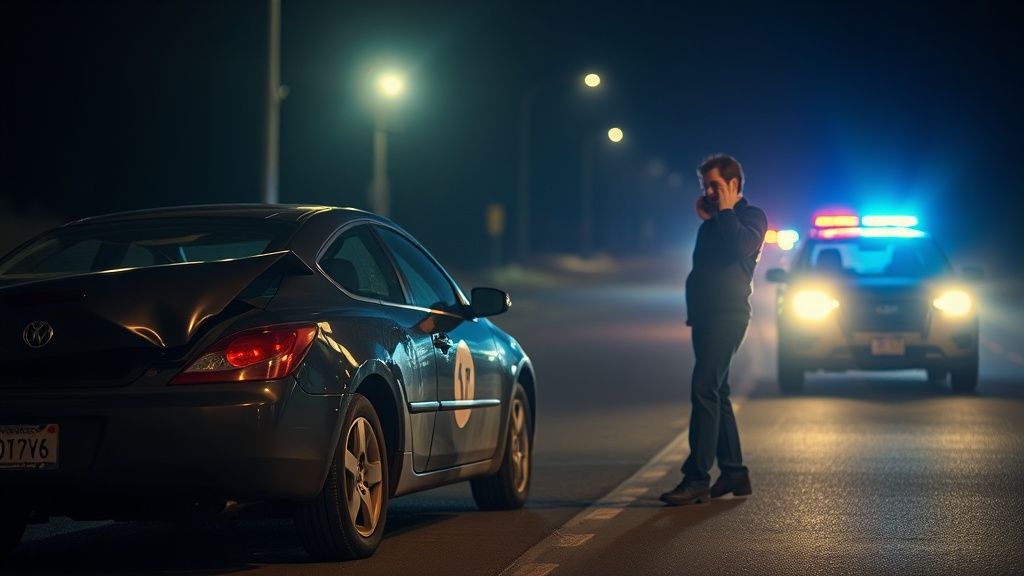
If you were hurt in a car accident in California that wasn't your fault, you have the legal right to be made whole — meaning the at-fault driver and their insurer owe you money for your medical bills, lost wages, property damage, and pain and suffering. But getting paid rarely happens automatically. Insurers look for any reason to pay less. Here is exactly what the law requires, what you need to do, and how to protect every dollar you are owed.
If you want to talk through your specific situation now, call (818) 794-9947 for a free consultation. No fee unless we win.
Quick-Answer Summary
- The at-fault driver's insurer is responsible for your damages under California's fault-based insurance system.
- California follows pure comparative fault — even if you were partly responsible, you can still recover (your payout is reduced by your share of fault).
- You have two years from the accident date to file a personal injury lawsuit (Cal. Code Civ. Proc. §335.1).
- A police report, photos, witness statements, and traffic citations are your core proof-of-fault tools.
- If the other driver is uninsured, your own UM/UIM coverage is the backstop.
- Do not give a recorded statement to the other driver's insurance company before speaking with an attorney.
- You pay nothing upfront — we handle California car accident claims on a contingency basis.
Proving the Other Driver Was at Fault
A police report alone does not prove fault — but it is powerful evidence because it reflects an officer's on-scene observations and any traffic citations issued.
Fault in a California car accident is built from a stack of evidence. The stronger your stack, the harder it is for the insurer to argue you share the blame.
What goes into a strong fault case:
- Police report. Call 911 at the scene whenever there is injury or significant property damage. The responding officer documents the positions of vehicles, any traffic-law violations, and sometimes assigns a preliminary fault determination. Ask for the report number before you leave.
- Traffic-law violations. A driver who ran a red light violated Cal. Veh. Code §21453. A driver who failed to yield on a left turn violated Cal. Veh. Code §21801. A citation on the other driver's record is near-conclusive proof of negligence in most cases.
- Photos and video. Photograph the scene from multiple angles before vehicles are moved — skid marks, final resting positions, damage patterns, road conditions, traffic signals. Check whether any nearby business has exterior surveillance cameras.
- Witness statements. Get names and phone numbers from anyone who saw the collision. Independent witnesses carry significant weight with adjusters and juries.
- Your own account. Write down everything you remember within 24 hours while details are fresh — speed, direction, weather, what you saw the other driver do immediately before impact.
One important note: do not apologize at the scene or say anything like "I didn't see you coming." California's pure comparative fault system means even a casual admission of partial awareness can be used to reduce your recovery.
California's Pure Comparative Fault Rule
California follows a pure comparative fault rule under California Civil Code Section 1714, which means you can recover compensation even if you were partly at fault, as long as the other driver was at least partially responsible.
Under Cal. Civ. Code §1714, every person is responsible for their own negligence. California courts apply a pure comparative fault standard — meaning even a driver who is found 90% at fault can still recover 10% of their damages from the other driver.
How it works in practice:
Suppose your total damages are $100,000. The insurance company argues you were 20% at fault for following too closely. Under pure comparative fault, you can still recover $80,000 — your damages reduced by your 20% share.
This is different from states with "contributory negligence" rules that bar all recovery if you share any fault. California's rule is more favorable to injured drivers. But it also means insurers actively look for ways to assign you partial blame — because every percentage point they shift to you reduces what they owe.
That is why how you talk to the other driver's insurer matters enormously, which we cover below.
Filing a Third-Party Claim vs. Going Through Your Own Insurance
You generally have two paths after a not-at-fault accident in California.
Path 1 — Third-Party Claim Against the At-Fault Driver's Insurer
This is the standard route. You file a claim directly with the at-fault driver's liability insurance carrier. Their insurer investigates, accepts or disputes liability, and negotiates a settlement.
Pros: You are not using your own coverage, so there is no deductible and your premiums are not affected (more on that below). The at-fault driver's policy is responsible for the full scope of your damages.
Cons: The other insurer has no obligation to treat you fairly or move quickly. They represent their policyholder, not you. Adjusters are trained to minimize payouts.
Path 2 — First-Party Claim Through Your Own Insurer
If the liability dispute is likely to take months, or if you need immediate vehicle repairs and medical coverage, you can file through your own collision or MedPay/PIP coverage first. Your insurer then pursues the at-fault driver's carrier through a process called subrogation to recoup what it paid you.
Pros: Faster resolution on property damage. Your own insurer has a duty of good faith toward you.
Cons: You may pay a deductible upfront (usually recovered later). Opens the door for your insurer to re-examine your claim, though California law limits adverse action when you were not at fault.
Will my rates go up? Under California Insurance Code §1861.02 and the California Department of Insurance's rate-regulation rules, an insurer generally cannot raise your premium solely because you were involved in an accident where you were not at fault. However, this protection has nuance — contact your carrier and confirm in writing that the claim is being coded as a not-at-fault accident.
What Damages You Can Recover
In California, the at-fault driver — or their insurance carrier — is legally responsible for your medical bills, lost wages, property damage, and pain and suffering.
California law entitles an injured driver to recover two categories of damages: economic (out-of-pocket losses) and non-economic (human impact losses).
Economic Damages
- Medical expenses — emergency room, ambulance, surgery, hospitalization, physical therapy, chiropractic care, prescription medications, future medical treatment reasonably expected from the injury.
- Lost wages — income you missed while recovering, documented by pay stubs and an employer letter. For self-employed individuals, tax returns and contracts support the calculation.
- Future lost earning capacity — if your injury limits your ability to work long-term, an economist or vocational expert can quantify the projected lifetime loss.
- Property damage — repair or fair-market replacement value of your vehicle, plus rental car costs while it is being repaired.
Non-Economic Damages
- Pain and suffering — physical pain, mental anguish, anxiety, and emotional distress caused by the accident and recovery.
- Loss of enjoyment of life — activities you can no longer do, hobbies you can no longer enjoy.
- Disfigurement and scarring — permanent cosmetic impact from the injury.
California does not cap non-economic damages in standard car accident cases (the cap under Cal. Civ. Code §3333.2 applies only to medical malpractice cases). Your non-economic recovery is whatever a jury or a negotiated settlement determines is fair.
One rule you must know: Under the Howell v. Hamilton Meats rule (Cal. Supreme Court, 2011), your medical-expense recovery is generally limited to the negotiated amount actually paid by your health insurer — not the billed amount — if health insurance covered the treatment. This affects settlement strategy and is one reason having an attorney negotiate the final number matters.
When the At-Fault Driver Is Uninsured or Underinsured
If the at-fault driver is uninsured, your own uninsured motorist coverage — required to be offered to every California driver under California Insurance Code Section 11580.2 — steps in to pay your damages.
California requires every driver to carry minimum bodily injury liability coverage. [SPEAKABLE] California requires every driver to carry at least $15,000 in bodily injury liability coverage per person under California Vehicle Code Section 16056, though that minimum is rising to $30,000 per person on January 1, 2025.
Despite that requirement, roughly 1 in 6 California drivers is estimated to be uninsured, according to the Insurance Research Council. Even insured drivers may carry only the state minimum — which can be exhausted quickly by a serious injury.
Uninsured Motorist (UM) Coverage
Under Cal. Ins. Code §11580.2, every California auto insurer must offer UM coverage. If you did not reject it in writing, you likely have it. UM coverage pays your damages when the at-fault driver has no insurance at all. It also covers hit-and-run accidents where the other driver cannot be identified.
Underinsured Motorist (UIM) Coverage
If the at-fault driver has insurance, but their policy limits are lower than your damages, your UIM coverage bridges the gap — up to your own policy limit.
Example: You have $100,000 in medical bills and lost wages. The at-fault driver has a $15,000 policy. Their insurer pays $15,000. Your UIM coverage (if you carry, say, $100,000 in UIM) can pay up to an additional $85,000.
UM/UIM claims go through your own insurer, and California requires your insurer to treat you fairly — the same good-faith standards that apply to any first-party claim. If your insurer acts in bad faith in handling a UM/UIM claim, you may have a separate bad-faith claim against them.
How Insurers Try to Shift Blame and Shrink Your Payout
Insurance adjusters are trained to look for any statement you make that can be used to shift partial blame to you, which reduces the amount they have to pay.
Understanding insurer tactics is not about paranoia — it is about protecting your legal rights. Here are the most common moves adjusters make in not-at-fault California car accident claims.
The Early Recorded Statement
Within days of the accident, the other driver's adjuster may call you and ask for a "quick recorded statement to process your claim faster." Do not give one without first speaking with an attorney. Adjusters are skilled interviewers. A phrase as innocent as "I didn't have much time to react" can be framed as evidence you were traveling too fast or following too closely.
The Quick Settlement Offer
Some adjusters make a fast, low offer before you know the full extent of your injuries. Once you sign a release, you cannot reopen the claim — even if you need surgery six months later. Wait until you reach what doctors call maximum medical improvement (MMI) before settling, or have an attorney evaluate whether any early offer is fair.
Disputing the Injury Causation
Adjusters commonly argue that your injuries are pre-existing, that the impact was "too minor" to cause the injury you describe, or that your treatment was excessive. Counter this with consistent medical records from immediately after the accident, your treating physician's opinion connecting the injury to the crash, and, where appropriate, an independent medical evaluation.
Delaying the Claim
Cal. Ins. Code §790.03 prohibits unfair claims settlement practices, including failing to acknowledge a claim promptly and not attempting to reach a fair settlement in good faith. If a carrier is stonewalling, documenting each delay creates a paper trail for a bad-faith claim or a WCAB complaint to the California Department of Insurance.
The Two-Year Deadline You Cannot Miss
You have two years from the date of the accident to file a personal injury lawsuit in California under California Code of Civil Procedure Section 335.1 — missing that deadline almost always ends your right to recover anything.
Two years sounds like a long time. It is not. Medical records must be gathered, liability must be investigated, experts must be retained, and settlement negotiations take time. Most experienced California personal injury attorneys recommend contacting a lawyer within the first 30 to 60 days of a serious accident — not because the deadline is immediately looming, but because evidence disappears, witnesses forget, and surveillance video gets overwritten.
Special deadlines to know:
- Claims against a California government entity (e.g., a city vehicle, a state highway employee) — you must file a government tort claim within 6 months of the accident under Cal. Gov. Code §911.2. Miss the 6-month window and you lose the right to sue the government, even if the 2-year personal injury deadline has not run.
- Minors — the 2-year clock generally does not start until the minor turns 18.
- Uninsured motorist claims — must typically be reported to your own insurer "promptly" per your policy; some policies have a specific notice deadline of 30 days for hit-and-run accidents.
If you are unsure which deadline applies to your situation, call (818) 794-9947 for a free case review.
What Nordanyan Law Does in a Not-At-Fault California Car Accident Case
We handle every aspect of your personal injury claim from the moment you call — so you can focus on recovering, not on fighting an insurance company.
Here is what that looks like in practice:
- Preserve evidence immediately — we send spoliation letters to businesses with surveillance cameras and request the police report before it is archived.
- Coordinate your medical care — we connect you with California physicians and specialists who treat accident injuries on a lien basis, meaning you do not pay out of pocket while your case is pending.
- Handle all insurer communication — you stop taking calls from adjusters. Every communication goes through our office.
- Build your damages package — we document every medical bill, lost paycheck, and out-of-pocket expense, and retain economists or life-care planners for serious injuries.
- Negotiate to the maximum — we handle every case as if it is going to trial, because insurance companies settle for more when they know the other side is prepared to fight.
- Take it to court when necessary — our attorneys are admitted to California state and federal courts, and we do not threaten trial as a bluff.
We've recovered over $150,000,000 for injured clients in Southern California. You pay $0 upfront. No fee unless we win.
Call (818) 794-9947 now or visit our free consultation page. A member of our team is available today in English and Spanish.
Frequently Asked Questions
What do I do if a car accident wasn't my fault in California?
Report the accident to your own insurance carrier (required by most policies regardless of fault), get the other driver's name, license, and insurance information, seek medical attention even if you feel okay, preserve all evidence, and contact a California personal injury attorney before giving any recorded statement to the other driver's insurer. The steps you take in the first 48 to 72 hours have a direct impact on the strength of your claim.
Will my insurance go up if the accident wasn't my fault in California?
California's insurance regulations generally prohibit insurers from surcharging your premium solely because you were in an accident where you were not at fault. However, this protection depends on how your insurer codes the claim. Confirm in writing with your carrier that the incident is being marked as a not-at-fault accident. If your insurer raises your rates despite a clear not-at-fault determination, you can file a complaint with the California Department of Insurance.
Who pays for my medical bills if the other driver was at fault?
The at-fault driver's liability insurance is responsible for your medical bills as part of your total damages. In the short term, your own health insurance, MedPay coverage, or medical lien arrangements with treating physicians can cover care while your claim is pending. You are then reimbursed — or your health insurer is reimbursed through subrogation — out of the settlement or judgment.
What if the at-fault driver has no insurance?
Your own uninsured motorist (UM) coverage, which California insurers are required to offer under Cal. Ins. Code §11580.2, steps in to pay your damages when the other driver is uninsured or is a hit-and-run driver who cannot be identified. If you are unsure whether you have UM coverage, check your declarations page or call your insurer. If your UM limits are not enough to cover serious injuries, consult an attorney about all available options.
Can I still recover compensation if I was partly at fault?
Yes. California's pure comparative fault rule means your recovery is reduced — not eliminated — by your percentage of fault. If a jury or settlement determines you were 25% at fault and your total damages are $200,000, you recover $150,000. Only if you are found 100% at fault would you recover nothing.
How long do I have to file a car accident lawsuit in California?
Two years from the date of the accident under Cal. Code Civ. Proc. §335.1 for most personal injury claims. If the at-fault driver was operating a government vehicle or working for a government agency, you have only 6 months to file a government tort claim under Cal. Gov. Code §911.2. Do not rely on these deadlines as a reason to wait — evidence degrades, witnesses move, and claims become harder to prove over time.
Do I have to accept the insurance company's first settlement offer?
No. The first offer from an at-fault driver's insurer is almost never their best offer. You have the right to negotiate, and you cannot reopen a claim once you sign a release. Before accepting any offer, make sure your medical treatment is complete — or that any future medical needs are fully accounted for in the settlement — and consider having an attorney evaluate the offer against your actual damages.
How much is my car accident case worth?
It depends on the severity of your injuries, your total medical expenses, your lost wages, the degree of the other driver's fault, whether you share any fault, the at-fault driver's insurance limits, and whether you have UIM coverage as a backstop. There is no honest average we can give you without reviewing your specific facts. Call (818) 794-9947 for a free case review — we will give you a straight answer based on your situation.
Reviewed by Minas Nordanyan, CA Bar #296806. Last updated June 2026. This article is general legal information about California law and is not legal advice for your specific situation. Contact our office to discuss the facts of your case.