If a pothole, missing guardrail, or broken traffic signal caused your crash, you may be dealing with something more complicated than a typical car accident claim. You may be dealing with a claim against a government agency, and that changes nearly everything about how you have to proceed.
California allows injured people to sue public agencies for dangerous road conditions. But the rules are stricter than a standard personal injury case, the deadlines are shorter, and the evidence you need starts disappearing from the moment of impact. This article walks you through how these claims work, which agency you need to target, and exactly how much time you have.
Quick answers:
- You have 6 months from the crash date to file a government tort claim, not a lawsuit.
- The governing statute is California Government Code §835.
- You must identify the correct public agency: Caltrans, a county, or a city.
- The agency must have had notice of the defect and failed to fix it.
- California's comparative fault rule lets you recover even if you share some blame.
- Physical evidence at the scene erodes within days.
If you've been hurt in a crash you believe was caused by a road defect in California, call (818) 794-9947 for a free case review. No fee unless we win.
How Poor Road Design, Potholes, and Missing Signage Cause Crashes
Road defects cause serious collisions every day in California. Some of the most common dangerous conditions we see in claims include:
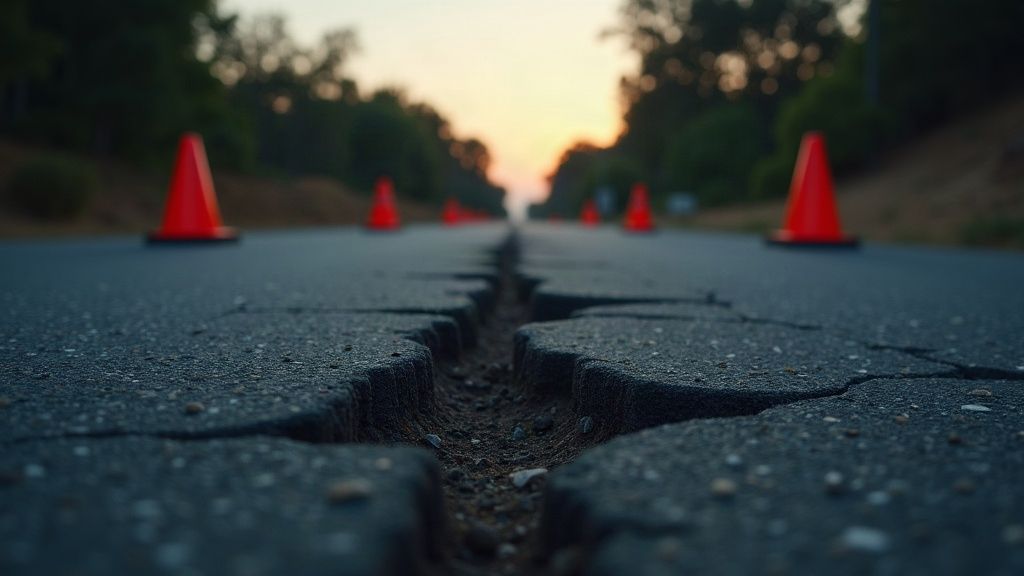
- Potholes and pavement failures that cause drivers to lose control or blow out tires.
- Missing or faded lane markings that lead to lane-departure crashes, especially at night.
- Absent or damaged guardrails that fail to prevent run-off-road crashes at curves or drop-offs.
- Malfunctioning traffic signals that create confusion at intersections.
- Dangerous intersection geometry where sight lines are blocked by overgrown vegetation or poor design.
- Inadequate road drainage that causes flooding or black ice.
- Missing or downed road signs, including stop signs, speed-limit signs, and warning signs.
- Uneven pavement at construction zones without proper transition strips or warnings.
What makes these cases legally distinct from a standard two-car crash is that the responsible party is a government entity, not a private driver or company. That distinction triggers a completely different set of rules.
The "Dangerous Condition of Public Property" Concept in California
California Government Code §835 is the statute at the center of every dangerous road claim against a public agency. It says, in plain terms, that a public entity is liable for an injury caused by a dangerous condition of its property if:
- The property was in a dangerous condition at the time of the injury.
- The injury was proximately caused by that dangerous condition.
- The dangerous condition created a reasonably foreseeable risk of the kind of injury that occurred.
- Either the public entity had actual or constructive notice of the dangerous condition at a sufficient time before the injury to have taken protective measures, OR a public employee's negligent or wrongful act created the dangerous condition.
The statute defines "dangerous condition" as a condition that creates a substantial risk of injury to someone who uses the public property with due care. A minor inconvenience is not enough. The condition must pose a real and serious hazard.
California Government Code Section 835 defines a dangerous condition of public property as a physical defect that creates a substantial risk of injury to a person using the property with due care.
What "Notice" Actually Means
Notice is often the contested issue in these cases. A public agency has actual notice if someone reported the defect to the agency before your crash, or if the agency's own records show it was aware of the problem.
Constructive notice is more nuanced. Under Government Code §835.2, an agency has constructive notice if the condition had existed for such a period of time, and was of such a visible nature, that the agency exercising reasonable care should have discovered it. Prior complaints, prior crashes at the same location, work orders, inspection records, and even 311 complaint logs can all go to constructive notice.
A public agency can be held liable only if it had actual or constructive notice of the defect and failed to repair it within a reasonable time.
Design Immunity and Its Limits
Public agencies sometimes claim design immunity under California Government Code §830.6, arguing the road was built according to an approved design plan. This defense has real limits. Design immunity can be lost if conditions change after the design was approved, if the approved design itself was adopted without a reasonable basis, or if the agency had notice that the design was creating a dangerous condition and failed to act.
Which Agency Is Responsible for Which Road
This is one of the first questions in any California dangerous road claim, and the answer directly determines who you file against.
Caltrans maintains state highways, counties maintain county roads, and cities or municipalities maintain local streets, so identifying the correct agency is one of the first steps in a dangerous road condition claim.
Here is a general breakdown:
| Road Type | Responsible Agency |
|, |, |
| State highways and freeways (e.g., US-101, I-5, SR-118) | California Department of Transportation (Caltrans) |
| County roads | The county (e.g., County of Los Angeles, County of San Bernardino) |
| City streets | The city or municipality |
| Local government parking structures | The local government that owns the structure |
| State parks access roads | California Department of Parks and Recreation |
One crash can involve more than one agency if, for example, a state highway intersects with a county road and the defect spans both. Identifying the correct responsible agency is not always obvious, and filing against the wrong agency wastes time and can cost you your entire claim. A review of the California Department of Transportation (Caltrans) maps, county assessor records, and city public works records typically resolves the question.
The Strict Government-Claim Deadline and Why It's Unforgiving
This is the most important procedural fact in this article, and it cannot be overstated.
In California you have only 6 months from the date of your crash to file a government tort claim against the agency responsible for the road.
Before you can file a lawsuit against a California government agency, you must first submit a government tort claim directly to that agency under the California Government Claims Act (California Government Code §910 et seq.). This is not the lawsuit itself. It is a required administrative step that gives the agency an opportunity to investigate and respond.
The deadline is 6 months from the date of the incident. Not from the date you discovered your injuries were serious. Not from the date treatment ended. Six months from the crash.
This compares to the general two-year statute of limitations for personal injury claims against private parties under Cal. Code of Civ. Proc. §335.1. The government-claim deadline is dramatically shorter, and missing it usually ends the case entirely.
What Happens After You File the Claim
Once you submit the government tort claim, the agency has 45 days to respond. The agency may:
- Accept the claim and offer a settlement.
- Reject the claim in writing.
- Ignore it (which counts as a rejection by operation of law after 45 days).
If a government agency sends you a written rejection of your tort claim, you then have 6 months from that notice to file a lawsuit in civil court; if it never sends a written rejection, you generally have 2 years from when your cause of action accrued.
If you miss the 6-month government-claim deadline, you can petition the agency to accept a late claim under Government Code §911.4, but late-claim relief is granted only in limited circumstances, such as when the claimant was a minor, was physically or mentally incapacitated, or when the failure to file was due to mistake, inadvertence, surprise, or excusable neglect. Courts scrutinize late-claim petitions carefully, and denial is common.
The practical lesson: contact an attorney as soon as possible after a crash you believe was caused by a road defect. Waiting weeks to "see how you feel" can forfeit your entire claim against the government.
The Evidence Needed to Prove a Dangerous Condition
A dangerous road condition claim lives or dies on evidence. Here is what builds a strong case.
Photographs and Video of the Defect
Time-stamped photographs of the exact defect, taken at the crash scene or as close to the crash date as possible, are critical. Road crews can repair a pothole in a matter of days. Without documentation, the defect may no longer exist when the agency's investigator goes to inspect.
If you are physically able at the scene, or if someone can go back within hours, document:
- The size and depth of the pothole, crack, or damaged pavement.
- Missing or damaged signs and their exact location.
- Lane markings (or the absence of them).
- Skid marks, debris, and your vehicle's final resting position.
- Surrounding conditions: lighting, sight-line obstructions, grade of the road.
Prior Complaints and Incident Reports
Public agencies maintain records. A history of prior complaints about the same location, prior crashes at the same spot, or prior repair requests that were denied or delayed is powerful evidence of constructive notice. These records are obtainable through California Public Records Act (Cal. Gov. Code §7920.000) requests to the agency.
Expert Analysis
Road design and traffic engineering experts can analyze the defect, measure it against applicable safety standards (such as Caltrans Highway Design Manual standards), and give an opinion on whether the condition created a substantial risk of injury. Expert testimony is frequently necessary to prove the "dangerous condition" element.
Weather and Maintenance Records
Agency maintenance logs, inspection schedules, and weather records can show when the condition first arose and how long it existed before your crash.
Why These Cases Require Fast, Careful Investigation
Two things make dangerous road condition claims uniquely time-sensitive.
First, the 6-month government-claim deadline compresses the investigation window dramatically. By the time you finish medical treatment and start thinking about legal options, you may already be close to the deadline.
Second, physical evidence degrades fast. Road crews patch potholes. Signs get replaced. Skid marks wash away in rain. The scene that existed at the moment of your crash can look completely different within days. If nobody documents the defect right away, that evidence is gone.
California's pure comparative fault rule, established by Li v. Yellow Cab Co. in 1975, allows an injured person to recover damages even if they were partly responsible for the crash.
It is also worth noting that even if you were speeding or not watching the road perfectly at the time of the crash, you may still be able to recover. Under California's pure comparative fault rule, established by the California Supreme Court in Li v. Yellow Cab Co., 13 Cal.3d 804 (1975), your damages are reduced by your percentage of fault rather than eliminated by it. A jury might find that the road was 70% responsible and you were 30% responsible, in which case you recover 70% of your total damages.
Working With a Government Agency Is Not Like Dealing With a Private Insurer
Government agencies have their own legal counsel and their own investigators. They will conduct their own inspection. They will look for reasons the condition did not create a substantial risk, reasons the agency lacked notice, and reasons your own driving contributed to the crash. Having an attorney who knows the California Government Claims Act and has handled public entity liability cases puts you in a fundamentally different position than going through the process alone.
We've recovered over $150,000,000 for injured people across Southern California. We handle every case as if it were going to trial, because agencies and insurers settle for more when they know the other side is prepared to fight.
If you were injured in a crash you believe was caused by a dangerous road in California, call (818) 794-9947 today. A free case review costs you nothing, and every day you wait is a day closer to the 6-month government-claim deadline.
FAQ
Can I sue the government for a dangerous road in California?
Yes. California Government Code §835 gives injured people the right to hold public agencies liable for dangerous conditions of public property, including roads, when the agency had notice of the condition and failed to address it. You must first file a government tort claim before you can file a lawsuit.
What is the deadline to file a government claim in California?
You have 6 months from the date of the incident to file a government tort claim with the responsible public agency under California Government Code §910 et seq. This deadline is much shorter than the two-year statute of limitations that applies to personal injury claims against private parties. Missing the 6-month deadline typically bars your lawsuit.
What counts as a dangerous condition of public property?
Under California Government Code §835, a dangerous condition is one that creates a substantial risk of injury to a person who is using the public property with due care. A minor inconvenience or very minor defect is not enough. Examples include large potholes, missing guardrails, nonfunctioning traffic signals, faded lane markings, and blocked sight lines at intersections.
Who is responsible for potholes and bad road design?
It depends on the road. Caltrans is responsible for California state highways and freeways. County governments are responsible for county roads. City governments are responsible for city streets. Identifying the correct responsible agency before filing your government tort claim is essential.
What if the agency says it did not know about the dangerous road condition?
A lack of actual notice is not a complete defense. Under California Government Code §835.2, an agency also has constructive notice if the condition existed long enough and was visible enough that a reasonably careful agency should have discovered it. Prior complaints, prior crashes at the same location, and inspection records are all relevant.
What if I was partly at fault for the crash?
California follows the pure comparative fault rule established by the California Supreme Court in Li v. Yellow Cab Co., 13 Cal.3d 804 (1975). Your recovery is reduced by your percentage of fault, but you are not barred from recovering entirely. If a jury finds the road defect was 75% responsible and your driving was 25% responsible, you recover 75% of your total damages.
How long does a dangerous road condition case take in California?
It varies significantly. After the government-claim period (45 days for the agency to respond, then 6 months to file suit), the litigation itself can take one to three years depending on the complexity of the case, the agency's defense, and court scheduling. Cases that settle before trial tend to resolve faster than those that proceed to a verdict.
Does a government agency have any defenses?
Yes. Common defenses include: design immunity under Government Code §830.6 (the road was built to an approved design plan), lack of notice of the defect, the condition was not actually dangerous, and comparative fault of the injured person. Design immunity can sometimes be overcome if the approved design was unreasonable or if conditions changed after the design was approved.
What damages can I recover in a dangerous road condition claim?
If your claim is successful, you may be able to recover medical expenses (past and future), lost wages, reduced earning capacity, pain and suffering, and property damage. The specific damages available depend on the facts of your case. No attorney can guarantee a particular outcome, but we will fight to recover every dollar you are entitled to under California law.
Do I need an attorney for a dangerous road condition claim in California?
You are not legally required to hire an attorney, but these claims are procedurally complex. The 6-month government-claim deadline is strict, identifying the correct agency can be complicated, and building the evidence of a "dangerous condition" and "notice" typically requires public records requests, expert analysis, and preservation of physical evidence. A misstep at any stage can end the case. We offer a free case review at (818) 794-9947. No fee unless we win.
Reviewed by Minas Nordanyan, CA Bar No. 296806. Last updated July 2026. This article is for general informational purposes and does not constitute legal advice. Results depend on the specific facts of your case. Past results do not guarantee future outcomes.