If you or a family member was bitten by a dog in California, you have rights under one of the strongest bite-liability laws in the country — and the owner does not get a free pass just because the dog had never bitten anyone before.
This article explains exactly how California's dog-bite statute works, what you need to prove, where the money to compensate you typically comes from, and what defenses the other side may raise.
If you have questions about your specific situation, call (818) 794-9947 for a free case review. No fee unless we win.
Quick-Answer Summary
- California follows strict liability for dog bites under Cal. Civ. Code §3342. No prior-bite history required.
- You must show: (1) a dog bite, (2) in a public place or while lawfully on private property, (3) the defendant owned the dog.
- Homeowner's or renter's insurance typically pays — not the owner out of pocket.
- Trespass and provocation are the two main defenses.
- California's pure comparative fault rule can reduce your recovery if you were partly at fault — but does not bar it entirely.
- The statute of limitations is two years from the date of the bite under Cal. Code Civ. Proc. §335.1.
- Damages can include medical bills, lost wages, scarring treatment, pain and suffering, and psychological harm.
California's Strict-Liability Statute — No "One Free Bite"
California Civil Code §3342 makes dog owners strictly liable for bite injuries — you do not have to prove the dog had a history of aggression or that the owner knew it was dangerous.
Many states follow the old common-law "one free bite" rule, which essentially lets a dog owner off the hook the first time their dog bites someone — because there was no prior evidence the animal was dangerous. California abolished that rule.
Under Cal. Civ. Code §3342, the owner of a dog is liable for damages suffered by any person who is bitten while in a public place or lawfully on private property — including the owner's own property — regardless of the dog's former viciousness and regardless of whether the owner knew the dog was dangerous.
That word "regardless" is the heart of the statute. It means the owner cannot escape liability by saying:
- "My dog has never bitten anyone before."
- "I had no idea he was aggressive."
- "I warned you he was jumpy."
None of those statements are a defense. The moment a dog bites someone in a covered location, liability attaches to the owner — full stop.
What counts as a "bite" under §3342? The statute uses the word "bite" specifically. Courts have interpreted this to mean the dog's teeth must make contact with the victim's body. A case where a dog knocks you down, scratches you with a paw, or causes you to fall while fleeing may not fall under §3342's strict-liability rule — though it may still give rise to a negligence claim under general tort principles. This distinction matters, so documenting exactly how the injury occurred is critical.
What You Must — and Need Not — Prove
To file a dog-bite claim in California, you must show the injury was caused by a bite, that you were in a public place or lawfully on private property at the time, and that the defendant owned the dog.
To win a strict-liability claim under Cal. Civ. Code §3342, you need to establish three elements:
1. The injury was caused by a dog bite.
Document the wound and get medical treatment immediately. Photographs, emergency-room records, and treating physician notes are the foundation of your case.
2. You were in a public place or lawfully on private property.
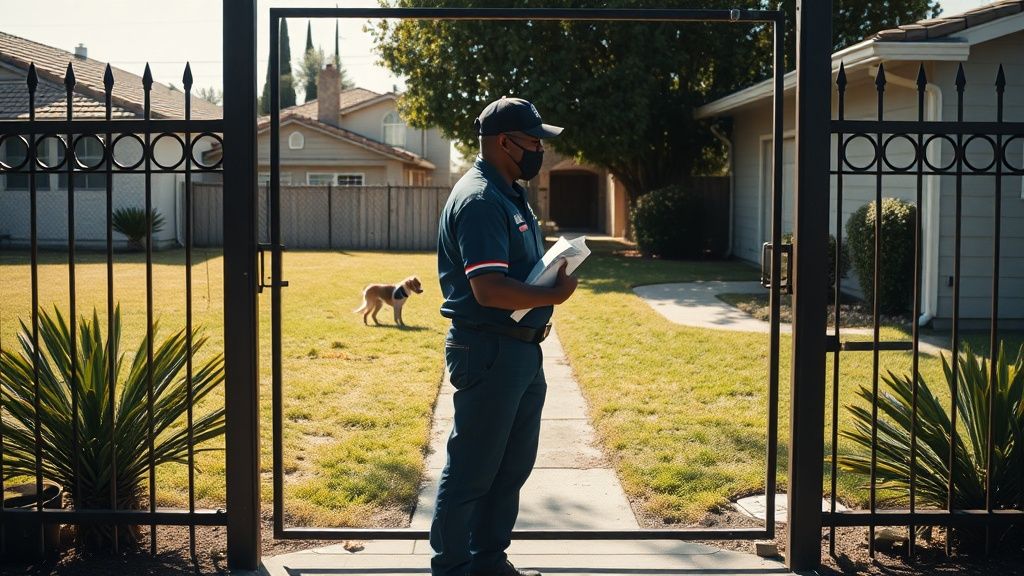
Public place: any street, park, sidewalk, beach, or publicly accessible space. Lawfully on private property: includes invited guests, delivery workers, mail carriers, utility workers, and anyone else with an express or implied right to be there. A social guest at the owner's home qualifies. A door-to-door salesperson with a posted "No Soliciting" sign is a closer call — but generally still qualifies unless actual notice of trespass was given.
3. The defendant owned the dog.
In most cases this is straightforward. In apartment complexes, multi-dog households, or situations where someone else was "handling" the dog at the time, ownership may be contested. Keep in mind that a person who was caring for the dog (a dog-sitter, for example) may also face liability under a separate negligence theory, even if they don't own the animal.
What you do NOT need to prove:
- Prior dangerous behavior by the dog.
- The owner's knowledge of any prior dangerous behavior.
- Any negligence by the owner.
That is strict liability in practice — the standard is easier to meet than ordinary negligence, which is exactly why the California Legislature enacted it.
Homeowner's and Renter's Insurance as the Usual Source of Recovery
Homeowner's and renter's insurance is usually the source of compensation in a California dog-bite case — the owner's insurer, not the owner personally, typically pays the settlement.
Most people picture a dog-bite lawsuit as suing an individual neighbor, which feels uncomfortable. In practice, the recovery almost always flows through an insurance policy — not directly from the owner's bank account.
Homeowner's insurance typically includes personal liability coverage that extends to dog-bite claims. Standard policies cover bodily injury caused by pets on or off the premises, subject to policy limits (commonly $100,000 to $300,000 in liability coverage) and any breed exclusions.
Renter's insurance works the same way. A renter who owns a dog is typically covered for dog-bite liability under their renter's policy, even if the bite happens away from the rental property.
What to watch for:
- Breed exclusions. Some insurers exclude certain breeds — pit bulls, Rottweilers, German Shepherds, Dobermans — from coverage. If the biting dog is an excluded breed, you may need to pursue the owner personally or look for a separate umbrella policy.
- Prior-bite exclusions. Some policies exclude dogs that have previously bitten someone. This is where the owner's claims history matters even though the legal standard doesn't require it.
- Umbrella policies. High-value dog-bite cases — typically those involving severe scarring, nerve damage, or significant lost wages — often exhaust the underlying homeowner's policy limit. An umbrella policy, if the owner has one, provides additional layers of coverage.
Practical step: When you consult an attorney, bring the name of the dog's owner and any insurance information you can gather. Your attorney can send a preservation letter to the insurer early, which prevents spoliation of the policy details.
Scarring, Nerve Damage, and Children as Victims
Dog bites are not just puncture wounds. Depending on the size of the dog and the location of the bite, injuries can include:
- Deep lacerations requiring stitches, staples, or surgical closure.
- Nerve damage — bites to the face, hand, or forearm can sever or compress nerves, causing permanent numbness, tingling, or loss of function.
- Bone fractures — large dogs can crush hand and wrist bones in a single bite.
- Infection — dog bites carry a significant infection risk, including Pasteurella, MRSA, and in rare cases, rabies. Post-exposure prophylaxis and antibiotic treatment add to medical costs.
- Permanent scarring and disfigurement — facial bites in particular often require multiple rounds of reconstructive or plastic surgery, which may continue for years.
- Psychological harm — post-traumatic stress, anxiety around dogs, and sleep disturbance are compensable non-economic damages in California.
Children as victims deserve specific attention. According to the CDC, children — particularly those between five and nine years old — are among the most frequently and seriously injured dog-bite victims. Because a child's face is at the same level as many dogs, bites often land there, with higher rates of facial scarring and disfigurement than in adult cases.
Children are among the most seriously injured dog-bite victims, and their claims may include future medical costs for reconstructive surgery and psychological treatment.
In a child's case, damages may include costs of future reconstructive surgeries extending into adulthood, as well as psychological counseling. Because a minor cannot settle their own claim, any settlement involving a child requires court approval under Cal. Prob. Code §3500 to protect the child's interests — a step that attorneys handle on the family's behalf.
Statute of limitations for minors. For injured children, the two-year limitations period under Cal. Code Civ. Proc. §335.1 is generally tolled (paused) until the child turns 18, giving them until age 20 to bring a claim. However, waiting that long typically means lost evidence and fading witness memories — acting sooner almost always produces better results.
Defenses: Trespass and Provocation
Cal. Civ. Code §3342 itself identifies two circumstances that limit or eliminate the owner's strict liability:
Trespass and provocation are the two statutory defenses under California's dog-bite law — if either applies, the owner's liability can be reduced or eliminated.
Trespass
The statute covers victims who are "in a public place or lawfully in a private place." If you were trespassing — on the property without permission, express or implied — you are outside the statute's protection. The owner may still face a negligence claim depending on the circumstances (California has modified the "no duty to trespassers" rule in specific contexts), but the strict-liability path is closed.
Gray areas: Being on a neighbor's front walk to knock on the door is generally not trespass. Cutting through a fenced backyard you knew was private likely is. The facts matter significantly.
Provocation
If the victim provoked the dog, the owner's liability is reduced or eliminated. Provocation does not require intentional teasing — courts look at whether a reasonable dog would have perceived the conduct as threatening. Stepping on a sleeping dog's paw, cornering an animal, or attempting to grab a dog that is eating can all constitute provocation.
Importantly, provocation is evaluated against an objective "reasonable dog" standard, not what the victim intended. A young child who accidentally provokes a dog may receive more lenient treatment than an adult who knowingly taunted one.
Comparative Fault Beyond Provocation
California's pure comparative fault rule means that even if you were partly responsible for the bite, you can still recover damages — your award is reduced by your percentage of fault.
California follows a pure comparative fault rule — established by the California Supreme Court in Li v. Yellow Cab Co., 13 Cal.3d 804 (1975) — meaning that if you were partly at fault for the incident, your recovery is reduced by your percentage of fault, but not eliminated (unless you are found 100% at fault). So if a jury finds you were 20% at fault for provoking the dog, you recover 80% of your damages.
What Damages Can You Recover?
A California dog-bite victim can pursue two categories of damages:
Economic damages — out-of-pocket, documentable losses:
- Emergency room and hospital bills
- Ongoing medical treatment, physical therapy, wound care
- Reconstructive or plastic surgery (including future procedures)
- Lost wages while recovering
- Future lost earnings if the injury causes permanent disability
- Prescription medications and medical devices
Non-economic damages — harder to quantify but fully compensable:
- Physical pain and suffering
- Emotional distress and psychological trauma
- Disfigurement and permanent scarring
- Loss of enjoyment of life
- Fear and anxiety (especially relevant when the victim develops a lasting phobia of dogs or crowds)
California does not cap non-economic damages in personal injury cases (the MICRA cap applies only to medical malpractice). That means there is no arbitrary ceiling on what a jury can award for pain and suffering in a dog-bite case.
What about punitive damages? Punitive damages in a dog-bite case are rare but not impossible. They apply when the owner's conduct was malicious or oppressive — for example, if an owner knew a dog had previously attacked people and deliberately concealed that history, or if they intentionally used the dog to threaten someone. These are uncommon scenarios, but if the facts support it, a California court can award punitive damages on top of compensatory ones.
The Two-Year Filing Deadline
California dog-bite claims are subject to a two-year statute of limitations under Cal. Code Civ. Proc. §335.1, meaning you generally have two years from the date of the bite to file a lawsuit.
Missing this deadline almost always means losing the right to sue — permanently. Two years sounds like a long time. It isn't. Evidence degrades, witnesses move, insurance policies get cancelled, and the dog's ownership history becomes harder to establish. Attorneys who handle dog-bite cases in California typically recommend contacting a lawyer within days to weeks of the incident, not months.
If a government employee was the dog handler — for example, a law enforcement K-9 unit — different rules apply. Claims against public agencies in California are subject to the Government Claims Act (Cal. Gov. Code §810 et seq.), which requires filing an administrative claim within six months of the incident before you can sue. Missing that six-month window can waive your right to recover entirely.
FAQ: California Dog Bite Law
Is California a strict liability state for dog bites?
Yes. Under Cal. Civ. Code §3342, dog owners are strictly liable for bite injuries. You do not need to prove the dog was previously dangerous or that the owner was negligent.
Do I have to prove the dog was dangerous before?
No. California abolished the "one free bite" rule. The statute imposes liability regardless of the dog's prior behavior or the owner's knowledge of any prior behavior.
Who pays for a dog bite injury in California?
Most compensation comes from the dog owner's homeowner's or renter's insurance policy. If the owner has no insurance, or if the policy excludes the dog's breed, you may need to pursue recovery directly from the owner.
What if the dog bit me on the owner's property?
You are still protected under Cal. Civ. Code §3342 if you were lawfully on the property — as a guest, delivery worker, contractor, or anyone else with express or implied permission to be there. Only trespassers are excluded from the statute's strict-liability protection.
What if I was partly at fault for the bite?
Your damages are reduced by your percentage of fault under California's pure comparative fault rule from Li v. Yellow Cab Co. (1975). You can still recover unless you are found 100% at fault.
Can I sue if the dog knocked me down but didn't actually bite me?
Not under §3342's strict liability rule — the statute specifically covers bites. However, you may have a negligence claim against the owner if they failed to control a dog they knew or should have known could harm people. These cases are harder to prove but not impossible.
How long do I have to file a dog-bite claim in California?
Two years from the date of the bite under Cal. Code Civ. Proc. §335.1. For children, the clock generally does not start until they turn 18. If a government employee's dog bit you, you have only six months to file an administrative claim under the Government Claims Act.
Are there breed-specific laws in California?
California state law prohibits breed-specific legislation at the state level, but some local ordinances impose additional restrictions on certain breeds. Regardless of breed, the §3342 strict-liability rule applies to every dog in California.
What if the dog's owner cannot be found or has no insurance?
This is a harder situation. Your attorney can investigate whether a landlord, property manager, or another party had control over the dog. In some cases, your own uninsured/underinsured motorist coverage or umbrella policy may apply — but this varies by policy.
Do I need an attorney for a dog-bite claim?
You are not legally required to hire an attorney, but insurance adjusters are trained to settle claims quickly and cheaply. Victims represented by attorneys typically recover more than those who negotiate on their own. Initial consultations are free, and personal injury attorneys take dog-bite cases on a contingency basis — no fee unless we win.
What to Do Right After a Dog Bite
- Get medical care immediately. Dog bites carry a real infection risk. An ER or urgent-care visit creates the medical record you'll need for your claim.
- Photograph the injury. Take photos before and after treatment, and continue photographing as the wound heals (or doesn't).
- Identify the dog and owner. Get the owner's name, address, and contact information. Ask for proof of rabies vaccination.
- Report the bite. In California, dog bites must be reported to local animal control or public health authorities. This creates an official record.
- Document the scene. Photograph where the bite occurred. Note whether there were "Beware of Dog" signs, fencing, or any other conditions.
- Gather witness information. Names and phone numbers of anyone who saw the incident.
- Contact an attorney before talking to the insurance company. The owner's insurer may contact you quickly with a settlement offer. Do not accept anything — or sign anything — until you understand the full extent of your injuries and your rights.
Call (818) 794-9947 — Free Case Review
If you or your child was bitten by a dog in California, you have a real claim under one of the most victim-protective statutes in the country — and you deserve to know what that claim is worth before you accept anything from an insurance company.
At Nordanyan Law, we handle personal injury cases, including dog-bite claims, across Southern California. We come to you if you can't travel. We handle everything in English and Spanish.
Call (818) 794-9947 for a free consultation. No fee unless we win.
Reviewed by Minas Nordanyan, CA Bar #296806. Last reviewed June 2026.