If you've been in a car accident in California, the evidence you collect in the first few minutes at the scene can determine whether your claim succeeds or fails. Insurance adjusters move fast. Skid marks fade. Witnesses leave. Footage gets overwritten. The physical reality of what happened begins disappearing almost immediately.
This guide covers the 10 specific categories of evidence that matter most in a California personal injury claim, why each one carries weight, and the legal rules that make collecting them both your right and your responsibility.
Quick-reference list:
- Photos of all vehicle damage from multiple angles
- Wide shots showing the road, lanes, and intersection layout
- Skid marks, debris, and the final resting position of each vehicle
- Traffic signs, signals, and any obstructed views
- The other driver's license, insurance, and license plate
- Names and phone numbers of every witness
- Photos of your visible injuries at the scene
- Weather, lighting, and road conditions at the time
- The responding officer's name, badge number, and report number
- Any nearby surveillance or dashcam sources to follow up on
1. Photos of All Vehicle Damage from Multiple Angles
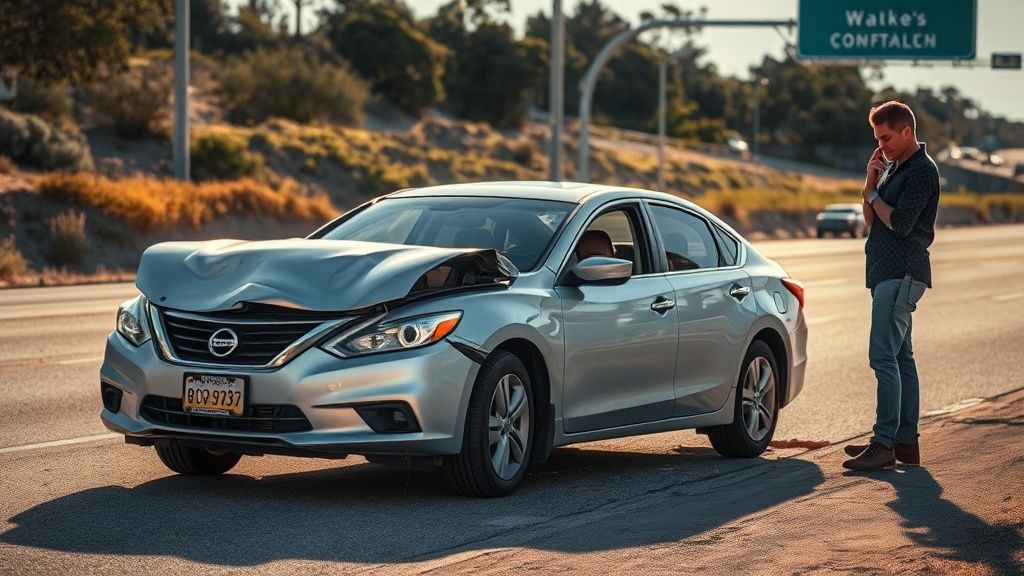
Photograph every vehicle involved from all four sides, close up and from a distance, before anything is moved, cleaned, or towed.
Close-up shots capture the depth and character of impact damage. Distance shots place that damage in context with the rest of the vehicle. Together, they let an accident reconstructionist estimate the force of the collision and identify the exact point of contact.
Many injured drivers photograph only the worst-looking damage and skip the panels that appear undamaged. That is a mistake. Adjusters and defense attorneys routinely argue that undocumented areas were pre-existing. If every panel is photographed, that argument disappears.
In California, fault is determined under a comparative fault system under Cal. Civ. Code §1714, which means the degree of damage visible on each vehicle directly affects how liability is apportioned. The more complete your photo record, the harder it is for the other side to minimize your claim.
Takeaway: Photograph all four sides of every vehicle, close up and at distance, before the scene clears.
2. Wide Shots Showing the Road, Lanes, and Intersection Layout
The individual damage photos tell you what happened to the vehicles. The wide shots tell you where the vehicles were and how they got there.
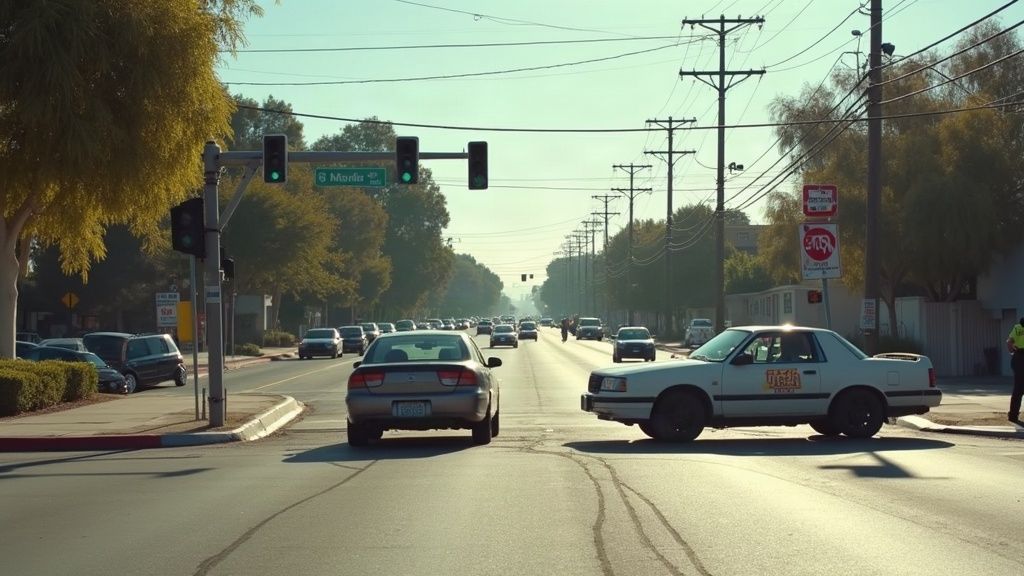
Pull back as far as you safely can and photograph the full road environment. Capture lane markings, center lines, crosswalks, turn lanes, and the geometry of how streets meet. If the crash happened at an intersection, take a shot from each of the four corners. If it happened on a highway, capture both directions of travel and any merge points.
These wide-angle context shots allow an attorney, an adjuster, or a jury to reconstruct exactly where each driver was positioned and how the collision unfolded, without relying solely on each party's account.
Road geometry can shift liability entirely. A driver who claims they had a green light is harder to challenge when a wide shot shows a traffic signal with a protected left-turn phase. A driver who claims they were in the correct lane is harder to dispute when the lane stripes are clearly documented.
Takeaway: Step back and photograph the full road layout from multiple directions before leaving the scene.
3. Skid Marks, Debris, and the Final Resting Position of Each Vehicle
Skid marks show where braking began, debris fields mark the point of impact, and each vehicle's final resting position confirms direction of travel, photograph all three before any vehicle is moved.
Skid marks are among the most time-sensitive evidence at any crash scene. Subsequent traffic, road crews, and rain can erase them within hours. The length and arc of a skid mark allow a reconstructionist to calculate pre-braking speed, which is often one of the central disputes in a negligence claim.
Debris, broken glass, plastic trim, fluid puddles, tire rubber, concentrates near the point of initial contact. Photograph the debris field in its entirety and include reference objects (a shoe, a water bottle, a lane stripe) so the scale is clear in the image.
The final resting position of each vehicle, documented before any towing, establishes the direction each car was traveling and the magnitude of the forces involved. Under California's negligence framework, these physical facts are often more persuasive than either driver's testimony.
Takeaway: Photograph skid marks, the full debris field, and each vehicle's final position before any tow truck arrives.
4. Traffic Signs, Signals, and Any Obstructed Views
California law requires roads to meet reasonable safety standards. When a sign is missing, a signal is malfunctioning, or a sight line is blocked by overgrown vegetation or an illegally parked commercial vehicle, the entity responsible for that condition may bear liability alongside or instead of the drivers involved.
Photograph every traffic control device near the crash: stop signs, signal heads (including whether the signal was functioning normally), speed limit signs, yield signs, and any warning markers. Then photograph the sight lines from each driver's perspective. If a bush, a fence, a parked truck, or a building corner blocked the view of oncoming traffic, that obstruction belongs in your evidence set.
Claims against government entities in California are governed by the California Tort Claims Act under Cal. Gov. Code §830, which creates liability for public property in a dangerous condition. Those claims come with a hard six-month deadline to file a government tort claim, shorter than the standard two-year personal injury statute of limitations under Cal. Code Civ. Proc. §335.1. If a signal failure or missing signage contributed to your crash, that photograph at the scene may be the difference between a viable government claim and a missed deadline.
Takeaway: Photograph every sign, signal, and visual obstruction near the crash; a government entity may share liability, and that claim has a six-month filing window.
5. The Other Driver's License, Insurance, and License Plate
This is not optional. Cal. Veh. Code §16025 requires every driver involved in a collision to provide their driver's license, name, current residence address, vehicle registration number, and evidence of financial responsibility (insurance) to all other parties involved. Photograph each document, do not rely on manually writing down the information, and photograph the license plate from a distance that makes the characters clearly legible.
If the other driver refuses to provide this information, that refusal is itself a Vehicle Code violation and should be noted to the responding officer. If they leave the scene, write down everything you can remember about the vehicle (color, make, model, partial plate) and tell the officer immediately. A hit-and-run triggers your own uninsured motorist coverage under Cal. Ins. Code §11580.2, which covers bodily injury caused by an uninsured or unidentified motorist.
Additionally, California requires every driver involved in a collision resulting in injury or property damage exceeding $1,000 to file a report with the DMV within ten days under Cal. Veh. Code §16000. Having the other driver's complete information is necessary to complete that report accurately.
Takeaway: Photograph the other driver's license, insurance card, registration, and license plate before the scene clears, state law requires this exchange.
6. Names and Phone Numbers of Every Witness
Insurance adjusters are trained to discount the accounts of the parties involved in a crash because both have a financial stake in the outcome. Witnesses have no such stake. A bystander who watched the collision from a nearby sidewalk, a cyclist who was stopped at the light, or a pedestrian who saw the other driver run a red, their account carries weight that your account and the other driver's account simply do not.
Approach every person who stopped to watch and ask for their full name and a phone number where they can be reached. Note where they were standing when the collision occurred, because their field of view affects what they could and could not have observed. If anyone is willing, ask them to briefly describe what they saw while you record a short video on your phone.
Witnesses scatter quickly. Once they leave the scene without leaving contact information, they are often impossible to find. Your attorney cannot preserve testimony from a witness they cannot locate.
Takeaway: Collect every bystander's full name, phone number, and standing position before they leave the scene.
7. Photos of Your Visible Injuries at the Scene
Injury photos taken at the accident scene carry a built-in timestamp that proves harm existed immediately after the collision, before any gap in treatment that an insurer might try to use against you.
Insurers routinely argue that injuries were not caused by the crash in question, or that they were pre-existing conditions. A photograph taken at the scene, with the vehicle and road visible in the background, ties your injury directly to that collision in a way that a hospital intake photo taken two hours later cannot.
Photograph cuts, scrapes, bruising, swelling, airbag burns, and road rash before anyone cleans or bandages the wounds. If a passenger was injured, photograph their injuries as well. If you are too hurt to take the photos yourself, ask a bystander or a passenger to do it.
You do not need to see blood to have a compensable injury. Soft tissue injuries, whiplash, and internal bruising may not produce visible marks, but a photo of your posture, your face, your visible distress, or any redness or swelling is still worth taking. Under California law, compensable damages include pain and suffering as well as medical expenses under Cal. Civ. Code §3333.
Takeaway: Photograph every visible injury before wounds are cleaned, and note any symptoms of pain even if there is no visible mark.
8. Weather, Lighting, and Road Conditions at the Time
Photograph the road surface, the sky, and any environmental factor that was present at the time of the crash: wet pavement, standing water, oil sheen, glare from the sun, fog, potholes, uneven asphalt, or construction debris. A written description of these conditions added to the police report or to your own notes is useful, but a photograph taken at the scene is far stronger because it cannot be disputed the way memory can.
Environmental conditions are central to comparative fault disputes. If the road surface was wet and the other driver was traveling at the posted speed limit but still could not stop in time, the road condition becomes relevant to whether that speed was actually reasonable under the circumstances. California holds drivers to the standard of a reasonably prudent person under the conditions actually present, not simply the posted limit.
Note the time of day as well. Lighting conditions at 5:45 p.m. in January are materially different from lighting at noon in July, and the angle of direct sun glare can be documented by photographing the sky in the direction each driver was looking.
Takeaway: Photograph pavement, sky, and any hazardous road condition at the moment of the crash, and record the exact time.
9. The Responding Officer's Name, Badge Number, and Report Number
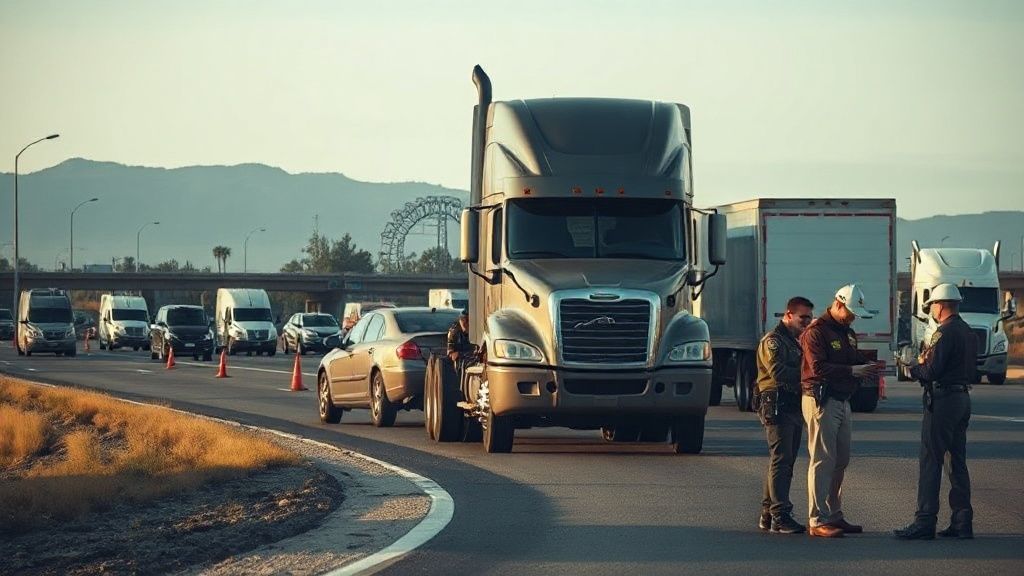
The police crash report is filed with the responding law enforcement agency, the CHP or local police department, and is the official document that records how the collision occurred.
Write down the responding officer's full name, badge or ID number, and the incident or report number they assign to the crash. The police crash report prepared by that officer is the official account of how the collision occurred. It will include the officer's assessment of contributing factors, any citations issued, witness names the officer collected, and diagrams of the scene. Attorneys, adjusters, and courts rely on it as the baseline factual record.
California law requires you to file a separate SR-1 report with the DMV within ten days if the collision resulted in injury or death, or property damage of $1,000 or more, under Cal. Veh. Code §16000. The report number the officer gives you helps ensure the two records are aligned. You can request a copy of the completed police report from the responding agency (CHP or local police department), typically within a few days of the crash, using that report number.
Takeaway: Write down the officer's name, badge number, and report number before you leave the scene, your attorney will need all three to pull the official record.
10. Any Nearby Surveillance or Dashcam Sources to Follow Up On
Cameras capture what no human witness can: an unbiased, continuous record of exactly what happened. Traffic intersection cameras, business security cameras, ATM cameras, Ring doorbells, and dashcams mounted in nearby vehicles may have recorded the crash or the seconds leading up to it.
Survey the scene before you leave. Note the location of every camera you can see, mounted on traffic poles, on building facades, facing the road from parking lots. Write down the business name and address for every commercial property with a visible camera. If another driver stopped who has a dashcam, ask whether their camera was recording and request a copy.
Video evidence is fragile. Security systems routinely overwrite footage on 24-to-72-hour cycles. Traffic camera footage managed by city or county agencies has its own retention schedule, which may be equally short. Once footage is overwritten, it is gone. Your attorney can send a written legal hold and preservation letter to each business, municipality, or individual requesting that footage be preserved. That letter needs to go out within hours of the crash, not days.
Takeaway: Survey the scene for every camera you can see, record business names and addresses, and tell your attorney immediately so preservation letters go out before footage is overwritten.
How This Evidence Protects Your California Personal Injury Claim
California personal injury claims are governed by a pure comparative fault system. Under Cal. Civ. Code §1714, any percentage of fault attributed to you reduces your recovery by that percentage. Insurance adjusters know this. Their job is to find evidence, or the absence of evidence, that increases your percentage of fault and reduces the amount they pay.
Every item on this list directly closes a gap that an adjuster would otherwise exploit. No photos of the scene? The adjuster reconstructs it from their own sources. No witness contact information? The adjuster relies on the other driver's version. No injury photos? The adjuster argues your injuries appeared after the crash. Each piece of evidence you collect at the scene is a gap the other side cannot fill with a narrative that benefits them.
We've recovered significant compensation for injured workers and car accident victims across Southern California. If you were hurt in a crash and you're not sure whether the evidence you have is enough to support a claim, a free case review costs you nothing. No fee unless we win.
Call (818) 794-9947 to speak with a California personal injury attorney. We come to you if you cannot travel.
Frequently Asked Questions
What evidence should I collect after a car accident?
The most important categories are: photos of all vehicle damage from multiple angles, wide shots of the road and intersection layout, skid marks and debris, traffic signs and any obstructed sight lines, the other driver's license and insurance information, names and phone numbers of every witness, photos of your visible injuries, weather and road conditions, the responding officer's report number, and the location of any nearby surveillance cameras. Collect all ten categories before leaving the scene if you are physically able to do so.
What photos should I take at the accident scene?
Photograph every vehicle from all four sides, the full road layout from multiple directions, skid marks and debris, traffic signs and signals, your own visible injuries, weather and road conditions, and the location of any cameras or dashcams you can see. Take close-up and distance shots for damage photos. Include reference objects in debris photos so scale is clear.
Do I need witness information after a crash?
Yes. Eyewitness accounts from people with no financial stake in the outcome carry significant weight with insurance adjusters and juries. Collect every bystander's full name and phone number before they leave the scene. Note where they were standing so your attorney understands their field of view. Witnesses who leave without giving contact information are almost impossible to locate afterward.
How important is evidence in a car accident claim?
Evidence is the foundation of a California personal injury claim. California uses a pure comparative fault system under Cal. Civ. Code §1714, meaning your recovery is reduced by whatever percentage of fault is attributed to you. The evidence you collect at the scene directly limits the other side's ability to shift fault onto you. Without scene evidence, adjusters reconstruct the crash using sources favorable to their interests.
What happens if I forget to collect evidence at the scene?
An attorney can still pursue your claim, but the evidentiary gaps make the process harder. Your attorney can subpoena the police report from the responding agency, request surveillance footage (though speed matters), hire an accident reconstructionist, and search for witnesses through social media and neighborhood canvassing. The sooner you contact an attorney after a crash, the more evidence preservation options remain open.
Can surveillance footage be used as evidence in a California car accident claim?
Yes, and it is often among the most persuasive evidence available. Surveillance and dashcam footage shows exactly what happened without relying on any party's account. However, most systems overwrite footage on cycles as short as 24 to 72 hours. Your attorney must send a written preservation letter to each recording owner immediately after the crash. Note every visible camera at the scene before you leave.
Does California require me to file any reports after a crash?
Yes. If the collision resulted in injury, death, or property damage of $1,000 or more, you must file an SR-1 report with the DMV within ten days under Cal. Veh. Code §16000. Separately, the responding law enforcement agency (CHP or local police) generates its own crash report, which your attorney can obtain using the report number the officer provides at the scene.