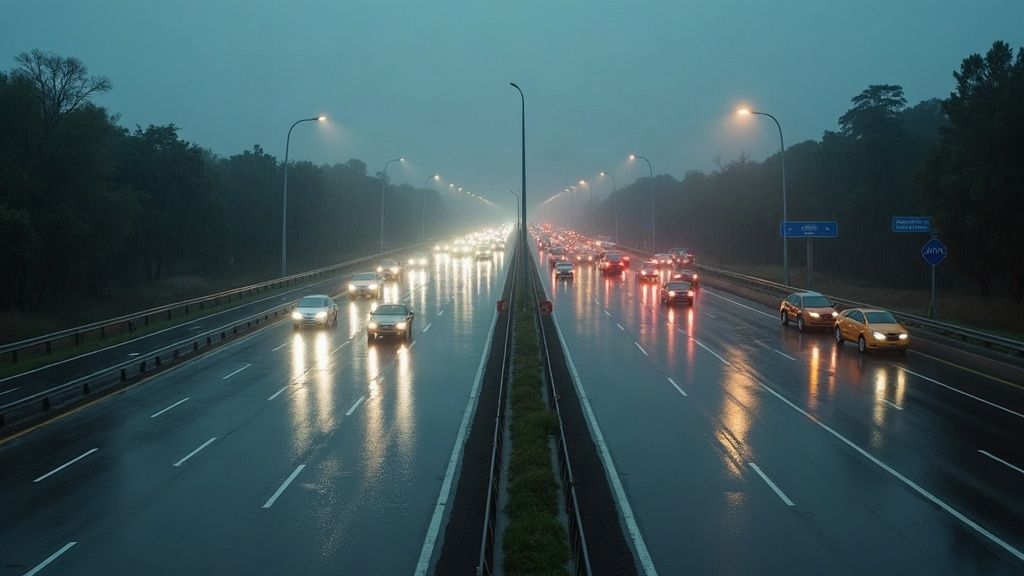
If you've ever spun out on a wet California freeway or felt your steering go light for a terrifying second in the rain, you already know how fast a hydroplaning accident can happen. What you may not know is how many myths surround these crashes, myths that cost injured drivers thousands of dollars in lost compensation every year.
California handles rain-related crash liability the same way it handles any other collision: fault, evidence, and damages under a pure comparative fault system. The rain does not change the rules. The myths below do real harm. Here is what the law actually says.
Quick summary, the 8 myths busted:
- Hydroplaning does not automatically make you at fault.
- Rain does not make your claim worthless.
- Insurers do not automatically treat weather claims fairly.
- Road design and drainage defects can create government liability.
- Low-speed rain crashes can cause serious injuries.
- You can prove speed for conditions without a police citation.
- Worn tires factor directly into fault.
- Skipping the doctor after a "minor" wet-road crash can destroy your claim.
1. Hydroplaning Accidents Are Automatically the Driver's Fault
The myth: If your car hydroplaned, you must have been driving too fast, so the crash is on you.
The truth: Hydroplaning is a condition, not an automatic verdict. California fault law asks a single question: did each driver act as a reasonably careful person would under the conditions? Cal. Veh. Code §22350 requires every driver to travel at a speed that is safe given traffic, visibility, road surface, and weather. A driver who follows that standard and still hydroplanes due to road design problems, sudden standing water, or another driver's unexpected maneuver is not automatically negligent.
California also follows pure comparative fault under Cal. Civ. Code §1431.2. Even if you were 30% responsible, you can still recover 70% of your damages. Fault is allocated in percentages, not given entirely to the driver whose car lost traction.
Hydroplaning does not automatically make you at fault in California, fault turns on whether you were driving reasonably for the road and weather conditions under California Vehicle Code Section 22350.
Takeaway: Do not accept blame because your car hydroplaned. The full picture of road conditions, speeds, and each driver's conduct determines fault.
2. Rain-Related Crashes Are Not Worth Pursuing Because Weather Was Involved
The myth: Bad weather caused the accident, so no one is really at fault and a claim will go nowhere.
The truth: Weather is a condition, not a defense. When another driver tailgates you in the rain, changes lanes without looking, or runs a stop sign on a slick intersection, their negligence does not vanish because the road was wet. California law has always imposed a duty to drive with greater care when conditions demand it. A driver who ignores that duty and hits you in a downpour is still liable.
Bad weather does not bar a California car accident claim; another driver's negligence in the rain is still negligence under California's comparative fault rules.
The dollar value of rain-related claims is governed by the same categories as any other crash: medical expenses, lost wages, property damage, and pain and suffering. Weather may be part of the factual picture, but it does not shrink damages that are otherwise provable and documented.
Takeaway: The fact that it was raining when you were hit does not reduce the value of your claim if another party's negligence caused your injuries.
3. Insurance Companies Automatically Treat Weather Claims Fairly
The myth: The adjuster will see that it was raining, recognize the difficulty of the situation, and offer a fair settlement.
The truth: Adjusters work for the insurance carrier, not for you. Rain-related crashes give adjusters an opening to argue that "weather caused it," reducing or eliminating their driver's assigned fault and, with it, the payout to you. This is a documented tactic, not a rare one.
California insurance companies are not required to treat weather-related claims favorably, and many adjusters use rain as a reason to reduce or deny payouts.
California's Fair Claims Settlement Practices Regulations, administered by the California Department of Insurance, require insurers to conduct a thorough investigation and offer fair settlements based on the evidence, but "fair" is not self-enforcing. Insurers that stall, lowball, or misrepresent the evidence can face bad faith claims, but extracting that accountability almost always requires an attorney.
Takeaway: Never assume the insurance company is working through the facts neutrally. Document everything, photos, weather service records, road drainage reports, witness contact information, before talking to an adjuster.
4. Road Design or Maintenance Issues Do Not Matter in Wet-Weather Crashes
The myth: If the road was poorly drained or poorly designed, that is just bad luck. Government entities are not worth suing.
The truth: California government entities, cities, counties, and the state itself, have a legal duty to maintain public roads in a reasonably safe condition. Cal. Gov. Code §835 imposes liability when a public entity's property is in a dangerous condition that creates a reasonably foreseeable risk of injury. Inadequate road drainage that causes standing water to accumulate in a travel lane, worn lane-groove patterns that no longer channel water, or deferred resurfacing that leaves ruts and channels, these are all conditions that courts have found actionable.
A city or county can be held liable for a hydroplaning crash if poor road drainage or deferred maintenance created an unreasonably dangerous condition under California Government Code Section 835.
Critical deadline: Claims against government entities in California require a tort claim to be filed with the agency within six months of the incident under Cal. Gov. Code §911.2. Miss that window and you lose the right to sue entirely, a deadline most injured drivers do not know exists.
Takeaway: If road drainage, surface conditions, or lane design contributed to your hydroplaning crash, a government entity may share liability. The six-month claim deadline makes acting quickly critical.
5. Low-Speed Rain Accidents Cannot Cause Serious Injuries
The myth: It was only a fender-bender in the rain, no one gets seriously hurt at low speeds.
The truth: The physics of hydroplaning undercut this myth directly. A vehicle that has partially or fully lost contact with the road can be moving faster than the driver realizes at the moment of impact. When the tires finally grip, or contact a barrier or another vehicle, the deceleration is sudden and transfers significant force to occupants. Soft tissue injuries, including whiplash to the cervical spine, commonly result from crashes that left minimal vehicle damage.
California courts have long recognized that property damage and injury severity do not always correlate. A small dent can accompany a serious neck or back injury. Insurance adjusters know this and frequently use "low impact" arguments to reduce soft tissue injury claims. Medical literature documents delayed symptom onset in whiplash: pain and stiffness often appear 24 to 72 hours after the collision, meaning a driver who feels fine at the scene may have a genuine injury developing.
Low-speed rain accidents can cause serious soft tissue injuries including whiplash, which may not produce symptoms for 24 to 72 hours after the crash.
Takeaway: Never let the size of the dent decide whether you seek medical attention. Your body's response to the force of impact matters more than the repair estimate.
6. You Cannot Prove Another Driver Was Speeding for Conditions
The myth: If the police did not cite the other driver for speeding, you cannot prove they were going too fast for the rain. The claim dies there.
The truth: A police citation is useful evidence, it is not the only evidence. Speed for conditions violations under Cal. Veh. Code §22350 can be established through multiple independent sources:
- Crash reconstruction: A trained engineer can calculate pre-impact speed from skid marks, gouge marks, vehicle crush, and resting positions.
- Vehicle data recorders (event data recorders): Most modern vehicles record speed, brake application, and throttle position in the seconds before a crash.
- Traffic and surveillance cameras: California's urban freeways and many intersections have camera infrastructure that may have captured the other driver's behavior.
- Witness statements: Bystanders, other motorists, and first responders can describe what they observed about the other driver's speed and conduct.
- Weather and road condition data: NOAA records, Caltrans drainage reports, and local weather station data establish the objective hazard level the other driver was facing.
Together, these sources can build a negligence case that does not depend on a citation.
Takeaway: The absence of a ticket does not close a rain crash claim. Evidence of speed for conditions exists independent of law enforcement records.
7. Tire Condition Does Not Factor Into Fault in a Rain Crash
The myth: Tires are a maintenance issue, not a legal one. No one checks tire tread in a crash investigation.
The truth: Tire tread depth is a legal standard in California. Cal. Veh. Code §27465 prohibits operating a vehicle with tires worn below the tread depth established by regulation. Tires with insufficient tread cannot channel water effectively, dramatically increasing the risk of hydroplaning. When an at-fault driver's tires are found to be worn below legal minimums at the time of a wet-road crash, that condition is direct evidence of negligence, and can increase the percentage of fault assigned to that driver.
Investigators and attorneys routinely request post-crash vehicle inspections that document tire condition. In severe crashes, law enforcement may photograph or measure tires as part of the scene investigation. In civil litigation, a vehicle inspection by a retained expert is standard practice.
If the at-fault driver's tires were legally defective and the tire manufacturer or a recent service center knew or should have known, additional liability theories, including product liability and third-party negligence, may also be available.
Takeaway: Tire condition is documented, measured, and used in California crash fault analysis. Worn tires on the vehicle that hit you can materially strengthen your claim.
8. It Is Fine to Skip a Doctor Visit After a Minor Wet-Road Accident
The myth: The crash seemed minor, you feel okay, and going to a doctor seems like overkill. You can wait and see how you feel.
The truth: This is the myth most likely to permanently damage your California personal injury claim. Insurance adjusters are trained to look for gaps in treatment, and a gap that begins at the scene of the crash is the most damaging gap of all. If you did not seek medical attention after the accident, the adjuster's argument is simple: if you were really hurt, you would have gone to a doctor. That argument, paired with delayed symptom onset in whiplash and soft tissue injuries, puts you in the position of explaining why you waited, a position you should never be in.
Medical records created within 24 to 48 hours of the crash establish a contemporaneous link between the collision and your injuries. That link is the foundation of a damages claim. Without it, everything rests on records created days or weeks later, when the insurer's narrative of "you weren't that hurt" has had time to take hold.
Skipping a doctor visit after a minor wet-road accident can permanently damage your California personal injury claim, because insurers argue that gaps in treatment mean the injuries were not serious.
California law does not require you to establish a perfect medical history to recover damages, but it does require you to prove that the accident caused your injuries. A same-day or next-day medical visit is the single most powerful thing you can do to protect that proof.
Takeaway: Go to a doctor the same day or within 24 hours of any rain-related crash, even if you feel fine at the scene. Your medical record is your claim's foundation.
What to Do If You Were Hurt in a California Rain or Hydroplaning Accident
The myths above all point to the same underlying reality: rain-related crash claims in California require the same documentation, legal analysis, and advocacy as any other serious crash, and in some ways more, because weather gives insurers an easy narrative to exploit.
Here is what to do immediately:
- Call 911. Get law enforcement and emergency medical services to the scene. The police report establishes facts while memories are fresh.
- Get medical attention the same day. Even if you feel fine. Especially if you feel fine, whiplash symptoms are frequently delayed.
- Document the scene. Photograph standing water, tire marks, road surface, drainage conditions, vehicle positions, and any visible road defects.
- Collect witness information. Names and phone numbers of anyone who saw the crash or the road conditions beforehand.
- Preserve your tires and vehicle. Do not have your car repaired until an attorney or expert has had a chance to document the physical evidence.
- Do not give a recorded statement to the other driver's insurer without legal counsel.
- If a government road defect contributed, act within six months. Cal. Gov. Code §912.2 is unforgiving.
We've recovered over $150,000,000 for injured Californians, including victims of rain and wet-road crashes, across more than 7,500 cases. If you've been hurt in a hydroplaning accident, the myths above may already be working against your claim. Call (818) 794-9947 for a free case review. No fee unless we win.
Frequently Asked Questions
Is hydroplaning always the driver's fault in California?
No. Hydroplaning is not automatic proof of fault. California law under Cal. Veh. Code §22350 asks whether a driver was traveling at a speed that was safe for the conditions. If another driver's negligence, a road defect, or sudden standing water caused the hydroplaning event rather than the driver's own unreasonable conduct, that driver may bear little or no fault. California's pure comparative fault system allocates liability in percentages, it does not assign all fault to the driver whose car lost traction.
Can you file a claim after a rain-related car accident in California?
Yes. A rain-related crash claim follows the same rules as any other California vehicle collision claim. You must show that another party was negligent, driving too fast for conditions, following too closely, or failing to maintain safe vehicle equipment, and that the negligence caused your injuries and damages. The rain is part of the factual background, not a bar to recovery.
Does bad weather reduce how much a car accident claim is worth?
Not automatically. Damages in a California personal injury claim, medical expenses, lost wages, property damage, and pain and suffering, are not reduced simply because it was raining. Weather may affect how fault is allocated among parties, which can affect the share of damages each party pays, but documented injuries and losses retain their full value under California law.
Can a city be liable for poor drainage causing a hydroplaning crash?
Yes. Under Cal. Gov. Code §835, a public entity is liable for injuries caused by a dangerous condition of public property if the entity had notice of the condition and failed to correct it in a reasonable time. Chronic standing water from inadequate drainage, deteriorated road surfaces, or missing pavement grooves that are supposed to channel water are conditions that courts have found actionable. A tort claim against the government entity must be filed within six months of the incident under Cal. Gov. Code §912.2.
What evidence can prove speed for conditions in a rain crash without a police citation?
Crash reconstruction by a qualified engineer, vehicle event data recorder downloads, traffic and surveillance camera footage, witness statements, and weather and road condition data from NOAA and Caltrans can collectively establish that a driver was traveling at an unsafe speed for rainy conditions under Cal. Veh. Code §22350. A citation from law enforcement is useful but not required to prove negligence in civil litigation.
How does tire condition affect fault in a California wet-road accident?
California Vehicle Code §27465 sets minimum tread depth requirements for vehicle tires. Tires worn below those minimums reduce water-channeling capability and increase hydroplaning risk. When an at-fault driver's tires are documented to have been legally deficient at the time of a rain crash, that condition is evidence of negligence and can increase the percentage of fault assigned to that driver in a comparative fault analysis.
How long do I have to file a personal injury claim after a rain crash in California?
California's general statute of limitations for personal injury claims is two years from the date of injury under Cal. Code Civ. Proc. §335.1. If a government entity may be liable for road design or maintenance defects, a separate tort claim must be filed with that entity within six months of the incident under Cal. Gov. Code §912.2, a much shorter and strictly enforced deadline.
What should I do immediately after a hydroplaning accident in California?
Call 911, seek medical attention the same day even if you feel fine, photograph the road surface and drainage conditions, collect witness contact information, preserve your vehicle and tires for inspection, and do not give a recorded statement to the opposing insurer without an attorney. If a government road defect contributed, contact an attorney immediately to protect the six-month government claims deadline.
Reviewed by Minas Nordanyan, CA Bar #296806. Last reviewed September 2026. This article is general legal information for California readers, not legal advice for your specific situation. Call (818) 794-9947 for a free case review with a licensed California personal injury attorney.