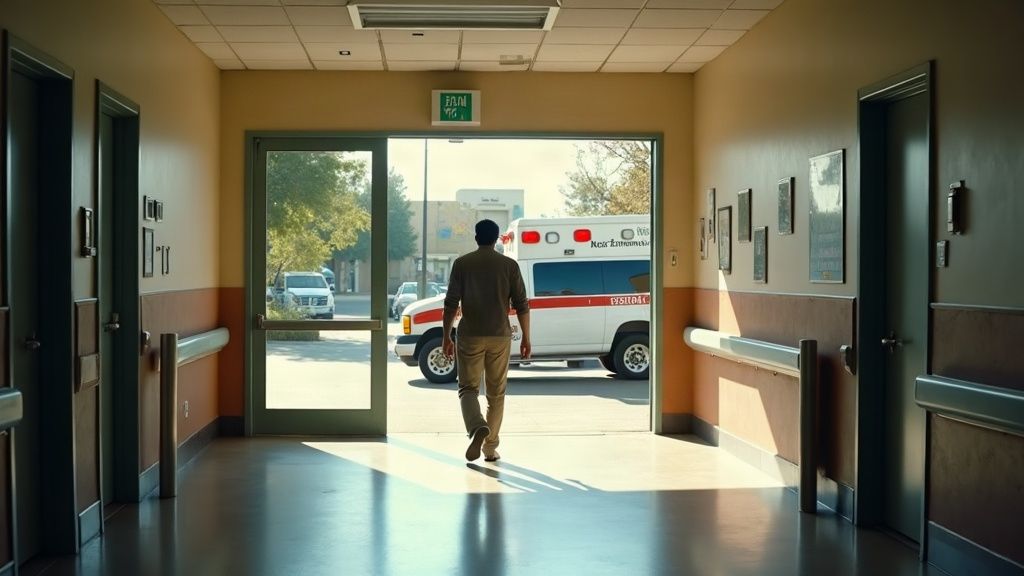
If you were in a car accident today and you feel fine right now, the instinct to skip the doctor is understandable. Nothing hurts. The car might not even look that bad. Why sit in a waiting room for hours?
Here is the honest answer: some of the most serious crash injuries produce no pain at the scene. Adrenaline, shock, and the mechanics of soft-tissue trauma all work together to hide the damage. By the time you feel it, days of evidence may already be gone, and every day you wait without a medical record makes your recovery harder and your legal options weaker.
We have recovered over $150,000,000 for injured Californians. The cases that come to us in the worst shape are not the ones with serious accidents. They are the ones where someone felt fine, waited two weeks, and then showed up with a denied insurance claim and a chronic neck injury. This article explains why that happens, and what you should do instead.
Here are the 8 reasons to see a doctor after a crash even if you feel fine:
- Adrenaline can mask pain for hours or days
- Some injuries, like concussions, are not obvious at first
- Internal injuries can be dangerous without early signs
- Early treatment leads to a better recovery
- A prompt medical record ties your injuries to the crash
- Gaps in care get used to deny or reduce your claim
- A doctor can catch problems before they worsen
- It protects both your health and your legal options
1. Adrenaline Can Mask Pain for Hours or Days
Adrenaline released during a crash can suppress pain for hours or even days, so feeling fine at the scene does not mean you are uninjured.
When your body detects a threat, like a collision, it floods your bloodstream with adrenaline and cortisol. These hormones trigger the fight-or-flight response, which among other things suppresses the perception of pain. This is a survival mechanism. It kept your ancestors moving after being hurt. In a crash, it keeps you walking around the scene exchanging insurance information while soft tissue tears and spinal structures compress in ways you cannot feel yet.
The effect can last anywhere from a few hours to two full days. Whiplash is the most common example: the cervical spine sustains micro-tears in muscles and ligaments during rapid deceleration, but the inflammation that produces pain does not peak until 24 to 48 hours later. Many people wake up the morning after a collision unable to turn their heads and have no idea why.
Practical takeaway: Go to an urgent care clinic or emergency room the same day, before the adrenaline wears off. A physician's notes from that visit document your condition at its closest point to the crash, which is exactly what you need.
2. Some Injuries, Like Concussions, Are Not Obvious at First
Concussions frequently produce no immediate symptoms, headaches, confusion, and cognitive changes can appear 24 to 72 hours after impact.
A concussion is a form of traumatic brain injury caused by the brain moving rapidly inside the skull during a collision. You do not have to hit your head on the steering wheel to sustain one. The rapid deceleration of a vehicle can cause the brain to shift even with a seatbelt on.
The reason concussions are so dangerous is that they are easy to dismiss in the first hours. You feel alert. You answer questions normally at the scene. There is no blood, no visible wound. But neurological symptoms, persistent headaches, difficulty concentrating, irritability, sleep disruption, and sensitivity to light, often emerge 24 to 72 hours after impact. Left untreated, a concussion increases the risk of post-concussion syndrome, which can last months and affect your ability to work.
A physician performing a post-collision evaluation will administer neurological screening that you cannot perform on yourself. They know what to look for when you do not.
Practical takeaway: Tell every doctor you see about the crash, even if your only complaint is feeling "a little off." That language in a medical chart can later support a brain injury diagnosis.
3. Internal Injuries Can Be Dangerous Without Early Signs
Internal injuries from blunt-force trauma can be life-threatening before any pain or external signs develop.
Blunt-force trauma from a seatbelt, steering wheel, or airbag deployment can damage organs including the spleen, liver, and kidneys without leaving any external marks. Internal bleeding can develop slowly, meaning a person walks away from the scene feeling fine and deteriorates over the following hours as blood accumulates in the abdominal cavity.
The absence of pain is not reassurance. It is a warning sign. The body's initial response to internal hemorrhage can include few symptoms until blood loss reaches a critical threshold. At that point, emergency intervention is necessary.
A physician can order imaging, a CT scan or abdominal ultrasound, that detects internal bleeding before it becomes life-threatening. This is not a test you can perform at home, and it is not something that shows up in symptoms until it is already a medical emergency.
Practical takeaway: If you were in a collision involving significant impact forces, even without visible injury, ask the treating physician specifically whether imaging of the chest or abdomen is warranted.
4. Early Treatment Leads to a Better Recovery
Early medical treatment after a crash produces measurably better physical outcomes. This is not a legal argument, it is a clinical one.
Soft-tissue injuries like whiplash respond well to early physical therapy, anti-inflammatory treatment, and activity modification. When those interventions begin within the first week, the likelihood of long-term chronic pain decreases significantly. When they are delayed by weeks, scar tissue begins to form, compensatory movement patterns develop, and what could have been a six-week recovery becomes a six-month one.
The same principle applies to herniated discs. A disc injury caught early can often be managed conservatively with physical therapy and epidural steroid injections. Left untreated, a herniated disc can progress to the point where surgery is the only option. Surgery is more dangerous, more expensive, and far more disruptive to your life than conservative early treatment.
Your body heals best when it has early, accurate information about what is wrong and a treatment plan designed around that information.
Practical takeaway: A same-day or next-day visit to a physician means treatment starts sooner. Every day of delay is a day your body is managing an injury without a plan.
5. A Prompt Medical Record Ties Your Injuries to the Crash
In California, a medical record created within 72 hours of a collision is the strongest evidence linking your injuries to the crash for a personal injury claim.
California personal injury law requires you to prove causation: the crash caused your injuries. This is not assumed. The defendant's insurance company will actively dispute it, and one of their most effective tools is the timeline between the collision and your first medical visit.
A medical record created the same day or within 72 hours of the crash is the cleanest possible evidence of causation. The record will document your account of the accident, the mechanism of injury, your reported symptoms, the physician's objective findings, and the diagnostic impressions, all anchored to a date that sits immediately after the collision.
The further you get from the crash without a medical record, the easier it becomes for an insurer to argue that your injuries came from somewhere else: a pre-existing condition, a subsequent activity, a second incident. That argument is much harder to make when your chart from the day of the crash already describes your condition.
This is not about gaming the legal system. It is about preserving an accurate record of what happened to your body.
Practical takeaway: Go to the doctor and tell them, in your own words, exactly how the crash happened and where you feel symptoms, even if those symptoms are vague. Get it in writing the same day.
6. Gaps in Care Get Used to Deny or Reduce Your Claim
Insurance adjusters routinely use gaps in medical treatment to argue a claimant was not seriously hurt, which can reduce or eliminate a damages award.
Insurance adjusters are trained to look for inconsistencies between a claimant's reported pain and their behavior. A two-week gap between a collision and the first medical visit is one of the most powerful tools they have.
Their argument is simple: if you were really hurt, you would have gone to the doctor right away. The fact that you waited means either you were not hurt, or something that happened in the intervening two weeks caused the injury, not their insured driver.
This argument is legally available to them. California Evidence Code allows admission of evidence about the timing of medical treatment in civil personal injury cases. Defense attorneys use it at trial. Insurance adjusters use it in negotiations. Even a valid, serious injury claim can be substantially reduced because of a gap in care.
A gap in treatment can also undermine your credibility. Jurors and adjusters alike have difficulty reconciling "I was in serious pain" with "I waited three weeks to see anyone." Closing that gap by seeking care immediately removes the argument entirely.
Practical takeaway: If you have already waited and now have a gap, do not wait any longer. Call a physician today and be completely honest about your timeline. Explain that you believed you were fine and symptoms worsened. That explanation belongs in the chart.
7. A Doctor Can Catch Problems Before They Worsen
A physician examining you after a collision is not just documenting what is wrong today. They are also looking for conditions that are likely to progress if untreated.
Hairline fractures in the vertebrae, for example, may produce only mild discomfort at first. Without imaging, they go undetected. Normal activity on a hairline fracture can cause it to worsen into a complete fracture, which is a far more serious injury requiring more aggressive treatment and a longer recovery.
Similarly, a small herniated disc that is asymptomatic today, because the herniation has not yet compressed a nerve root, can become severely painful and disabling weeks later if not identified and managed. A physician who sees you early can order an MRI, identify the herniation, and recommend activity modifications that prevent it from worsening.
Cervical instability, torn tendons, and partial ligament tears all follow the same pattern: manageable early, progressively harder to treat the longer they go unaddressed.
Practical takeaway: Think of the post-collision medical visit not as treating symptoms you have but as screening for problems that could develop. The doctor's job is to look ahead.
8. It Protects Both Your Health and Your Legal Options
Seeing a doctor the same day or within 72 hours of a crash protects both your physical health and your legal right to recover compensation in California.
Every point on this list reduces to this one: the decision to see a doctor after a collision, even when you feel fine, protects two things at once.
Your health is protected because delayed injuries get diagnosed, internal injuries get ruled out, and a treatment plan begins before damage compounds. Your legal options are protected because the medical record is created, the causation link is established, and the insurer cannot use a gap in care to cut your recovery.
California law gives you the right to pursue compensation from an at-fault driver for medical expenses, lost wages, and pain and suffering under Cal. Civ. Code §3333. That right is worth protecting. But it depends on evidence, and the most important evidence is a medical record that connects your injuries to the crash.
The decision you make in the hours after a collision determines how much of that evidence exists. A same-day doctor visit costs a few hours. Skipping it can cost you a significant portion of your legal recovery, or all of it.
Practical takeaway: See a doctor today, even if you feel fine. Tell them about the crash. Get the documentation. Then call us to make sure your legal options are fully preserved.
If you were in a car accident in California and are unsure whether your symptoms, or lack of symptoms, rise to the level of a personal injury claim, we can help you figure that out. Our attorneys review cases at no cost to you, and we take personal injury cases on a contingency basis, meaning $0 upfront and no fee unless we win.
Call (818) 794-9947 for a free case review, or contact us online anytime.
Frequently Asked Questions
Should I see a doctor after a car accident if I feel fine?
Yes. Feeling fine immediately after a crash does not mean you are uninjured. Adrenaline released during the collision can suppress pain signals for hours or days, and serious injuries, including concussions, internal bleeding, and soft-tissue damage, often produce no immediate symptoms. A same-day or next-day medical evaluation is the only way to rule out hidden injuries and create a medical record that protects your health and your legal claim.
Why do injuries appear days after a crash?
Most delayed crash injuries are caused by one of three mechanisms. First, adrenaline and cortisol released during the collision suppress pain perception for up to 48 hours. Second, soft-tissue injuries like whiplash produce inflammation that peaks one to two days after impact, not immediately. Third, neurological injuries including concussions can have a latent period before symptoms like headaches, confusion, and fatigue appear. All three mechanisms explain why people who feel fine at the scene develop significant pain and functional limitations within 72 hours.
Does not seeing a doctor hurt my claim?
Yes, significantly. California insurers and defense attorneys use gaps in medical treatment as evidence that a claimant was not seriously injured or that subsequent activities, not the crash, caused the injury. A gap between the collision and your first medical visit gives the insurer a credible argument to reduce or deny your claim. The longer the gap, the more damage it does to your case. Seeking care immediately eliminates that argument.
How long after an accident should I get checked out?
The same day is ideal. Within 72 hours is strongly recommended for both medical and legal reasons. Beyond 72 hours, the evidentiary value of the medical record weakens and the risk of undetected injury progression increases. If you have already waited, go today, and be honest with your physician about the timeline. A documented explanation of why you delayed is far better than no record at all.
What kind of doctor should I see after a car accident?
An emergency room or urgent care physician is appropriate for same-day evaluation, particularly if you suspect internal injury or have any neurological symptoms. Your primary care physician can follow up for ongoing care. A specialist, orthopedist, neurologist, or physiatrist, may be needed depending on what the initial exam reveals. The most important thing is to be seen by a licensed physician who can document the visit, not just a chiropractor or a therapist whose notes carry less evidentiary weight in a California personal injury claim.
Will my health insurance cover a post-accident medical visit?
California health insurance typically covers medically necessary care regardless of the cause. However, the at-fault driver's liability insurance, or your own MedPay or uninsured motorist coverage, may ultimately be responsible for your medical bills. A personal injury attorney can help you understand the reimbursement order and make sure your bills are handled correctly so you are not left paying out of pocket for an injury someone else caused.
What should I tell the doctor after a car accident?
Tell the doctor exactly how the collision happened, including the direction of impact and the approximate speed involved. Describe every symptom you are experiencing, even if it feels minor, and mention any areas of your body that feel different than they did before the crash. Do not minimize your symptoms or say you feel fine if you have any discomfort at all. Everything you report will be documented, and that documentation becomes the foundation of your medical and legal records.
Can I still file a claim if I waited to see a doctor?
Yes, but the delay will create complications you will need to address. California's statute of limitations for personal injury claims is two years from the date of the collision under Cal. Code Civ. Proc. §335.1, so you may still have time to file. The challenge is explaining the gap in care in a way that preserves your credibility. A personal injury attorney can help you document the reasons for the delay and build the strongest possible case given the circumstances. Call (818) 794-9947 for a free consultation.