Winter mountain roads in California can turn dangerous without warning. One moment you are driving through a clear stretch of Highway 50 or I-80, and the next your tires are sliding on a patch of black ice you could not see until it was too late.
If you were hurt in a mountain road accident this winter, you have legal rights, and some specific deadlines and rules that apply to these crashes and do not apply to typical city-street collisions. Here are eight things every driver should understand.
Quick answers: the 8 things to know
- Black ice forms invisibly on shaded mountain passes and is one of the leading causes of winter highway crashes in California.
- Icy conditions reduce but do not eliminate a driver's legal fault under California's pure comparative fault rule.
- Driving without chains when Caltrans chain controls are active violates Cal. Veh. Code §2815 and supports a negligence claim.
- Caltrans maintenance records are discoverable evidence when a road defect contributed to the crash.
- Multi-vehicle mountain pileups split fault among many parties, with each defendant bearing only their share of non-economic damages under Cal. Civ. Code §1431.2.
- No cell signal at the crash site does not excuse the duty to report an injury accident under Cal. Veh. Code §20008.
- Mountain tow operations are slower and more expensive than city tows, and your window to inspect the vehicle before fees pile up is short.
- Unfamiliar drivers from lower elevations often carry a larger share of comparative fault for failing to adjust to mountain conditions.
1. Black Ice on Shaded Mountain Passes Can Catch Even Careful Drivers Off Guard
Black ice forms when water or mist freezes on pavement that is already below 32 degrees Fahrenheit, leaving a nearly invisible glaze that can send a vehicle into a skid with no warning.
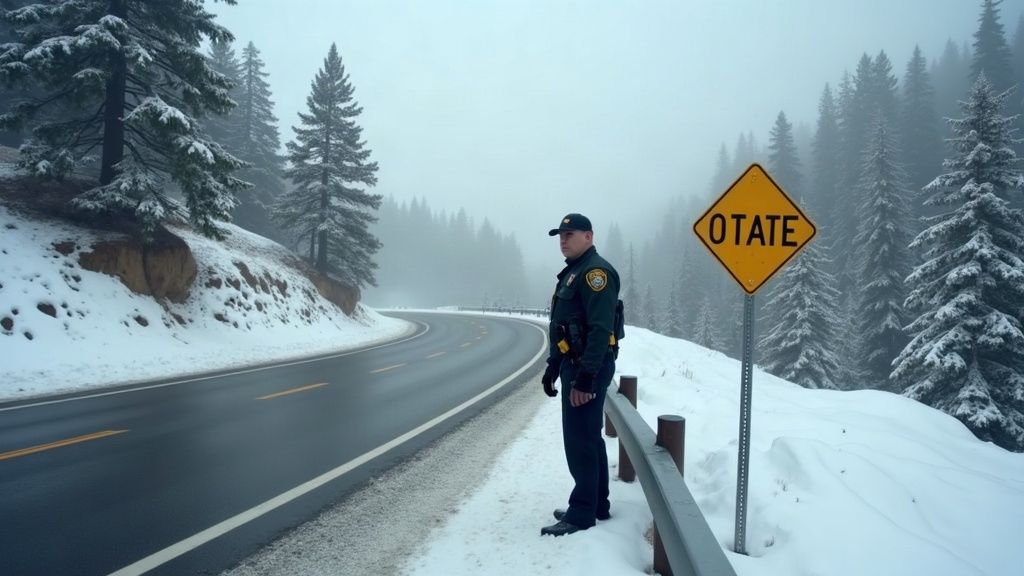
The most dangerous spots are predictable once you know what to look for. North-facing curves hold cold air and shade long after the sun rises. Bridges and overpasses lose ground heat from below. Tunnel exits drop in temperature abruptly. These conditions are common on routes like Highway 18 near Big Bear, the Cajon Pass on I-15, and the Sierra Nevada crossings on I-80 and Highway 50 during storms and overnight freezes.
The key point for a legal claim: black ice is a known and documented hazard on California mountain roads. That means it is foreseeable. A driver who does not account for the possibility of ice, by slowing down, increasing following distance, or heeding weather advisories posted on Caltrans QuickMap, may be found to have fallen below the standard of reasonable care even if the ice itself was invisible.
Takeaway: Invisible does not mean unforeseeable. Courts apply the reasonably prudent driver standard to the conditions that were known or knowable before the crash.
2. Fault Isn't Automatically Excused Just Because Roads Were Icy
California's pure comparative fault rule, established in Li v. Yellow Cab Co., means icy roads reduce but do not erase driver responsibility, a driver who was speeding on an icy road can still be found partly at fault.
California follows pure comparative fault, a doctrine the California Supreme Court adopted in Li v. Yellow Cab Co., 13 Cal.3d 804 (1975). Under that rule, a court assigns each party a percentage of fault and reduces the plaintiff's recovery by their own share. A driver who is 25 percent at fault recovers 75 percent of their total damages. Fault is never fully erased by weather alone.
In practice, insurance adjusters will try to use icy conditions to argue that the accident was an "Act of God" and that no driver is responsible. California courts reject that argument when a driver was: traveling above the posted advisory speed for winter conditions, following too closely for slick roads, ignoring Caltrans weather warnings, or failing to use chains when they were required. Each of those behaviors can support a finding of comparative fault regardless of the ice.
If another driver caused your crash by doing any of the above, their fault does not disappear because the road was icy. Your attorney's job is to document exactly how each driver's conduct departed from the reasonable standard.
Takeaway: Weather is a context, not a shield. Fault analysis still focuses on what each driver did or failed to do given the conditions they knew or should have known about.
3. Chain Control Violations Can Affect How Liability Is Assessed
Driving without required chains when Caltrans chain controls are active violates California Vehicle Code §2815 and is treated as evidence of negligence in a civil lawsuit.
Cal. Veh. Code §2815 gives Caltrans the authority to restrict mountain highway access to vehicles equipped with tire chains or snow tires during winter storms. Violations are misdemeanors. The controls are posted on roadside signs and updated in real time on Caltrans QuickMap.
In a civil case, a chain control violation is relevant in two ways. First, it is evidence of negligence per se: a driver who violates a safety statute designed to prevent the exact type of accident that occurred is presumed negligent unless they can show an excuse. Second, it speaks directly to that driver's comparative fault percentage. A jury that learns a driver ignored an active chain control requirement will typically assign that driver a substantially higher fault share.
If you were hit by a driver who was not in compliance with chain controls at the time of the crash, your attorney should request the Caltrans chain control logs for that date and location to establish when controls were active and what level (R1, R2, or R3) was in effect.
Takeaway: Document chain control status at the time of your accident. Caltrans posts historical control information and it can be critical evidence in your case.
4. Caltrans Road Maintenance Records May Become Relevant Evidence
Caltrans has a legal duty to maintain California highways in a reasonably safe condition. When a government road defect contributed to your crash, a missing warning sign, a guardrail that should have been repaired, a drainage problem that caused ice to accumulate in an unusual location, Caltrans may share liability.
The critical procedural point: you cannot sue a California government agency without first filing a government tort claim. Under Gov. Code §911.2, that claim must be filed with the California Department of Transportation (Caltrans) within six months of the date of the incident. Miss that window and your lawsuit against Caltrans is barred, permanently.
Once litigation begins, Caltrans maintenance logs, inspection schedules, and prior complaint records for the crash location can be obtained through the discovery process. Prior reports of ice accumulation, requests for additional signage, or a history of crashes at the same spot are all relevant to whether the agency had notice of the defect and failed to act.
If your crash happened at a location with a guardrail failure, a missing advisory speed sign, or a known drainage problem, tell your attorney immediately. The six-month government claim deadline runs from the crash date, not from when you hire a lawyer.
Takeaway: If a road defect played any role in your crash, the government claim deadline is six months, shorter than the standard personal injury statute of limitations and non-negotiable.
5. Multi-Vehicle Pileups on Mountain Routes Create Complex Fault Questions
In a multi-vehicle mountain pileup, Cal. Civ. Code §1431.2 makes each defendant pay only their own share of non-economic damages like pain and suffering.
Chain-reaction crashes on routes like I-80, Highway 50, and the Grapevine (I-5) regularly involve five, ten, or more vehicles. Sorting fault in those cases is legally complex for two reasons.
First, California's pure comparative fault system (from Li v. Yellow Cab Co.) requires the jury to assign a percentage of fault to each party. Reconstructing the sequence of impacts, who braked first, who was following too closely, who was already stopped when a later vehicle struck them, requires witness statements, surveillance or dashcam footage, skid mark analysis, and sometimes accident reconstruction experts.
Second, Cal. Civ. Code §1431.2 (Proposition 51) creates a separate rule for non-economic damages such as pain and suffering: each defendant pays only their own proportionate share, not the shares of defendants who are judgment-proof or uninsured. For economic damages, medical bills, lost wages, joint and several liability still applies. In a pileup with one solvent defendant and several uninsured drivers, that distinction can significantly affect how much you actually recover.
The practical implication: in a multi-vehicle mountain crash, you need an attorney who can identify every potentially liable party, preserve evidence before weather or cleanup destroys it, and understand how the Proposition 51 split affects the realistic recovery picture.
Takeaway: In a multi-vehicle pileup, your recovery for pain and suffering depends on each defendant's individual fault share, identify every liable party early before evidence disappears.
6. Cell Service Gaps in Mountain Areas Can Delay Reporting and Documentation
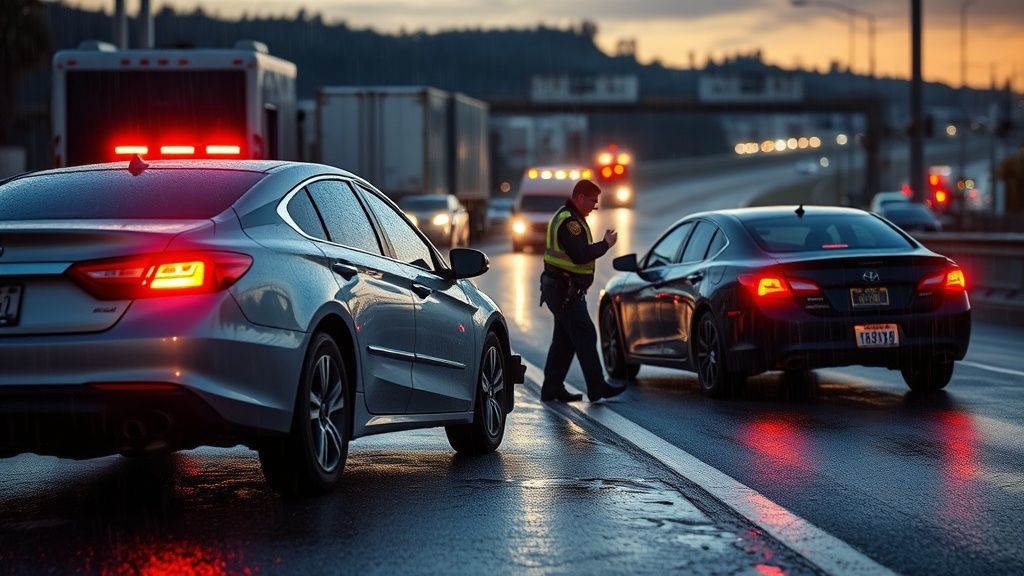
California Vehicle Code §20008 still requires you to report an injury accident to law enforcement as soon as reasonably possible, even when there is no cell signal at the crash site.
Mountain stretches of Highway 38, Highway 18, parts of I-80 east of Donner Summit, and many forest service connector roads have no reliable cell coverage. That creates real problems after an accident: you cannot call 911, you cannot reach your insurance company, and you cannot upload photos to document the scene.
What the law still requires: Cal. Veh. Code §20008 requires every driver involved in an accident resulting in injury or death to make a written report to the California Highway Patrol or local law enforcement as soon as possible. Courts have interpreted "as soon as possible" in light of real-world constraints like remote locations, but you must report the moment you reach a signal area or the next town.
Practical steps when there is no signal: stay at the scene and document everything you can with your phone camera before the battery dies or the scene is disturbed. Photograph all vehicles, road conditions, tire marks, signage, guardrails, and any visible ice. Note the time, the weather, and any witnesses' names and license plates on paper. When you reach cell service, call 911, then call an attorney.
Takeaway: No signal does not mean no duty. Document manually at the scene and report to law enforcement the moment you reach coverage.
7. Tow and Recovery Logistics Differ from Typical City-Street Accidents
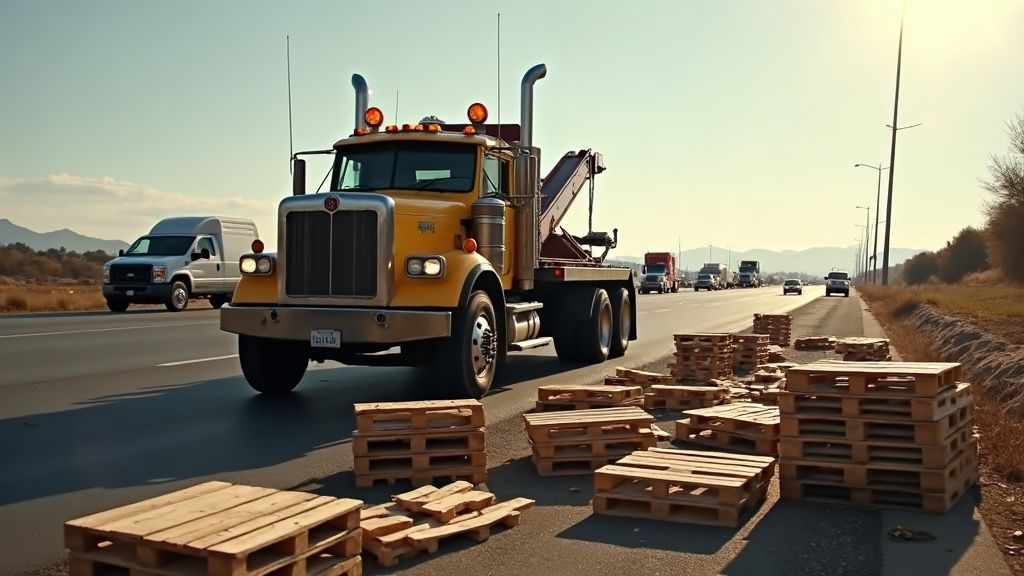
Mountain tow operations are not the same as calling a flatbed to your neighborhood intersection. In steep, narrow canyon terrain, think the road down to Lake Arrowhead, the switchbacks on Highway 2 in the San Gabriels, or remote sections of the Eastern Sierra, standard tow trucks cannot operate. Recovery requires a heavy-duty winch truck or specialized equipment, and response times can run two to four hours or longer in winter weather.
That delay matters for your case in two ways. First, if your vehicle remained on the roadway and was struck again while you were waiting, which is not uncommon in low-visibility conditions, a second accident creates an additional insurance layer and additional fault questions. Second, once the vehicle is moved, it often goes to an impound yard far from the crash site, sometimes in a different county.
California law gives you the right to inspect a stored vehicle, but daily storage fees begin accruing quickly. You generally have 72 hours to arrange inspection and retrieval before daily charges become significant. Waiting too long to inspect the vehicle also allows evidence of the impact, airbag deployment data from the event data recorder, damage patterns, mechanical failure points, to be lost to weather or impound handling.
Ask your attorney to arrange an independent inspection of the vehicle as early as possible. The event data recorder, if recovered, can establish pre-crash speed and braking behavior, which is directly relevant to fault.
Takeaway: Move quickly on vehicle inspection after a mountain crash. Event data recorder evidence and physical damage patterns are time-sensitive and critical to reconstructing fault.
8. Out-of-Town or Unfamiliar Drivers Add Another Layer to Fault Disputes
California mountain roads attract large numbers of drivers from Los Angeles, the Inland Empire, and the Central Valley who have limited experience with chain controls, reduced advisory speeds, and the behavior of vehicles in sub-freezing temperatures. That inexperience is legally relevant.
California holds every driver to the standard of a reasonably prudent person acting under the actual conditions present at the time of the crash. A driver from a lower-elevation area is not given a pass for not knowing that a shaded curve on Highway 138 stays icy three hours after sunrise, or that reducing speed to 20 miles per hour below the posted limit is common and expected practice on a mountain pass in a snowstorm. The objective reasonably-prudent-driver standard applies regardless of experience level.
In practice, this means that an unfamiliar driver who rear-ended your vehicle while driving at freeway speeds on a packed-snow highway carries a substantial comparative fault share even if they claim they did not know conditions were dangerous. Insurance adjusters for those drivers will argue the weather was the cause. Your attorney can counter with evidence that the driver ignored posted advisory speeds, did not carry chains, and had no reasonable basis to expect dry-road conditions on a Sierra Nevada pass in January.
If you were the unfamiliar driver and the crash was not your fault, the same analysis protects you: the relevant question is what a reasonably prudent driver would have done given the visible conditions, not whether you had prior mountain driving experience.
Takeaway: The reasonable prudent driver standard is objective, not subjective, unfamiliarity with mountain conditions is not a legal excuse, and it can support a higher fault finding against an inexperienced driver who caused your crash.
What to Do Right After a Winter Mountain Road Accident
The first 72 hours after a crash on a California mountain road determine what evidence you can preserve and what deadlines you can still meet. Here is the short list:
- Stay at the scene and document everything manually if there is no cell signal, photos, paper notes, witness information.
- Call 911 or report to CHP as soon as you have coverage. Cal. Veh. Code §20008 requires reporting injury accidents to law enforcement as soon as reasonably possible.
- Seek medical attention immediately, even if you feel fine. Soft-tissue injuries and concussions frequently have delayed symptoms in cold weather.
- Check chain control status for the time of your accident on Caltrans QuickMap and take a screenshot before the historical data is archived.
- Arrange vehicle inspection within 72 hours of impound before storage fees accumulate and physical evidence is lost.
- Consult an attorney before speaking further with any insurance adjuster. If Caltrans road conditions played any role, the six-month government claim deadline starts on the crash date.
If your accident happened while you were driving for work, a delivery route, a work trip, a job site commute covered by your employer, you may also have a workers' compensation claim in addition to your personal injury claim. The two can run side by side and you should not have to choose between them.
Frequently Asked Questions
Who is at fault in a black ice car accident in California?
Fault in a black ice accident is analyzed under California's pure comparative fault doctrine, established in Li v. Yellow Cab Co., 13 Cal.3d 804 (1975). Icy conditions are a factor in the analysis but do not automatically excuse any driver. A driver who was traveling too fast for conditions, following too closely, ignoring chain controls, or failing to heed weather advisories can still be found at fault even though black ice was present. Each party's fault is expressed as a percentage, and recovery is reduced by the plaintiff's own share.
Are chain control violations used against drivers in accident claims?
Yes. A violation of Cal. Veh. Code §2815, driving without required chains or snow tires when Caltrans chain controls are active, is a misdemeanor and is used in civil cases as evidence of negligence. It is particularly powerful because it supports a negligence per se argument: the driver violated a safety statute designed to prevent exactly the type of accident that occurred. Caltrans chain control logs showing active restrictions at the time of the crash are obtainable during litigation.
Can weather conditions reduce liability in a California car accident?
Weather conditions are relevant context but do not reduce or eliminate liability by themselves. Under California's pure comparative fault rule, the question is always whether each driver acted as a reasonably prudent person would have given the conditions that were known or knowable. A driver who slowed appropriately, maintained safe following distance, and complied with chain controls on an icy road may escape or minimize fault. A driver who drove as if roads were dry does not.
What should I do after a crash on a mountain highway?
Stay at the scene, document everything you can with your phone camera and paper notes, and report the accident to law enforcement as soon as you have cell coverage under Cal. Veh. Code §20008. Seek medical attention immediately. Arrange an independent vehicle inspection within 72 hours. If Caltrans road conditions or a missing sign played any role, contact an attorney the same day, the government tort claim window under Gov. Code §911.2 is six months from the crash date, not six months from when you retain counsel.
What is the deadline to sue Caltrans after a mountain road crash?
Before suing Caltrans, you must file a government tort claim within six months of the incident under Gov. Code §911.2. This is shorter than the two-year statute of limitations for standard personal injury claims. If Caltrans denies the claim or takes no action within 45 days, you then have six months to file a lawsuit. Missing the initial six-month claim deadline forfeits your right to sue entirely.
Does Proposition 51 apply to mountain pileup cases?
Yes. Cal. Civ. Code §1431.2, enacted as Proposition 51, makes each defendant in a personal injury case responsible for only their own proportionate share of non-economic damages such as pain and suffering. In a multi-vehicle pileup with several at-fault drivers, each defendant pays their assigned percentage of your non-economic damages, not the full amount. For economic damages like medical bills and lost wages, joint and several liability still applies, which is why identifying every solvent defendant matters.
Can I file a workers' comp claim if the mountain road crash happened while I was driving for work?
Yes. If you were driving for work purposes at the time of the crash, a delivery, a job site visit, a client call during a scheduled work trip, you may have a California workers' compensation claim in addition to a personal injury claim against any at-fault driver. The two claims are not mutually exclusive. Your workers' comp insurer may later assert a lien against your personal injury recovery, which is a reason to coordinate both claims with the same attorney from the beginning.
How is fault divided in a mountain pileup with multiple uninsured drivers?
Under Cal. Civ. Code §1431.2, you can only recover the proportionate share of non-economic damages from each defendant who is actually solvent or insured. If a defendant responsible for 40 percent of your pain and suffering is uninsured, that portion of your non-economic recovery may be uncollectable unless you carry uninsured motorist coverage. For economic damages, joint and several liability means any solvent defendant can be held responsible for the full amount of economic damages, with the right to seek contribution from co-defendants. This is why uninsured motorist coverage is especially valuable when driving on mountain routes.
If you were injured in a winter mountain road accident in California, every day you wait is a day closer to a deadline that cannot be extended. Call (818) 794-9947 for a free case review. No fee unless we win.