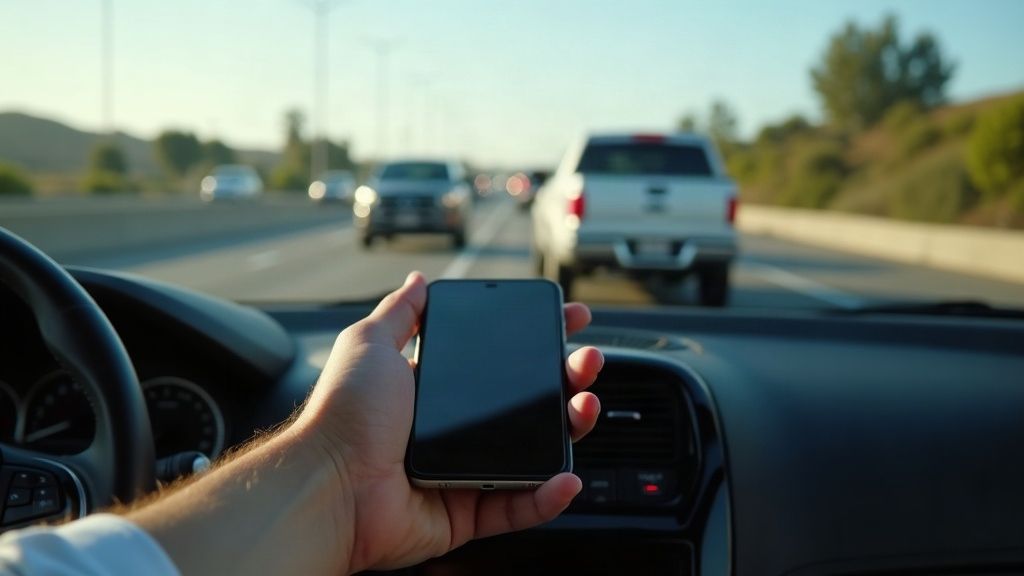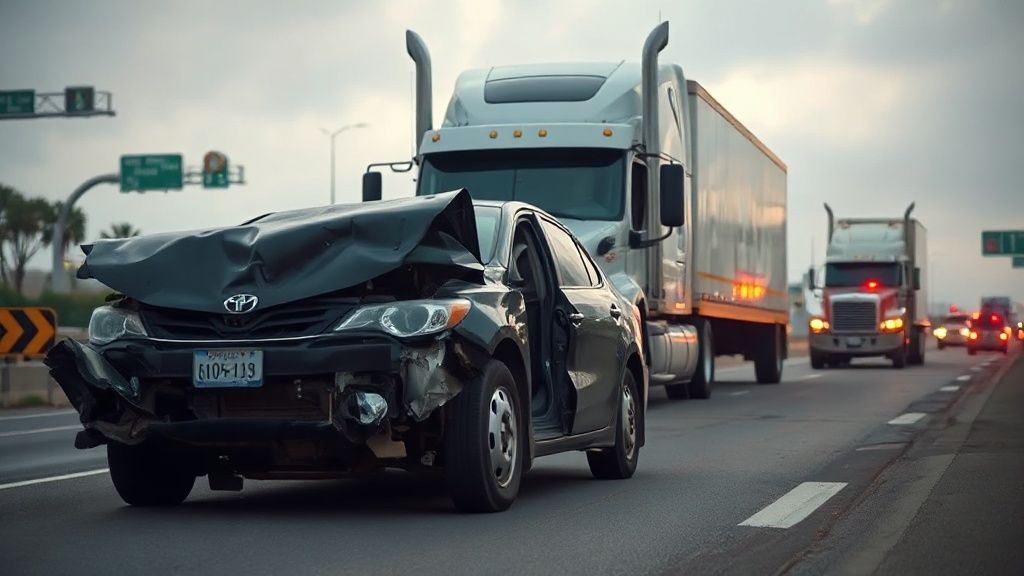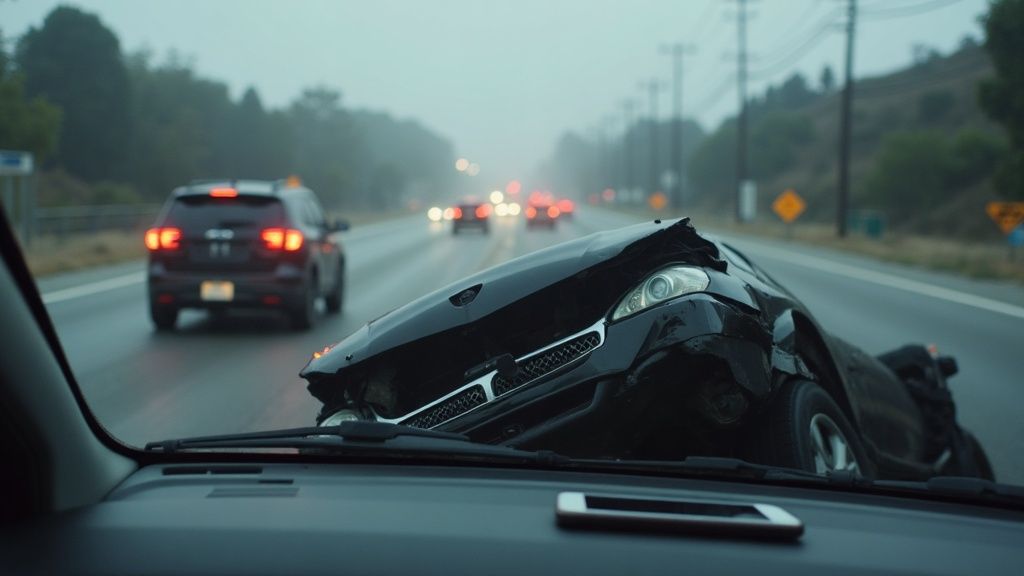
If you were hurt in a crash and you believe the other driver was on their phone, you already sense the core problem: proving it. The driver is not going to hand you their phone. The insurance adjuster is not going to assume it. You need evidence, and you need to know where California law stands before that evidence disappears.
This article walks through exactly how distracted driving claims work in California, what proof courts and insurance carriers actually accept, and what to do in the days after a crash to protect your right to recover.
Quick answers for skimmers:
- California bans handheld phone use while driving under Cal. Veh. Code §23123.5. A violation is direct evidence of negligence.
- Cell phone carrier records show exact timestamps for every text, call, and data session. Your attorney can subpoena them.
- Dashcam video, witness statements, and the police report are often your fastest-available evidence.
- California's pure comparative fault rule (Cal. Civ. Code §1714) lets you recover even if you share some blame, with your award reduced proportionally.
- The deadline to file a personal injury lawsuit is generally two years from the accident date under Cal. Code Civ. Proc. §335.1.
- Call (818) 794-9947 for a free case review. No fee unless we win.
How Distracted Driving Causes Serious Crashes
Reading a text at 65 miles per hour means your eyes leave the road for roughly five seconds. In that time, you cover the length of a football field without looking. That simple math explains why distracted driving crashes tend to be severe: the driver never brakes before impact.
The DWC and the National Highway Traffic Safety Administration both track distracted driving as a leading cause of traffic deaths and serious injuries. While national figures change year to year, California consistently records thousands of injury crashes annually where phone use or other distraction is listed as a contributing factor in the official California Highway Patrol SWITRS database.
These crashes produce some of the most damaging injury patterns in personal injury practice: rear-end impacts at highway speeds, intersection T-bones where the distracted driver never saw the red light, and pedestrian strikes. If you walked away with a spinal injury, a traumatic brain injury, or significant soft tissue damage, the mechanism of the crash matters for both your medical care and your legal claim.
California's Hands-Free Law and What Counts as Distracted Driving
Cal. Veh. Code §23123.5 prohibits any driver from holding and using a handheld wireless communications device while driving. That covers texting, calling without a hands-free setup, scrolling social media, and using navigation by holding the phone. The law requires the phone to be mounted on the windshield or dashboard in a location that does not block the driver's view, and interaction must be limited to a single swipe or tap.
A first violation under §23123.5 carries a base fine. A second or subsequent violation carries a higher base fine, and points are added to the driver's record starting with the second offense. More important for your civil case: a citation for this violation creates what California courts treat as evidence of negligence per se. When a driver breaks a safety statute and that violation causes the kind of harm the statute was designed to prevent, the driver is presumed negligent. They then have to explain why their conduct was not the cause of your injuries.
Distracted driving is broader than phones. California law also covers:
- Eating, drinking, or grooming while driving (relevant to ordinary negligence claims even without a specific cell-phone citation)
- Adjusting in-vehicle infotainment systems in a way that diverts attention
- Reaching for objects in the vehicle
- Cognitive distraction from a hands-free conversation (harder to prove, but real in reconstructed crash cases)
For the purposes of building an evidence-based injury claim, phone-based distraction is by far the easiest to document because it leaves a digital record.
Evidence That Shows a Driver Was on Their Phone at the Moment of Impact
This is where most distracted driving claims are won or lost. The key word is "at the moment of impact." An insurance carrier will argue that the driver looked at their phone ten minutes before the crash, put it down, and was driving normally when the collision happened. Your job, with your attorney, is to close that gap.
Cell Phone Carrier Records
To prove a driver was texting at the moment of impact, your attorney can subpoena the at-fault driver's cell phone carrier records, which show the exact time of every call, text, and data session.
Carrier records are the gold standard in distracted driving litigation. They contain:
- Outgoing and incoming call logs with timestamps to the second
- Text message send and receive timestamps (the content of texts requires a separate, more involved process)
- Data session logs showing when the device was actively transmitting or receiving data, which captures social media, navigation apps, and browsing
When your attorney compares these timestamps against the crash time documented in the police report, dispatch records, and any vehicle event data recorder (EDR) output, the overlap can be precise. A text sent fourteen seconds before impact, when the road was clear, versus a text in progress at the second of impact, is a material difference that changes the value of a claim.
Subpoenas for phone records are issued through the civil litigation process. They cannot be obtained without filing a lawsuit or reaching a cooperation agreement with the other side. This is one concrete reason why moving quickly matters: carriers retain detailed records only for a limited time, and the window to preserve them closes.
The Police Report and Officer Observations
When law enforcement responds to a crash, the investigating officer documents their observations. If a witness told the officer they saw the at-fault driver looking at their phone, that gets into the report. If the officer observed the phone in an unusual position, noted the driver's admissions, or issued a citation for §23123.5, all of that appears in the official CHP or local police collision report.
A police report that notes the officer's observations about phone use, combined with a citation for a hands-free violation, creates a strong foundation for proving negligence in a distracted driving case.
You are entitled to a copy of the traffic collision report. In California, you can request it through the reporting agency (CHP or local police department) after it is completed, which typically takes several days to several weeks depending on the agency.
Dashcam and Surveillance Footage
Dashcam footage from your own vehicle or from nearby businesses is often the fastest way to document driver distraction before formal discovery begins.
If your vehicle has a dashcam, preserve the footage immediately. Do not overwrite it. Copy it to a separate drive and share it with your attorney on day one.
Beyond your own dashcam, consider:
- Traffic cameras at or near the intersection
- Business security cameras on adjacent buildings
- Dashcam footage from other vehicles traveling nearby (witnesses who stop often have dashcams of their own)
- Ring or similar residential security cameras in residential crash locations
Surveillance footage is time-sensitive. Many businesses overwrite their security footage on a rolling 24-to-72-hour loop. Your attorney can send a legal hold letter to a business the day after the crash. Without that letter, the footage may be gone before you know you needed it.
Eyewitness Statements
Witnesses who saw the at-fault driver looking at their phone, drifting between lanes, or failing to brake before impact are valuable. Get their names and contact information at the scene if you are physically able to. If not, ask someone else to do it on your behalf.
Witness credibility matters. A disinterested bystander, such as a pedestrian on the sidewalk or a driver in a parallel lane, carries more weight than a passenger in your vehicle. But any corroborating witness is better than none.
Vehicle Event Data Recorders (EDRs)
Most modern vehicles have an EDR, sometimes called a "black box," that captures pre-crash data: vehicle speed, throttle position, brake application, and steering input in the seconds before impact. If the at-fault driver made no attempt to brake before a collision at a signaled intersection, that absence of braking action supports the inference that the driver was not watching the road.
EDR data must be extracted quickly because some vehicles overwrite it after a set number of ignition cycles. Preservation requires sending a spoliation letter to the at-fault driver and, in some cases, seeking a court order.
Using All of This Evidence Together
No single piece of evidence wins a distracted driving case by itself. What builds a compelling claim is correlation across multiple independent sources. When carrier records show an active text session, the EDR shows no braking, a witness saw the driver looking down, and the police report notes a §23123.5 citation, the combined picture is hard for an insurance carrier to dispute.
Your attorney's job is to gather these sources, preserve them before they disappear, and present them in a sequence that connects the driver's phone use to the specific moment your crash occurred.
How Distracted Driving Affects Fault and Your Recovery
California follows pure comparative fault. Under Cal. Civ. Code §1714, each party in a crash is responsible for their own percentage of fault. If a jury finds the other driver 90 percent at fault and you 10 percent at fault, you recover 90 percent of your total damages.
California follows a pure comparative fault rule, meaning you can recover compensation even if you were partly responsible for the crash, though your award is reduced by your percentage of fault.
This matters in distracted driving cases because insurance adjusters often argue contributory negligence on your part: you were speeding, you failed to yield, your brake lights were out. You do not have to be blameless to recover. But the more clearly you can document the other driver's distraction, the harder it is for the adjuster to shift fault percentage onto you.
What Damages Are Available
In a California personal injury claim for a distracted driving crash, recoverable damages generally include:
Economic damages:
- Medical expenses (past and future): emergency care, surgery, physical therapy, specialist visits, medical equipment, prescription costs
- Lost wages and lost earning capacity if the injury affects your ability to work
- Property damage to your vehicle and personal property inside it
Non-economic damages:
- Pain and suffering
- Emotional distress
- Loss of enjoyment of life
- Loss of consortium (for a spouse or domestic partner, in appropriate cases)
California does not cap non-economic damages in ordinary personal injury cases the way it does in medical malpractice cases. The value of your non-economic damages depends on the severity and permanence of your injuries, how they affect your daily life, and the skill with which your attorney presents that evidence.
Punitive damages:
California allows punitive damages under Cal. Civ. Code §3294 when the defendant acted with malice, oppression, or fraud. Punitive damages in distracted driving cases are uncommon in ordinary crashes, but courts have awarded them where a driver was repeatedly warned about their phone use, had prior distracted driving incidents, or was engaged in conduct that goes beyond simple negligence into conscious disregard for the safety of others. This is a fact-specific determination, not a routine expectation.
Steps to Protect Your Claim Right After the Crash
The first 72 hours after a distracted driving crash are the most important for evidence preservation. Here is what to do and in what order.
1. Call 911 and stay at the scene. A police report creates the official record. Without it, you are fighting a credibility battle against the other driver's account alone.
2. Document the scene. Photograph vehicle positions, damage to both cars, road conditions, skid marks (or their absence), traffic signals, and any visible phone or device in the at-fault driver's vehicle. Photograph your own injuries.
3. Collect witness information. Names, phone numbers, email addresses. Witnesses leave quickly once the police arrive.
4. Say nothing about fault. To the other driver, to the responding officer about your share of responsibility, and especially to any insurance representative who contacts you at the scene or within the first 24 hours. You do not know the full picture yet.
5. Seek medical care immediately. Even if you feel fine. Adrenaline masks injury. Delayed treatment creates a gap the insurance adjuster will use to argue your injuries were not caused by the crash. Emergency room records tie your injury to the crash date.
6. Preserve your dashcam footage. Copy it before it overwrites. Share it with your attorney.
7. Do not post about the crash on social media. Insurance adjusters actively monitor claimant social media. A photo of you at a family event three days after the crash, even if you are genuinely in pain, can be used to minimize your injury claim.
8. Contact a personal injury attorney before speaking to the other driver's insurance carrier. The carrier's adjuster is not on your side. Their job is to resolve the claim for as little as possible. An attorney speaks to them on your behalf and ensures you do not inadvertently say something that reduces your recovery.
The Filing Deadline You Cannot Miss
The statute of limitations for a car accident personal injury claim in California is two years from the date of the accident under Code of Civil Procedure §335.1.
If you miss the two-year window, California courts will almost certainly dismiss your case regardless of how strong your evidence is. There are limited exceptions: if the injured person is a minor, if the defendant left California after the crash, or if you did not discover your injury until later. But these exceptions are narrow and fact-specific. Do not count on them.
If the at-fault driver was a government employee acting within the scope of their employment, such as a city bus driver or a government fleet vehicle operator, a separate administrative claim deadline of six months applies under Cal. Gov. Code §911.2 before you can file a lawsuit. Missing that shorter deadline bars the claim entirely.
Two years sounds like a long time. It is not, once you factor in the time needed to gather evidence, complete medical treatment to understand the full extent of your injuries, and negotiate with the insurance carrier before a lawsuit becomes necessary.
Frequently Asked Questions
How do you prove a driver was texting in a California accident?
The most direct way is through cell phone carrier records, which show the exact timestamp of every text message, call, and data session. Your attorney can subpoena these records through the litigation process. Supporting evidence includes dashcam footage, eyewitness statements, the police report, and vehicle event data recorder output showing no braking before impact. Multiple independent sources, when they point to the same conclusion, create a compelling case.
Is distracted driving illegal in California?
Yes. California Vehicle Code §23123.5 prohibits any driver from holding or using a handheld wireless device while operating a vehicle. Violation carries base fines and, on a second offense, a point on the driver's record. A citation for this violation is treated as evidence of negligence in a civil injury claim.
Can I get phone records after a car accident?
Not directly. Cell phone carriers do not release records to private individuals without a court order. Your attorney can obtain them through a subpoena issued in the civil litigation process. This is one reason to consult an attorney promptly: carriers retain detailed records for a limited time, and delay can result in the loss of critical evidence.
What damages can I recover in a distracted-driving crash?
In California, you can generally recover economic damages (medical bills, lost wages, future medical care, property damage) and non-economic damages (pain and suffering, emotional distress, loss of enjoyment of life). Punitive damages are available in limited circumstances where the driver's conduct shows conscious disregard for others' safety. Your specific recovery depends on the facts of your crash, the severity of your injuries, and how fault is apportioned between the parties.
What if I was partly at fault for the crash?
California's pure comparative fault rule means you can still recover compensation. Your award is reduced by your own percentage of fault. If a jury finds the other driver 80 percent responsible and you 20 percent responsible, you recover 80 percent of your total damages.
How long do I have to file a lawsuit in California after a car accident?
Generally two years from the date of the accident under Code of Civil Procedure §335.1. If the at-fault driver was a government employee or the accident involved a government vehicle, an administrative claim must be filed within six months under California Government Code §911.2. Both deadlines are strict. Missing them typically bars your claim permanently.
Does a citation for texting while driving guarantee I win my case?
No. A citation under Vehicle Code §23123.5 is strong evidence of negligence and creates a presumption that shifts the burden to the at-fault driver to explain their conduct. But a civil injury case still requires proof that the violation caused your specific injuries and damages. The strength of your claim depends on the full body of evidence, including the severity of your injuries and any dispute about your own fault percentage.
What should I do if the other driver's insurance company contacts me right after the crash?
Do not give a recorded statement and do not accept any settlement offer before consulting an attorney. Insurance adjusters contact claimants quickly because early statements and early settlements tend to favor the carrier, not the injured person. Once you accept a settlement, you typically release all future claims related to that crash, even if your injuries turn out to be more serious than you knew at the time.
Talk to a California Personal Injury Attorney Before the Evidence Disappears
Distracted driving cases are winnable. Phone records do not lie, and California law gives your attorney the tools to get them. But the window to preserve those records, dashcam footage, and witness memory closes fast.
If you were hurt by a driver you believe was on their phone, call Nordanyan Law at (818) 794-9947 for a free case review. We handle personal injury cases for injured workers and California residents across Southern California. No fee unless we win.
Reviewed by Minas Nordanyan, CA Bar #296806. Last updated July 2026. This article is general legal information, not legal advice. Your rights depend on the specific facts of your case.