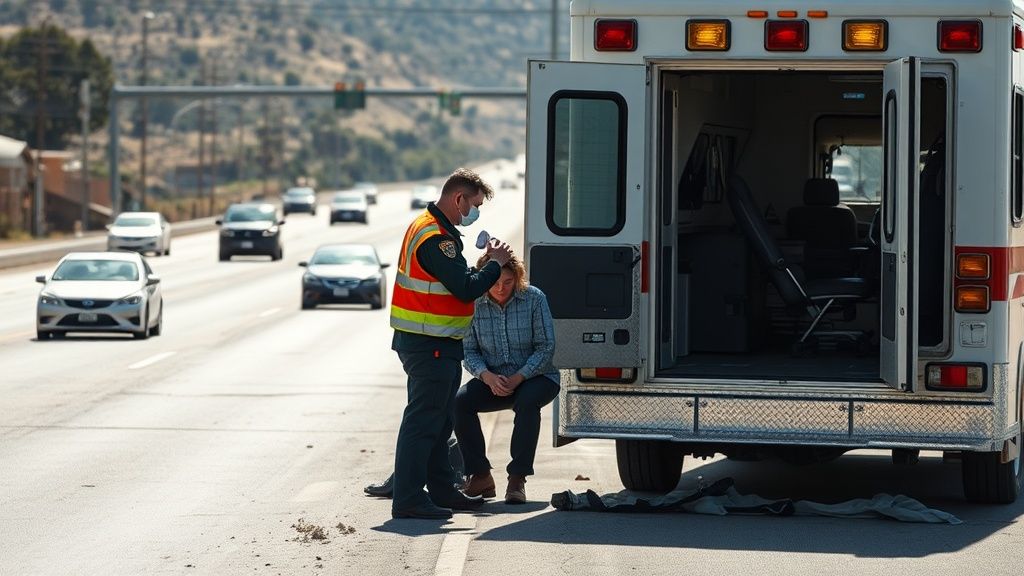
Nerve damage is one of the most misunderstood injuries that follows a car accident in California. Unlike a broken bone that shows up clearly on an X-ray, damaged nerves can hide from standard imaging for weeks. Symptoms come and go. Insurance adjusters treat the injury as minor. And by the time you realize how serious it is, you may have already said something that hurts your claim.
This article explains how nerve damage actually happens in a crash, how to get it properly diagnosed, and how California law values that injury when you pursue a personal injury claim.
Quick-Answer Summary
- Tingling, numbness, burning pain, and muscle weakness after a crash are all warning signs of nerve damage that should be evaluated by a physician immediately.
- An EMG (electromyography) and NCS (nerve conduction study) are the standard diagnostic tests that objectively document nerve injury for an insurance or court claim.
- California lets you recover for both economic damages (medical bills, lost wages, reduced earning capacity) and non-economic damages (pain and suffering) under Cal. Civ. Code §3333.
- The two-year statute of limitations for filing a California personal injury lawsuit is set by Cal. Code Civ. Proc. §335.1.
- Insurance adjusters systematically undervalue nerve damage claims because the injury is largely invisible on common imaging.
- If the accident happened while you were working, both a personal injury claim and a California workers' compensation claim may be available simultaneously.
How Car Accidents Cause Nerve Damage: Compression, Stretching, and Direct Trauma
The human body absorbs enormous forces during a collision, even a moderate rear-end crash at 25 miles per hour. Those forces travel through the spine, shoulders, neck, and limbs in fractions of a second. Nerves are not built to absorb that kind of sudden loading.
There are three primary injury mechanisms:
Compression. A displaced vertebral disc, swollen tissue, or a fractured bone fragment can press against a nerve root or a peripheral nerve. The result is radiculopathy, the clinical term for a compressed nerve root in the spine that radiates pain, tingling, or numbness into the arms or legs.
Stretching (traction injury). When the head snaps violently to one side, the nerves in the brachial plexus, the network that runs from the neck into the arm, can be stretched beyond their elastic limit. This is common in side-impact and rollover collisions. Severe stretching can tear nerve fibers partially or completely.
Direct trauma. A limb pinned by a steering column, a dashboard impact, or broken glass can lacerate or crush peripheral nerves directly.
Any of these three mechanisms can produce damage that ranges from temporary disruption (neurapraxia, where function usually recovers over weeks) to partial tearing (axonotmesis) to complete nerve severance (neurotmesis), which often means permanent impairment.
Warning Signs That Are Easy to Dismiss: Tingling, Numbness, and Burning Pain
Nerve damage after a car accident can be permanent, and California law allows you to recover compensation for ongoing pain, lost income, and future medical care.
The symptoms of nerve injury are easy to dismiss in the days following a crash, especially when you are already dealing with bruising, whiplash soreness, and the stress of an insurance claim. The warning signs to watch for include:
- Tingling or a "pins and needles" sensation in the hands, fingers, feet, or toes
- Persistent numbness in a limb or one side of the face
- Burning or electrical pain that travels from the neck into the arm, or from the lower back into the leg
- Muscle weakness that makes gripping, lifting, or walking more difficult than normal
- Loss of fine motor control, such as difficulty buttoning a shirt or typing
- Hypersensitivity, where normal touch or temperature feels painful
- Unexplained fatigue in a limb after brief activity
These symptoms often worsen over days to weeks as post-injury inflammation builds around the affected nerve. Many people make the mistake of waiting to see if the symptoms resolve on their own. From a medical standpoint, waiting delays treatment. From a legal standpoint, waiting creates a gap between the crash and the documented injury that an insurance adjuster will use to argue the nerve damage is unrelated to the accident.
See a physician within 48 to 72 hours of the crash, even if you feel like you can manage the discomfort. Tell your doctor about every symptom, including the ones that seem minor.
Diagnostic Tools: EMG, Nerve Conduction Studies, and Imaging
The two most important tests for confirming nerve damage after a crash are an electromyography test, called an EMG, and a nerve conduction study, called an NCS.
Getting the right tests ordered is critical. Here is what each one does and why it matters for your claim.
Electromyography (EMG)
An EMG measures the electrical activity inside your muscles. A specialist inserts a thin needle electrode into a muscle and records the signals while the muscle is at rest and while you contract it. Abnormal electrical activity, such as fibrillation potentials or positive sharp waves, indicates that the nerve supplying that muscle is damaged. This is objective, measurable evidence that cannot be faked and cannot be explained away as subjective pain complaints.
Nerve Conduction Study (NCS)
An NCS measures how fast and how strongly an electrical impulse travels along a specific nerve. Small electrodes placed on the skin deliver a mild electrical pulse, and sensors record the speed and amplitude of the signal as it moves down the nerve. Slowed conduction velocity or reduced amplitude is direct evidence of nerve damage. Insurance carriers and defense attorneys are much less able to dispute an NCS finding than they are to dispute a patient's self-reported pain level.
EMG and NCS are typically performed together by a neurologist or a physical medicine and rehabilitation specialist (a physiatrist).
MRI and CT Imaging
An MRI of the spine can reveal disc herniations, spinal stenosis, or canal narrowing that compresses a nerve root. A high-resolution MRI neurography can image peripheral nerves directly in some cases. CT scans are useful when bone fragments or fractures may be pressing against neural structures.
Important caveat: a normal MRI does not rule out nerve damage. Functional nerve injury at the axon level often produces no visible abnormality on standard imaging. This is precisely why EMG and NCS results carry so much weight in a claim, and why you need an attorney who understands what the combination of normal imaging plus abnormal EMG actually means for your case value.
Why Nerve Injuries Are Often Undervalued by Insurance Adjusters
Insurance adjusters routinely undervalue nerve damage claims because the injury does not show up on a standard X-ray, and an MRI can appear normal even when nerve function is significantly reduced.
Insurance companies are for-profit businesses. Their adjusters are trained to settle claims as quickly and cheaply as possible. Nerve injuries create a specific set of opportunities for them to do that.
The invisibility problem. An adjuster reviewing your file sees an X-ray that shows no fracture and possibly an MRI with no obvious herniation. Without understanding EMG and NCS data, they treat the claim as a soft-tissue case and offer a correspondingly low settlement.
The delayed diagnosis problem. If you did not report numbness or tingling at the emergency room on the day of the crash, the adjuster argues that your nerve symptoms developed later and may not be related to the accident.
The pre-existing condition argument. Any prior back pain, prior spine treatment, or any notation of neck stiffness in your medical history before the accident gives the adjuster grounds to argue that your nerve damage existed before the crash. California's comparative fault rules under Cal. Civ. Code §1431.2 can affect how pre-existing conditions are handled, and an insurer may try to apportion a significant percentage of your damages to a pre-existing condition.
The "you'll recover" argument. Some nerve injuries do heal. Adjusters exploit this by making early settlement offers before it is clear whether your injury is temporary or permanent. Once you sign a release, you cannot go back for more money even if symptoms worsen significantly.
The way to counter all three of these tactics is thorough, early, and well-documented medical evidence.
Long-Term Impact on Work and Daily Activities
Nerve injuries that limit your ability to grip, lift, walk, or concentrate directly reduce your earning capacity, which is a separate category of compensable economic damages under California law.
Nerve damage does not always resolve. For many crash victims, partial or complete nerve injuries create lasting limitations that affect their ability to work and to live without pain.
Under California law, compensable damages in a personal injury claim include both economic and non-economic losses. Cal. Civ. Code §3333 allows a plaintiff to recover all damages that are proximately caused by the defendant's negligence, including future losses. The following categories are directly relevant to nerve injuries:
Lost earning capacity. If nerve damage reduces your ability to perform your pre-accident job functions, you may be entitled to compensation not only for wages already lost but for the reduction in what you are capable of earning over your remaining work life. This requires expert vocational and economic testimony in many cases, and it significantly increases the total value of a claim.
Future medical expenses. Nerve injuries often require ongoing treatment, including physical therapy, pain management, nerve block injections, and in some cases surgical intervention such as nerve decompression or grafting. The cost of that future care is a compensable economic damage.
Pain and suffering. Chronic neuropathic pain, the constant burning or electric-shock sensation that characterizes many nerve injuries, is a significant non-economic damage. California has no statutory cap on non-economic damages in standard personal injury cases (though Cal. Civ. Code §3333.2 does cap non-economic damages in medical malpractice cases). An attorney experienced in personal injury claims will work with your treating physicians to document the intensity and daily impact of that pain.
Loss of enjoyment of life. If nerve damage has taken away activities you previously enjoyed, such as playing with your children, hiking, cooking, or playing a sport or instrument, California courts recognize that loss as a separate element of non-economic damages.
Building Medical Evidence for a Fair Settlement
In California, you have two years from the date of a car accident to file a personal injury lawsuit, but medical documentation should begin within days of the crash.
A strong California nerve damage claim rests on three pillars: complete medical records, expert opinions, and a documented connection between the crash and the injury.
Step 1: Report every symptom, every visit. Do not minimize your symptoms to your doctor because you are worried about appearing weak or overreactive. Every notation your physician makes about tingling, numbness, weakness, or radiating pain becomes part of the evidentiary record.
Step 2: Follow through on all recommended testing. If your doctor orders an EMG and NCS, complete it promptly. If a specialist referral is recommended, attend every appointment. Insurance carriers and defense attorneys look for gaps in treatment as evidence that you were not actually hurt as badly as you claim.
Step 3: Get the right specialist involved early. A neurologist or physiatrist who can interpret EMG and NCS data and connect the findings to the forces of your specific collision is far more credible to a jury or an insurer than a general practitioner who notes your complaints in a chart without objective testing.
Step 4: Document daily impact. Keep a written journal of how your symptoms affect your daily activities. Note when pain is severe, when you cannot perform specific tasks, and how your sleep, mood, and ability to work are affected. This record supports the non-economic portion of your claim.
Step 5: Do not give a recorded statement to the opposing insurance carrier without speaking to an attorney first. Anything you say can be used to minimize your claim. This is not a suggestion to be dishonest; it is a warning that you deserve legal guidance before you answer questions from someone whose financial interest is to pay you as little as possible.
Step 6: Understand the deadline. Cal. Code Civ. Proc. §335.1 sets the statute of limitations for California personal injury claims at two years from the date of injury. Missing that deadline almost always bars your claim entirely. There are narrow exceptions, including a tolling provision for minors and for cases where the defendant cannot be identified, but those exceptions do not apply in most standard car accident cases.
A note on workers' compensation. [SPEAKABLE] If you were hurt in a car accident while on the job in California, you may be entitled to file both a personal injury claim against the at-fault driver and a workers' compensation claim at the same time. These claims run on separate legal tracks. The workers' comp claim is administered by the DWC and the WCAB, and it has its own deadlines, its own medical evaluation process, and its own benefit structure. Failing to file the workers' comp claim does not preserve your PI claim rights, and vice versa. If this situation applies to you, it is important to speak with an attorney who handles both practice areas.
Frequently Asked Questions
How do you know if you have nerve damage after a car accident?
The most common signs are tingling, numbness, burning pain, or weakness in your arms, hands, legs, or feet that begins during or after a crash. These symptoms can appear immediately or develop over days to weeks as inflammation builds around the injured nerve. A physician can order an EMG and nerve conduction study to objectively confirm whether nerve damage is present and how severe it is.
Can nerve damage from a car accident be permanent?
Yes. Whether nerve damage is temporary or permanent depends on the type of injury. Neurapraxia, the mildest form, typically resolves in weeks to months. Axonotmesis involves partial tearing of the nerve fiber and may heal slowly over months to a year or more, often with residual deficits. Neurotmesis, complete nerve severance, generally results in permanent impairment unless surgically repaired, and even with surgery, full function is not guaranteed.
How much is a nerve damage settlement worth in California?
There is no standard settlement amount. Value depends on the severity of the injury, whether it is temporary or permanent, the impact on your ability to work and perform daily activities, the quality of your medical documentation, and the insurance coverage available. California law under Cal. Civ. Code §3333 allows recovery for past and future medical expenses, lost income, lost earning capacity, pain and suffering, and loss of enjoyment of life. Because nerve injuries are frequently undervalued by insurers, having an attorney who can present expert medical and vocational evidence often makes a meaningful difference to the outcome.
What tests confirm nerve damage after a crash?
The two most important objective tests are electromyography (EMG) and nerve conduction studies (NCS), typically performed together by a neurologist or physiatrist. MRI imaging can confirm structural causes of nerve compression such as a herniated disc. A normal MRI does not rule out nerve damage; EMG and NCS can document nerve dysfunction even when imaging appears normal.
What happens if the insurance company says my symptoms are pre-existing?
California's comparative fault framework under Cal. Civ. Code §1431.2 allows damages to be apportioned among causes. However, California also follows the "eggshell plaintiff" doctrine, which requires a defendant to take you as they found you. If a pre-existing spinal condition was asymptomatic and the crash aggravated or activated it, you can still recover for the aggravation. A neurologist who can distinguish baseline pre-accident function from post-accident deficits based on objective test findings is essential to defeating a pre-existing condition defense.
How long do I have to file a nerve damage car accident claim in California?
California sets a two-year statute of limitations for personal injury lawsuits under Cal. Code Civ. Proc. §335.1, measured from the date of the accident. If the claim involves a government entity (such as a city bus or a state highway collision), you must file a government tort claim under Cal. Gov. Code §911.2 within six months of the incident. Missing either deadline typically bars your claim permanently.
Should I settle quickly if the insurance company makes an early offer?
In most nerve damage cases, no. Early settlement offers are made before the full extent of your injury is known. If your nerve damage turns out to be permanent or requires surgery, an early settlement for soft-tissue damages will not come close to covering your actual losses. Once you sign a release, the claim is closed. Talk to a personal injury attorney before accepting any offer.
Can I handle a nerve damage claim without an attorney?
You have that right under California law, but nerve damage claims are among the most technically complex personal injury cases to value correctly. They require expert medical testimony, an understanding of EMG and NCS data, vocational and economic analysis for lost earning capacity, and familiarity with how California courts approach non-economic damages for chronic pain. Injured workers who handle complex claims without representation frequently receive less than the full value of their damages.
Talk to a California Personal Injury Attorney About Your Nerve Damage Claim
Nerve damage is a serious injury that deserves serious legal attention. If you or someone you care about is experiencing tingling, numbness, weakness, or burning pain after a California car accident, the window to document and protect your claim is open right now.
We have recovered over $150,000,000 for injured Californians across workers' compensation and personal injury cases. We take every case personally, and we handle every case as if it is going to trial, because insurance carriers settle for more when they know the other side is prepared to fight.
Call (818) 794-9947 for a free consultation. No fee unless we win. Available in English and Spanish.
Reviewed by Minas Nordanyan, CA Bar #296806. Last reviewed August 2026. This article is for general informational purposes only and does not constitute legal advice. No attorney-client relationship is formed by reading this article. For advice specific to your situation, call (818) 794-9947 to speak with a licensed California personal injury attorney.